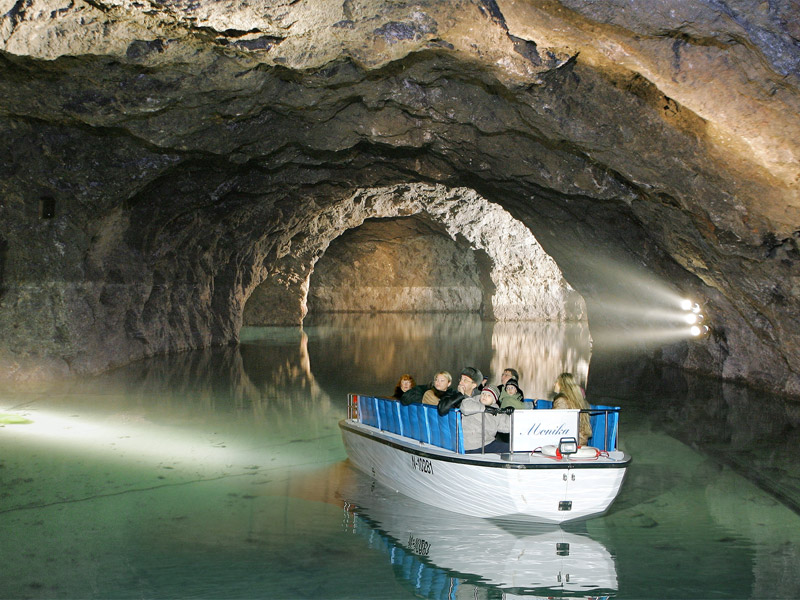
The Seegrotte (Lake Grotto) in Hinterbrühl, Austria, is home to the largest underground lake in Europe, a surreal subterranean body of crystal-clear water, 60 metres below ground, formed when a gypsum mine flooded in 1912 and creating a spectacular underground world where visitors can glide across the lake’s surface by electric boat through vast, still caverns of extraordinary atmospheric power. Located just 17 kilometres south of Vienna, the Seegrotte is one of the most unusual day trips from the Austrian capital, part industrial heritage (the gypsum mining history), part geological wonder, and part World War II history (the Nazis used the flooded mine as a secret aircraft factory, building Heinkel He 162 jet fighters here using forced labour from Mauthausen concentration camp).
In This Article
Quick Facts: Seegrotte, Austria
\n
- \n
- Best time to visit: Year-round, the underground temperature is a constant 9°C regardless of the season; bring a warm layer even in summer; the lake is especially atmospheric when the cave’s lighting reflects on the still water
- How to get there: ~25 minutes from Vienna by car (A21 motorway towards Hinterbrühl); ~45 minutes by public transport (Vienna S-Bahn to Mödling + bus); the Seegrotte is in the village of Hinterbrühl
- Entry fee: ~€12 (adult) including the boat ride on the underground lake
- Lake size: 6,200 m², the largest subterranean lake in Europe
\n
\n
\n
\n
Not far from Vienna, in the village of Hinterbrül, there is the cave system with the largest underground lake in Europe – Seegrotte, covering an area of 6,200 m². It is not a classic natural cave but the former gypsum mine. In 1912, the ceiling fell down and mine was flooded with 20 million liters of water.
\n
\nPhoto by seegrotte.com
\n
In the past, up to 1800, the cave was used for making red and white plaster. During World War II the cave housed also the factory for the production of combat aircraft. The first jet fighter in the world (Heinkel He162) was constructed right here.
\n
The underground lake was explored in the 30′s of last century, and later open to the public. There are 9 °C in the cave and the tour lasting 45 minutes includes a boat trip. Seegrotte is now great tourist attraction with about 250,000 visitors a year. It is open every day, all year-round. The basic adult admission is €9 or €6 for children.
\n
Open:
\n1st April – 31 October from 9.00 to 17.00
\n1st November – 31 March from 9.00 – 12.00 and 13.00 – 15.00
\n
Seegrotte is one of the most impressive natural attractions in the world. Being also a cultural monument it should be definitely included in your list of places to visit when travelling to Austria.
\n
For further information visit Seegrotte official site.
\n
View The Hinterbrühl Seegrotte in Austria in a larger map
World War II History and the Secret Aircraft Factory
\n
One of the most remarkable and sobering chapters in the Seegrotte’s history unfolded during World War II, when the Nazi regime transformed the flooded gypsum mine into a secret underground aircraft factory. In 1944, as Allied bombing campaigns intensified above ground, the Germans moved production of the Heinkel He 162 jet fighter, one of the world’s first jet-powered aircraft, into the safety of the caverns. The factory employed forced labour from the Mauthausen concentration camp, and conditions were harsh in the damp, cold underground environment. Hundreds of workers lived and toiled in the caves, sleeping in bunk beds stacked between mining machinery and aircraft assembly lines. The war ended before full-scale production could be achieved, and the factory was abandoned as Allied forces advanced into Austria. Today, visitors can see remnants of this period, including the concrete foundations of the factory floor and informational panels that document this dark but historically significant episode.
\n\n
The Boat Ride and Gypsum Mining heritage
\n
The centrepiece of any visit to the Seegrotte is the boat ride across the vast underground lake, a silent electric-powered journey across 6,200 square metres of still, crystal-clear water. The lake occupies the lowest section of the former gypsum mine, where the ceiling collapsed in 1912 and 20 million litres of water rushed in, flooding the tunnels and creating the largest subterranean lake in Europe. The boat glides slowly across the surface, passing beneath arches of exposed rock where the original mine workings are still visible in the ceiling. The constant temperature of 9 degrees Celsius means that warm clothing is essential even in summer. Before the flood, the Seegrotte was a working gypsum quarry that operated for centuries, supplying material for plaster production throughout the Austro-Hungarian Empire. The distinctive white colour of the gypsum veins, visible in the rock faces throughout the tour, contrasts with the darker limestone country rock and gives the cave walls a striking banded appearance. Today the site receives approximately 250,000 visitors annually, making it one of the most popular underground attractions in Austria.
\n\n
Have you taken the boat across Europe’s largest underground lake or explored the Seegrotte near Vienna? Share your subterranean Austrian adventures in the comments! 🛶
\n
Explore all our Austria travel guides, from Vienna coffeehouses to Alpine peaks.
Explore More
If you enjoyed this article, you might also like:
