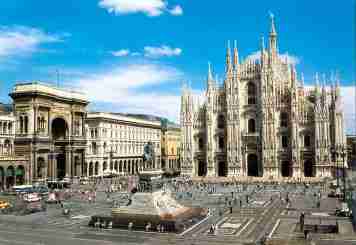
Milan (Milano) is Italy’s capital of fashion, design, and finance — a sophisticated northern metropolis that moves faster than Rome, dresses sharper than Paris, and contains some of the most extraordinary cultural treasures in the country, including Leonardo da Vinci’s The Last Supper and one of the largest Gothic cathedrals in the world. Often dismissed as Italy’s “business city” by tourists who pass through en route to Lake Como or Venice, Milan rewards those who stop with a concentration of world-class art, innovative cuisine, and a contemporary creative energy that feels more like London or New York than the Italy of sun-drenched piazzas — yet the aperitivo culture, the Navigli canals, and the breathtaking Duomo are unmistakably, passionately Italian.
Quick Facts: Milan, Italy
- Best time to visit: April–June and September–October for pleasant weather; April for the Salone del Mobile (Milan Design Week) — the city buzzes with design events and prices spike; July–August is hot and many locals are on holiday (some restaurants close); December for Christmas shopping and the atmospheric holiday markets
- Top attractions: The Duomo di Milano (the world’s fifth-largest cathedral, with a rooftop terrace of spires and gargoyles you can walk among), Leonardo da Vinci’s The Last Supper at Santa Maria delle Grazie (book 2–3 months ahead — tickets sell out instantly), the Galleria Vittorio Emanuele II (Italy’s oldest shopping arcade), and the Pinacoteca di Brera
- How to get there: Milan has three airports — Malpensa (MXP, the main intercontinental hub), Linate (LIN, mostly European flights, closer to the city), and Bergamo Orio al Serio (BGY, budget airlines); ~3 hours from Rome by high-speed Frecciarossa train; ~4 hours from Paris by TGV
- Best for: Fashion lovers, design enthusiasts, opera fans (La Scala is here), foodies, and anyone who wants to see Italy’s most dynamic contemporary side
The Last Supper: How to See It
Leonardo da Vinci’s The Last Supper (Il Cenacolo) — painted between 1495 and 1498 on the wall of the refectory of the Convent of Santa Maria delle Grazie — is one of the most famous paintings in the world and one of the hardest to see. Visits are strictly limited to 15-minute slots for groups of 25 people. Tickets are released in blocks and sell out months in advance. Booking strategy: Check the official website (cenacolovinciano.vivaticket.it) regularly; last-minute cancellations are sometimes released 2–3 days before; or book a guided tour through a reputable operator that includes pre-booked Last Supper tickets.
Milan (Milano) is a city in Italy and the capital of the region of Lombardy and of the province of Milan. The city proper has a population of about 1,300,000, while the urban area is the first in Italy and the fifth largest in the European Union with a population of 4,345,000.
The city is at its hottest – weather-wise – in August, when locals take holidays, and many places close; though it can provide a tranquil alternative to the crowded coast.
Fashion and finance aside, Milan’s other religion is, of course, football. The city is home to both AC Milan and Inter Milano, two of Italy’s top teams, and passionate crowds pack San Siro stadium on Sunday in season.
The city also harbours some lesser-known attractions such as the Navigli’s canal-side cafés and old-fashioned gelaterie (ice-cream shops) and the funky design district of Isola.
Top Sights in Milan
- Teatro alla Scala
- Tempio della Vittoria
- Corso Vittorio Emanuelle II
- Piazza Duomo
- Biblioteca Ambrosiana
- Duomo Cathedral in Milan
- Arena Civica
- Naviglio della Martesana
- Ticinese Gate
- Via Monte Napoleone
- Poldi-Pezzoli Museum
- Bagatti-Valsecchi Palace
- Litta Theatre
View Milano – the city of Italian fashion in a larger map
Have you seen The Last Supper, walked on the Duomo rooftop, or discovered Milan’s design scene? Share your Milanese discoveries in the comments! 👠
Discover more Italy travel guides and historic European cities.
