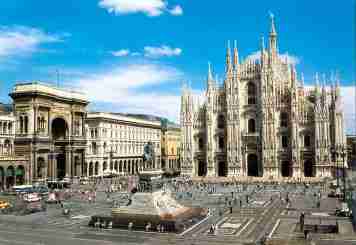
Milan (Milano) is Italy’s capital of fashion, design, and finance, a sophisticated northern metropolis that moves faster than Rome, dresses sharper than Paris, and contains some of the most extraordinary cultural treasures in the country, including Leonardo da Vinci’s The Last Supper and one of the largest Gothic cathedrals in the world. Often dismissed as Italy’s “business city” by tourists who pass through en route to Lake Como or Venice, Milan rewards those who stop with a concentration of world-class art, innovative cuisine, and a contemporary creative energy that feels more like London or New York than the Italy of sun-drenched piazzas, yet the aperitivo culture, the Navigli canals, and the breathtaking Duomo are unmistakably, passionately Italian.
In This Article
The Duomo and Milan’s Architectural Masterpieces
The Duomo di Milano is the centrepiece of the city and the fifth-largest cathedral in the world. Its construction began in 1386 under Gian Galeazzo Visconti and continued for nearly six centuries, resulting in a breathtaking fusion of Gothic and Renaissance styles. The white marble facade is a forest of 135 spires and over 3,400 statues, including the golden Madonnina that has watched over Milan since 1774. Visitors can take the stairs or an elevator to the rooftop terrace, where a walkway winds between the spires, offering an up-close view of the intricate stonework and a panoramic vista of the city and the Alps beyond. Inside, the vast nave is supported by 52 pillars, and the stained glass windows, some dating from the 15th century, cast coloured light across the marble floor. Opposite the cathedral stands the Galleria Vittorio Emanuele II, Italy’s oldest active shopping arcade, a 19th-century glass-vaulted gallery of luxury boutiques, cafes, and restaurants, where locals and tourists alike perform the traditional spinning of their heels on the mosaic bull to bring good luck. The Sforza Castle, a short walk from the Duomo, houses multiple museums and provides a green escape in the heart of the city.
Art and Culture: From The Last Supper to La Scala
Milan’s cultural offerings rival those of any European capital. Leonardo da Vinci’s The Last Supper, painted between 1495 and 1498 on the refectory wall of the Convent of Santa Maria delle Grazie, is one of the most famous and fragile works of art in existence. Tickets must be booked weeks or months in advance, as visits are limited to 15 minutes for groups of just 25 people. Behind the Duomo, the Teatro alla Scala is the world’s most famous opera house, where Verdi, Puccini, and Toscanini made history. The adjacent La Scala Museum displays costumes, instruments, and memorabilia from two centuries of operatic triumph. For art lovers, the Pinacoteca di Brera houses one of Italy’s finest collections of Renaissance paintings, including works by Caravaggio, Raphael, and Piero della Francesca. The Sforza Castle (Castello Sforzesco), a vast 15th-century fortress, contains multiple museums including Michelangelo’s unfinished Rondanini Pieta, one of the artist’s final and most moving sculptures. The Church of Santa Maria delle Grazie itself is worth visiting for its architecture and peaceful cloisters, even if you cannot secure Last Supper tickets.
Milan Beyond the Guidebooks: Navigli, Design, and Aperitivo
To experience Milan like a local, head to the Navigli district, where a network of canals built by Leonardo da Vinci once carried goods through the city. Today, the canal banks are lined with vintage shops, art galleries, and bars that serve the famous Milanese aperitivo: a pre-dinner drink accompanied by an abundant buffet of olives, cheeses, cured meats, and small plates. The Isola district, once a working-class neighbourhood, has transformed into Milan’s hippest design quarter, with avant-garde architecture, concept stores, and restaurants that define modern Milanese cuisine. Fashion enthusiasts flock to the Quadrilatero della Moda, the four streets around Via Monte Napoleone that host the flagship stores of every major Italian and international fashion house. Milan Design Week in April transforms the entire city into a showcase of furniture, lighting, and industrial design. Football fans should not miss a match at San Siro stadium, home to both AC Milan and Inter Milan, where the atmosphere on match days is electrifying. The city also has a thriving food scene, from traditional trattorias serving risotto alla Milanese to Michelin-starred restaurants pushing culinary boundaries.
Have you seen The Last Supper, walked on the Duomo rooftop, or discovered Milan’s design scene? Share your Milanese discoveries in the comments! 👠
Explore all our Italy travel guides, from the Dolomites to Sicily.
Explore More
If you enjoyed this article, you might also like:

What a wonderful article. Milan has been on my wish list for ages and this just moved it right to the top. The photos are stunning. How many days would you recommend for a first-time visitor?