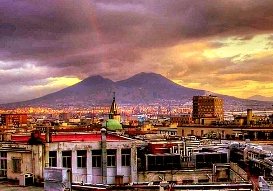
Mount Vesuvius (Monte Vesuvio) is the most famous volcano in the world — the brooding 1,281-metre giant looming over the Bay of Naples whose catastrophic eruption in AD 79 buried the Roman cities of Pompeii and Herculaneum in metres of ash and pumice, preserving them in extraordinary detail for nearly two millennia and creating one of the most important archaeological sites on Earth. Still active and closely monitored — it last erupted in 1944 — Vesuvius is one of the most dangerous volcanoes on the planet due to the 3 million people living in its shadow. But for visitors, hiking to the crater rim is one of the most accessible volcano experiences in Europe: a relatively easy walk with panoramic views of the entire Bay of Naples, the Isle of Capri, and the still-steaming crater below.
Quick Facts: Mount Vesuvius, Italy
- Best time to visit: April–June and September–October for the most comfortable hiking weather; summer is hot and the crater rim is exposed with no shade; the crater is occasionally closed during periods of increased seismic activity — check before travelling
- Height: 1,281 metres (the crater itself is 300 metres deep and 600 metres in diameter)
- How to get there: ~30 minutes from Naples by car to the Vesuvio National Park car park at 1,000m; from Pompeii, take the EAV bus or join a guided tour; from the car park, the crater rim is a 20–30 minute walk on a gravel path (moderately steep, suitable for most fitness levels)
- Entry fee: ~€11 (adult) for access to the crater rim trail (online booking mandatory — tickets include a timed entry slot)
- Combine with: Pompeii (~30 min from Vesuvius), Herculaneum (~20 min), and the National Archaeological Museum in Naples (where the finest Pompeii artefacts are housed)
Vesuvius and the Destruction of Pompeii
The AD 79 eruption lasted approximately 25 hours, ejecting a column of ash and pumice 33 kilometres into the stratosphere and releasing thermal energy equivalent to 100,000 Hiroshima-sized atomic bombs. Pompeii was buried under 4–6 metres of ash and pumice; Herculaneum was destroyed by a succession of pyroclastic surges — superheated avalanches of gas and rock travelling at up to 700 km/h — that carbonised organic material instantly, preserving wooden structures, food, and even the famous scrolls of the Villa dei Papiri. Of the estimated 20,000 inhabitants of Pompeii, approximately 2,000 perished; the plaster casts of their bodies, created by pouring plaster into the cavities left by decomposed remains, remain one of the most haunting archaeological sights in the world.
If you’re ever in or around Pompeii or Napoli, you surely will see the hill in the background. It is the volcano Mount Vesuvius (or Monte Vesuvio in Italian). It is not very high – about 1277 m but it has a lot of troubled history. It is known mainly for destroying Roman cities of Pompeii and Herculaneum when exploded in the year of 79, and killed many thousands of people. The towns’ locations were eventually forgotten until their accidental rediscovery in the 18th century.
Already on the way to Vesuvio you can see the places where nothing grows. In 1944 there was the last eruption of lava flowed through here. From the car park you can walk to the top of a very busy sidewalk. Hike is pretty tough and definitely not suitable for older people. There are stalls selling refreshments and souvenirs on the top.
During the beautiful weather it really worth to look at the Gulf of Naples, the sea and also to the crater of a volcano.
View Monte Vesuvio – destruction of the Roman cities of Pompeii and Herculaneum in Italy in a larger map
Have you stood on the rim of Vesuvius or walked the streets of Pompeii? Share your experiences of Italy’s most famous volcano in the comments! 🌋
Discover more Italy travel guides, natural wonders of Europe, and historic European destinations.
