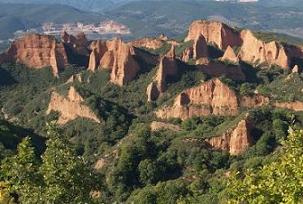
Las Médulas is one of the most extraordinary human-altered landscapes in the world — a UNESCO World Heritage site in the province of León, Spain, where the largest open-pit gold mine in the Roman Empire transformed a mountain into a surreal landscape of jagged red-orange peaks, deep ravines, and chestnut groves that looks more like a Martian canyon than the gentle hills of northern Castile and León. Over 250 years of Roman mining (1st–3rd centuries AD), an estimated 1.5 million kilograms of gold were extracted using an ingenious hydraulic mining technique called ruina montium (“wrecking of mountains”) — water was channelled through 500 kilometres of aqueducts and released under pressure to literally blast away the mountain, washing the gold-bearing sediment into sluices below.
Quick Facts: Las Médulas, Spain
- Best time to visit: Year-round; autumn (October–November) for the most spectacular colours when the chestnut trees turn gold and orange against the red rock; spring for wildflowers
- How to get there: ~2 hours from León by car; ~3.5 hours from Santiago de Compostela; the nearest town is Ponferrada (30 min, with a magnificent Templar castle)
- Top experience: The Orellán viewpoint (Mirador de Orellán) — the classic panorama of the entire Las Médulas landscape, best in the late afternoon when the sun brings out the red and orange of the rock
- Entry: Free
Las Médulas was in the Roman Empire the most important gold mine. It is located in Spain, just few kilometres from the town of Ponferrada, near the borders with Portugal.
The mining started already in the 1st Century. The Romans used the hydraulic mining technique. After two centuries of extremely profitable mining the Romans departed and left here a devastated landscape. But after centuries it has changed and now the country looks so much impressive that in 1997 was Las Médulas registered by the UNESCO as one of the World Heritage Sites.
Even today you can still see a mining operation there, at non-forested slopes, that are full of steep rocky bits in orange or almost red color. According to Pliny the Elder, it could be extracted about 1,650,000 kg of pure gold during the 250 years of mining.
Villages in the area of Las Médulas belong to the poorest in Spain. Once you come here you will feel that the time totally stopped. The buildings are abandoned and dilapidated, young people left to large cities. Just after including the area to UNESCO the first tourists started to arrive. Local residents are very sincere and offer their domestic products, especially wines, liqueurs and cheeses.
View Las Médulas in Spain – the most important gold mine in the Roman Empire in a larger map
Have you stood at the Orellán viewpoint or explored the Roman gold-mining landscape of Las Médulas? Share your Castilian discoveries in the comments! ⛰️
Discover more Spain travel guides and historic European destinations.
