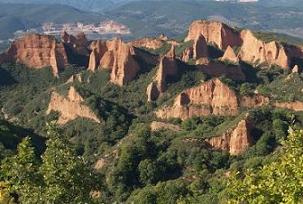
Las Médulas is one of the most extraordinary human-altered landscapes in the world, a UNESCO World heritage site in the province of León, Spain, where the largest open-pit gold mine in the Roman Empire transformed a mountain into a surreal landscape of jagged red-orange peaks, deep ravines, and chestnut groves that looks more like a Martian canyon than the gentle hills of northern Castile and León. Over 250 years of Roman mining (1st, 3rd centuries AD), an estimated 1.5 million kilograms of gold were extracted using an ingenious hydraulic mining technique called ruina montium (“wrecking of mountains”), water was channelled through 500 kilometres of aqueducts and released under pressure to literally blast away the mountain, washing the gold-bearing sediment into sluices below.
In This Article
Quick Facts: Las Médulas, Spain
- Best time to visit: Year-round; autumn (October, November) for the most spectacular colours when the chestnut trees turn gold and orange against the red rock; spring for wildflowers
- How to get there: ~2 hours from León by car; ~3.5 hours from Santiago de Compostela; the nearest town is Ponferrada (30 min, with a magnificent Templar castle)
- Top experience: The Orellán viewpoint (Mirador de Orellán), the classic panorama of the entire Las Médulas landscape, best in the late afternoon when the sun brings out the red and orange of the rock
- Entry: Free
Ruina Montium: The Ingenious Roman Mining Technique
The Romans employed a hydraulic mining technique known as ruina montium, or wrecking of mountains, which was described in detail by the Roman naturalist and historian Pliny the Elder, who served as a procurator in the region. The technique was remarkably sophisticated and involved the construction of an extensive network of aqueducts, channels, and reservoirs to capture and store water from the mountain streams. At least 500 kilometres of aqueducts were built across the surrounding mountains, some carved directly into solid rock, to bring water to the gold-bearing deposits. When sufficient water had been stored, the reservoirs were opened simultaneously, releasing a massive surge of water that would literally blast away the mountainside, washing the sediment containing gold particles into a series of carefully constructed sluices below. The sluices were lined with gorse and other vegetation that trapped the gold particles while allowing the lighter rock and soil to wash away. The scale of the operation was staggering. It is estimated that the Romans extracted approximately 1.5 million kilograms of gold from Las Médulas over 250 years of mining, creating a landscape of jagged red-orange peaks, deep ravines, and tunnels that would later be described as resembling a Martian landscape. Pliny the Elder wrote that the mining operations of Las Médulas surpassed the prodigies of the natural world, a testament to the awe that this human-made landscape inspired even in Roman times.
The Landscape Today: Hiking Trails and Viewpoints
Today, Las Médulas is a UNESCO World heritage site and one of the most remarkable landscapes in Spain, where the scars of Roman mining have softened over centuries into a surreal and beautiful terrain. The best way to experience Las Médulas is on foot, following the network of walking trails that wind through the red rock formations, chestnut groves, and oak forests. The most famous viewpoint is the Mirador de Orellán, a balcony-like viewpoint that offers the classic panorama of the entire Las Médulas landscape. The view from Orellán is most spectacular in the late afternoon, when the low sun brings out the deep reds, oranges, and ochres of the rock, creating a warm, almost glowing effect that is unforgettable. Another excellent viewpoint is the Mirador de Valiña, which offers a different perspective of the site. The walking trails range from short, easy walks suitable for families to longer hikes that explore the more remote areas of the site. The Sendero de las Valiñas is a 3-kilometre circular trail that passes through the most dramatic rock formations and includes sections of the Roman aqueduct system. The longer Sendero de los Conventos trail explores the lower slopes and the remains of the Roman settlement. In autumn, the chestnut trees that cover the surrounding hills turn golden and orange, adding another layer of colour to the landscape and making this the most photogenic time to visit.
Visiting Las Médulas: Practical Tips and Nearby Attractions
Las Médulas is located in the province of León, in the autonomous community of Castile and León, in north-western Spain. The nearest significant town is Ponferrada, 30 minutes away by car, which is home to one of the best-preserved Templar castles in Europe. The Castillo de los Templarios, with its massive walls, towers, and moats, is a fascinating historical site that provides context for the medieval history of the region. The town of Ponferrada also has a good selection of hotels, restaurants, and services. The village of Las Médulas itself is small and charming, with traditional stone houses, a couple of restaurants serving local cuisine, and a small museum that explains the history and geology of the site. The local cuisine is hearty and rustic, featuring dishes such as botillo (a cured meat roll), roasted lamb, and Leonese-style stews, all best accompanied by wines from the nearby Bierzo wine region. The Bierzo is a rising star in Spanish wine, producing excellent reds from the Mencía grape and crisp whites from Godello. Many of the wineries offer tastings and tours. Las Médulas can be visited year-round, but autumn and spring offer the most pleasant temperatures and the most beautiful light. Summer can be very hot, and winter can be cold and wet. The site is free to access, though there is a small charge for the guided tours and the museum. Allow at least half a day to explore the main viewpoints and walking trails.
Have you stood at the Orellán viewpoint or explored the Roman gold-mining landscape of Las Médulas? Share your Castilian discoveries in the comments! ⛰️
Explore all our Spain travel guides, from Barcelona Gaudí to Andalusia plazas.
Explore More
If you enjoyed this article, you might also like:

I stumbled upon Las Medulas completely by accident during a road trip and it ended up being the highlight of the entire journey. Funny how the best discoveries are often the unplanned ones. Your article captures why this place is so special.