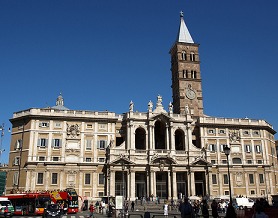
basilica di Santa Maria Maggiore in Rome – one of the four papal basilicas | Italy

Architecture and Interior Splendour
The basilica di Santa Maria Maggiore impresses every visitor from the moment they step through its ancient wooden doors into the soaring interior. The design follows the classic early Christian basilica plan with a central nave flanked by two side aisles, separated by 40 majestic columns of white marble and grey granite that were repurposed from ancient Roman buildings after the fall of the empire. The coffered ceiling, gilded with the first gold brought from the Americas by Christopher Columbus and presented to the church by Pope Alexander VI, glows with Renaissance craftsmanship that has survived centuries of use. The floor features intricate Cosmatesque work, a medieval mosaic technique using small pieces of coloured marble and glass to create elaborate geometric patterns that seem to shift as you walk across them. The 75-metre Romanesque bell tower, added in 1377 and the tallest in Rome, offers panoramic views over the Esplanade of the Esquiline Hill and the rooftops of the surrounding city. The basilica’s 18th-century façade combines Baroque grandeur with a surviving 13th-century mosaic showing Christ enthroned between saints, a preview of the artistic treasures that await the visitor inside the building.
The Mosaics of Santa Maria Maggiore
The basilica is most celebrated by art historians for its extraordinary mosaics, which represent some of the finest surviving examples of early Christian and medieval art anywhere in the city of Rome. The triumphal arch at the far end of the nave and the upper walls preserve magnificent 5th-century mosaics depicting scenes from the Old and New Testaments, including the stories of Abraham, Isaac, Jacob, and Moses told in vivid visual detail. These early Christian works are remarkable for their brilliant colours, which have retained their intensity through sixteen centuries, and the narrative clarity with which they communicate biblical stories to a largely illiterate medieval congregation. The apse mosaic, created by the Franciscan artist Jacopo Torriti between 1290 and 1295, is the crowning glory of the entire basilica. It depicts the Coronation of the Virgin surrounded by angels and saints, executed in brilliant gold tesserae that catch and reflect the light streaming through the apse windows throughout the day. The mosaic represents the pinnacle of the Roman medieval artistic tradition and profoundly influenced generations of artists who followed in the centuries after its completion.
The Miracle of the Snow and Papal Connections
The foundation of Santa Maria Maggiore is rooted in one of Rome’s most beloved and enduring religious legends. According to pious tradition, on the night of August 4 in the year 358, the Virgin Mary appeared in a dream separately to Pope Liberius and a wealthy Roman patrician named John, instructing them both to build a church on the Esquiline Hill where snow would miraculously fall the next morning. On a sweltering summer morning, snow miraculously fell on the Esquiline Hill, marking the precise outline of the future basilica in a clear and unmistakable sign. This miraculous event is commemorated each year on August 5 with a dramatic and moving celebration during which white rose petals are released from the coffered ceiling of the nave to simulate the miraculous summer snowfall. The basilica holds particular significance in the Catholic Church as one of the four papal basilicas, a special status that places it among the most important churches in Christendom. The popes have maintained a close connection with Santa Maria Maggiore for many centuries, and the basilica contains the burial places of several popes, including Sixtus V and Paul V, as well as the great Baroque sculptor and architect Gian Lorenzo Bernini.
View basilica di Santa Maria Maggiore in Rome – one of the four papal basilicas | Italy in a larger map
The Romanesque bell tower was added to the basilica in 1377 and with its 75 meters it is the highest one in Rome. At the turn of the 16th and 17th century, basilica underwent a reconstruction. The basilica boasts wonderfully ornate interior. Richly painted coffered ceiling is supported with 40 massive columns, which were transferred here from the ancient Roman buildings. The beautiful decoration is everywhere you take a look. But the most breathtaking is a mosaic created between 1290 – 1295 by Jacopo Torritim. It is located in the apse, which is considered the top of medieval mosaic tradition in Rome. Other important mosaics come from the 5th century and decorate boat and triumphal arch. Mosaics on the side-walls show scenes of Moses, Abraham, Isaac and Jacob.
Once you are here, do not miss a visit to Chapel Cappella Sistina from 1585, which is a kind of church in the church. It is the work of Domenico Fontana, who created it for Pope Sixtus V. At the opposite side, there is the Cappella Paolina, built in 1611 for two popes – Paul V and Clement VIII. They tried to create a more beautiful chapel, than the opposite one, therefore it is overdecorated.
View basilica di Santa Maria Maggiore in Rome – one of the four papal basilicas Italy in a larger map
Explore More
If you enjoyed this article, you might also like: