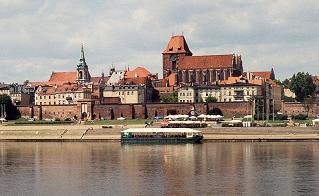
Toruń is one of Poland’s most beautiful and historically significant cities, a UNESCO World heritage Gothic masterpiece on the banks of the Vistula River whose perfectly preserved medieval Old Town of red-brick churches, merchant houses, and defensive walls is one of the finest ensembles of Gothic architecture in Europe. Birthplace of Nicolaus Copernicus in 1473, Toruń is also the spiritual home of Polish gingerbread (pierniki), a tradition stretching back to the Middle Ages, and a vibrant university city with a thriving cultural scene that belies its relatively compact size.
In This Article
The Gothic Splendour of Toruń’s Old Town
Toruń’s Old Town is one of Poland’s most perfectly preserved medieval urban complexes, a designation recognised by UNESCO in 1997 when it was added to the World heritage List as an outstanding example of brick Gothic architecture. The heart of this historic district is the Old Town Market Square (Rynek Staromiejski), dominated by the monumental Old Town Hall, which art historian Nikolaus Pevsner called “one of the most impressive town halls in Europe.” Built over two centuries beginning in the mid-13th century, the hall combines Gothic foundations with Renaissance embellishments, its tower offering panoramic views across the red-tiled rooftops of the city to the broad expanse of the Vistula River beyond.
The city’s medieval defensive walls, among the best preserved in Poland, stretch for nearly two kilometres and include several imposing gates such as the Bridge Gate (Brama Mostowa) and the Holy Spirit Gate (Brama Ducha Swietego). The most curious of Toruń’s structures is the Leaning Tower (Krzywa Wieża), a 15th-century tower that tilts at a noticeable angle due to the unstable sandy ground on which it was built. Local legend claims the tower was built by a Teutonic Knight who broke the order’s celibacy rules, and the lean represents his moral deviation. Another gem is the House of the Star (Dom Pod Gwiazdą), a Gothic merchant house with an elaborate Baroque facade that now houses the Museum of Far Eastern Art, one of the few collections of Asian art in Poland.
Copernicus and the Legacy of Learning
Nicolaus Copernicus, known in Polish as Mikołaj Kopernik, was born in Toruń in 1473 in a Gothic merchant’s house on St. Anne’s Street. The Copernicus House Museum now occupies this carefully restored building, presenting exhibits on the astronomer’s life, his education at the universities of Kraków, Bologna, and Padua, and his revolutionary heliocentric theory that placed the Sun rather than the Earth at the centre of the known universe. The museum’s multimedia displays bring to life the intellectual environment of Renaissance Poland and Copernicus’s work as a mathematician, physician, economist, and canon administrator alongside his astronomical pursuits.
Toruń’s Nicolaus Copernicus University, founded in 1945 and named in honour of the city’s most famous son, is one of Poland’s leading academic institutions. The university’s Faculty of Fine Arts has helped maintain the city’s tradition of craftsmanship. The Toruń Planetarium, housed in a converted 19th-century gasometer, offers daily shows on astronomy and space exploration, including a dedicated programme on Copernicus’s discoveries. Throughout the city, monuments to Copernicus can be found in squares and gardens, the most famous being the bronze statue erected in 1853 in the Old Town Market Square, which shows the astronomer holding an armillary sphere.
Gingerbread: Toruń’s Sweet Tradition
Toruń’s association with gingerbread (pierniki) is nearly as old as the city itself. The earliest written record of gingerbread baking in Toruń dates from 1380, and by the 16th century the city was exporting its spiced honey cakes across Europe. The secret of Toruń’s gingerbread lies in the quality of its ingredients: local honey, rye flour, and a precise blend of spices including cinnamon, ginger, cloves, cardamom, and nutmeg. The dough was traditionally aged for months or even years before baking, a practice that developed the deep, complex flavours that distinguished Toruń pierniki from ordinary gingerbread.
The Living Museum of Gingerbread (Muzeum Piernika) offers visitors the chance to bake their own traditional Toruń pierniki using 500-year-old recipes and methods. Dressed in medieval aprons, participants grind spices, knead dough, and press it into ornate wooden moulds before baking their creations in a wood-fired oven. The museum also displays historic gingerbread moulds, some carved with scenes of courtly life and religious imagery. The Kopernik confectionery, operating since the 18th century, sells decorated gingerbread hearts, figures, and elaborate gift boxes that make perfect souvenirs of a city that has elevated baking into an art form.
View Toruń – Gothic architecture at its best, and the birthplace of Copernicus Poland in a larger map
Have you walked the Gothic streets of Toruń, baked gingerbread, or traced Copernicus’s footsteps? Share your Toruń discoveries in the comments! 🏛️
Explore all our Poland travel guides, from Kraków square to the Tatra Mountains.
Explore More
If you enjoyed this article, you might also like:
