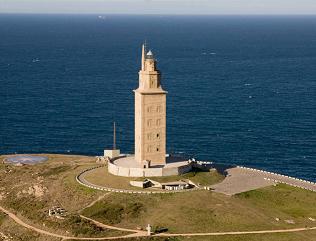
The Torre de Hércules (Tower of Hercules) is the oldest active lighthouse in the world, a 55-metre Roman lighthouse built in the late 1st century AD on a rocky headland in A Coruña, Galicia, northwestern Spain, that has been guiding ships into the harbour continuously for over 1,900 years. Declared a UNESCO World heritage site in 2009, it is the only fully preserved Roman lighthouse still in operation. The tower was originally constructed under the Emperor Trajan and designed by the architect Gaius Sevius Lupus. It was modelled on the legendary Pharos of Alexandria, one of the Seven Wonders of the Ancient World, and the Torre de Hércules is the closest surviving relative to that lost wonder, still lighting the Galician coast after two millennia.
In This Article
Quick Facts: Tower of Hercules
- Best time to visit: Year-round; the view from the top of the tower is best on clear days (panoramas of the Atlantic and A Coruña) and especially dramatic at sunset
- How to get there: ~10 minutes from A Coruña city centre by car or bus; the tower is on a peninsula north of the city; ~1 hour from Santiago de Compostela
- Entry fee: ~€3 (adult)
- Combine with: The historic centre of A Coruña, the Roman walls of Lugo (UNESCO, 1 hour), and the Costa da Morte (Coast of Death, Galicia’s wild Atlantic shoreline)
Roman Engineering That Survived Two Millennia
Torre de Hercules is an ancient Roman tower in Spain, which since its inception has served as a beacon. It is so far the oldest active lighthouse in the world. It is located in Galicia, A Coruña, about 2.5 km from the city center.
Torre de Hercules was already built by the Romans in the 2nd century. As already mentioned, it is still working, which makes it a unique monument. Torre de Hercules is 68 meters high; there are 234 stairs leading to the top. The lighting ensures a group of 4 lights that flash every 20 seconds and is visible up to a distance of 39 km. Torre de Hercules and this entire site is otherwise surrounded by a series of legends.
The tower’s design reflects the practical genius of Roman engineering. The original structure consisted of a square base surmounted by two progressively narrower tiers, creating a sturdy yet elegant profile that has withstood nearly two millennia of Atlantic storms. The exterior was clad in stone panels, some of which still bear the marks of ancient quarrying and transportation. In the 18th century, a neoclassical restoration added an outer skin to protect the Roman core. The interior ramp, rather than a spiral staircase, allowed supplies to be hauled up by pack animals during the Roman period, a design feature that is still visible today.
Legends, the Statue Park, and Visiting A Coruña
Around the tower Torre de Hercules there is the Statue Park, an open-air museum. There are more than 15 sculptures by major artists of the 20th Century, such as Francisco Leiro or Pablo Serrano. For local residents the most important sculpture is Breogan, which is the mythological father of the population of Galicia.
The tower is deeply woven into Galician mythology. According to the most famous legend, the hero Hercules slew the giant Geryon, who terrorised the local population, and buried his head on the headland. The tower was then built atop this burial site, with the lighthouse beam serving as a symbol of victory over darkness and chaos. The Breogan sculpture in the park commemorates another Celtic myth: Breogan was the legendary Celtic king who built a great tower in Galicia from which his sons glimpsed Ireland across the sea, setting in motion the mythological origins of the Gaelic people.
Thanks to its historical significance, Torre de Hercules is registered since 2009 in the UNESCO World Cultural heritage.
Not far from tower you can also visit A Coruña, Santiago de Compostela, the Roman walls of Lugo city, Aquarium Finisterrae. A Coruña itself is a vibrant port city with a beautiful historic centre, a lively food scene, and some of the best seafood in Spain. The nearby Costa da Morte, or Coast of Death, offers some of the most dramatic coastal scenery in Europe, with towering cliffs and treacherous reefs. The Roman walls of Lugo, another UNESCO site just an hour inland, represent the best-preserved Roman fortifications in the world.
View Torre de Hércules – the oldest active lighthouse in the world Spain in a larger map
Have you climbed the oldest lighthouse on Earth or discovered A Coruña’s Roman heritage? Share your Galician experiences in the comments! 🗼
Explore all our Spain travel guides, from Barcelona Gaudí to Andalusia plazas.
Explore More
If you enjoyed this article, you might also like:

What a fantastic write-up. We followed your itinerary for Torre de Hercules almost to the letter and it was one of the best travel experiences we have ever had. The balance of famous sights and hidden corners was perfect.