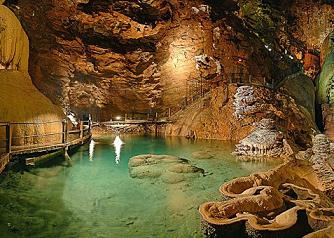
Gouffre de Padirac is one of France’s most extraordinary natural wonders, a vast limestone chasm 103 metres deep in the Lot region of southwestern France that leads to an underground river navigable by boat through a labyrinth of spectacular cave chambers, stalactite formations, and crystalline pools. Discovered in 1889 by the explorer Édouard-Alfred Martel (the father of modern speleology), Padirac welcomes over 400,000 visitors annually, making it one of France’s most popular underground attractions, and one of the most remarkable cave systems open to the public anywhere in Europe.
In This Article
The Underground Boat Ride Experience
The tour of Gouffre de Padirac begins with a dramatic descent into the vast chasm, either by staircase or elevator, descending 103 metres to the floor of the cave. From there, a walkway leads through a series of impressive chambers to the underground river, where visitors board flat-bottomed boats for a guided boat ride that is the highlight of the experience. The river flows through 550 metres of accessible galleries, and the boat glides silently through the Grand Dome, a cavern nearly 100 metres high, past spectacular stalactite formations including the famous Dislocation, a massive collapsed column that lies across the river.
The boat trip ends at the Lac de la Pluie, a crystal-clear pool where visitors can see the perfect reflections of stalactites on the absolutely still water surface, creating a mirror effect that is one of the most photographed scenes in any European cave system. The entire visit lasts about 1.5 hours and combines walking with the boat ride. The cave maintains a constant temperature of 13 degrees Celsius year-round, so a jacket or sweater is essential even on the hottest summer day. Over 400,000 people visit each year, and more than 20 million visitors have experienced this underground world since it opened.
Discovery and Practical Information
The cave was discovered in 1889 by Edouard-Alfred Martel, the father of modern speleology, who descended into the chasm using ropes and explored the underground river with a collapsible canvas boat. His exploration revealed a vast network of passages and chambers that had remained hidden for millions of years. Martel’s detailed descriptions and drawings captured the public imagination, and the site opened to visitors soon after. Today, his exploration equipment is displayed in the visitor centre.
The cave is open from April to October, with extended hours during July and August. Arriving early in the morning is strongly recommended to avoid long queues. The site is approximately 2 hours from Toulouse and 2.5 hours from Bordeaux by car. The nearest notable town is Rocamadour, just 15 kilometres away, one of France’s most beautiful medieval villages perched dramatically on a cliff face. The basic admission fee for adults is approximately 16 euros and includes the guided boat ride. For the full experience, consider booking the extended tour that includes additional chambers not shown on the standard route.
Geology and Formation of the Cave
The Gouffre de Padirac was formed over millions of years as acidic groundwater slowly dissolved the limestone bedrock of the Causses du Quercy region, creating a vast network of underground cavities and passages. The cave system is part of a larger karst landscape that includes numerous other caves, sinkholes, and underground rivers throughout the Lot and Dordogne regions of southwestern France. The spectacular stalactites and stalagmites that decorate the cave chambers have been growing for thousands of years, with some of the larger formations taking tens of thousands of years to reach their current size.
The cave’s constant temperature of 13 degrees Celsius and high humidity create ideal conditions for the growth of these formations, and the underground river that visitors navigate by boat continues to shape the cave system to this day. The famous Lac de la Pluie, where the boat ride ends, is a crystal-clear pool fed by mineral-rich water that drips from the ceiling, and its perfectly still surface creates stunning mirror reflections of the stalactites above. The cave was discovered in 1889 by Edouard-Alfred Martel, the father of modern speleology, who descended 103 metres into the chasm using ropes and explored the underground river with a collapsible canvas boat.
View Gouffre de Padirac – great limestone cave in France in a larger map
Have you explored Gouffre de Padirac or discovered France’s cave systems? Share your underground adventures in the comments! 🔻
Explore all our France travel guides, from Parisian boulevards to Provence lavender.
Explore More
If you enjoyed this article, you might also like:
