Cyprus is a hot country in every sense, the legendary birthplace of Aphrodite, a Mediterranean island of extraordinary archaeological riches, golden beaches, and a divided capital that is unique in Europe. Warm and welcoming, with a cuisine that blends Greek, Turkish, and Middle Eastern influences, Cyprus offers more than 300 days of sunshine a year, some of the best-preserved Byzantine frescoes in the Orthodox world, and a complex, fascinating history that stretches from Neolithic settlements (the oldest on the island at Choirokoitia date back to 7000 BC) through Greek, Roman, Byzantine, Lusignan, Venetian, Ottoman, and British rule to its current status as a divided island, the Republic of Cyprus in the south (EU member) and the Turkish Republic of Northern Cyprus in the north (recognised only by Turkey).
Quick Facts: Cyprus Travel Guide
\n
- \n
- Best time to visit: April–June and September–October for warm, pleasant temperatures; July–August is very hot (35°C+ on the coast) but perfect for beach holidays; March–April for the wildflower season, the Troodos Mountains are carpeted in orchids and anemones; December–February is mild on the coast but cold in the mountains (there’s even skiing on Mount Olympus, yes, Cyprus has a Mount Olympus too)
- Top attractions in Cyprus: The archaeological site of Kourion (a magnificent Greco-Roman city with one of the most dramatically sited amphitheatres in the Mediterranean), the Tombs of the Kings in Paphos, the painted Byzantine churches of the Troodos Mountains (10 of which are UNESCO-listed), the divided capital Nicosia, and the beaches, from party-central Ayia Napa to the wild, unspoilt Akamas Peninsula
- How to get to Cyprus: Larnaca International Airport (LCA) and Paphos International Airport (PFO); regular flights from across Europe; the island is well-connected by road but public transport is limited outside the main cities, renting a car is recommended for exploring
- Currency: Euro (€) in the Republic of Cyprus; Turkish Lira (TL) in Northern Cyprus (Euros widely accepted in the north as well)
- Best for: Beach lovers, history and archaeology enthusiasts, foodies, and hikers (the Troodos Mountains offer excellent walking)
\n
\n
\n
\n
\n
Cyprus Highlights
\n
- \n
- Paphos and the West: The entire city of Paphos is a UNESCO World heritage site that encompasses the Tombs of the Kings, the stunning Roman mosaics (the finest in the Eastern Mediterranean), and the legendary birthplace of Aphrodite at Petra tou Romiou (Aphrodite’s Rock), where the goddess of love rose from the sea foam.
- Troodos Mountains: Cool and green in summer, snow-capped in winter, the Troodos range is home to 10 UNESCO-listed Byzantine churches and monasteries whose interiors are completely covered in vibrant 11th–16th-century frescoes, among the finest Byzantine art in the world.
- Kyrenia (Girne): The most beautiful harbour town in Cyprus, with a magnificent Crusader castle, a horseshoe-shaped Venetian harbour lined with restaurants, and views across the Mediterranean to the Anatolian mountains of Turkey.
- Akamas Peninsula: The wildest, least developed corner of the island, a nature reserve of cliffs, hidden coves, sea caves, and the famous Blue Lagoon that is best explored by boat or 4×4.
\n
\n
\n
\n
The third largest island in the Mediterranean Sea – after Sicily and Sardinia – is that of Cyprus. Located 113 km south from Turkey and about 120 km west from the Syrian coast. Although it geographically belongs to Asia, but culturally to Europe. When you say Cyprus, think of Aphrodite’s island of love and beauty in the eastern Mediterranean.
\n
Cyprus is an ideal place for sport lovers. In winter you can both ski in the mountains of Troodos and also swim in the waves of the sea. There are golf courses, tennis courts and you can enjoy plenty of water sports here.
\n
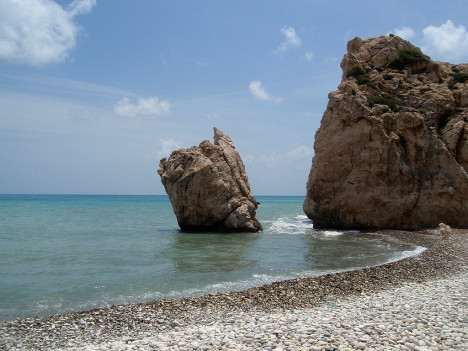
\nCyprus coast by Anton S.
\n
Cyprus has been divided since 1974 into two independent parts – the northern Turkish and Southern Greek, the boundary leads even through the center of the capital city of Lefkosia (Nicosia). Reserve at least one day for a visit to the Turkish part of Cyprus – architecture buffs will appreciate the Gothic cathedral converted into mosque.
\n
If you would have the opportunity to attend famous local outdoor wedding with a reception, often involving the whole village, breaking the pomegranate – a symbol of fertility, singing and dancing until dawn.
\n
Cyprus has lots of archaeological sites and an enormous number of monuments from the times of biblical apostles Paul and Barnabas, Romans, Ottomans, Crusaders. You should try easy hiking into the Troodos mountains and Akamas gorge.
\n
Cyprus also boasts several UNESCO heritage sites, such as Paphos, Troodos Churches with wall paintings and Chirokoitia.\n
