Lake Königssee in the Berchtesgaden National Park is Germany’s third deepest lake, reaching 190 metres at its maximum depth, and its famously clear, cold water is so protected that only electric-powered boats with special permits have been allowed to navigate it since the beginning of the 20th century, making it one of the cleanest lakes in the country. The lake lies in a deep, narrow valley carved by glacial erosion during the last ice age, stretching 7.7 kilometres from north to south but rarely exceeding 1.7 kilometres in width. On three sides, the steep walls of the Watzmann massif rise almost vertically from the water’s edge, creating an amphitheatre of rock that produces a famous seven-fold echo, demonstrated by boat captains who stop midway and play a flugelhorn or trumpet for passengers. The echo bounces between the sheer rock faces, returning up to seven times before fading, a tradition that has delighted visitors since the earliest tourist boats began operating in the 19th century.
\n\n
Quick Facts: Lake Königssee
\n
- \n
- Location: Berchtesgaden National Park, south-east Bavaria, Germany, directly on the border with Austria. The town of Berchtesgaden is the main gateway, approximately 25 km from Salzburg, Austria
- Best time to visit: May to September for boat services and hiking conditions. July and August are warmest but busiest. October offers autumn colours along the valley sides and fewer crowds, though boat services are reduced. Winter visits are possible for snowshoeing and cross-country skiing but the lake may be frozen and boat services stop entirely
- Boat services: Electric boats run from the northern end of the lake (near the town of Schönau am Königssee) to the southern end at St. Bartholomä (approximately 30 minutes) and further to Salet (the last stop, approximately 45 minutes). Tickets cost approximately €20 return to Salet (as of 2026). The echo demonstration occurs on the outward journey
- Key sights: St. Bartholomä Church, a distinctive red-domed pilgrimage chapel on the western shore, dating from 1698. The church is accessible only by boat and includes a historic guesthouse serving fresh trout from the lake. From Salet, a 15-minute walk leads to the smaller Lake Obersee and the Röthbach Waterfall, which drops 470 metres from the surrounding cliffs
\n
\n
\n
\n
\n\n
Located in the southeastern portion of Germany, where you will find the nation’s border with Austria, you will also find the majestic Lake Königssee. For the most part, the lake is situated within the Berchtesgaden National Park; although there are parts that are not included within the park area.
\n
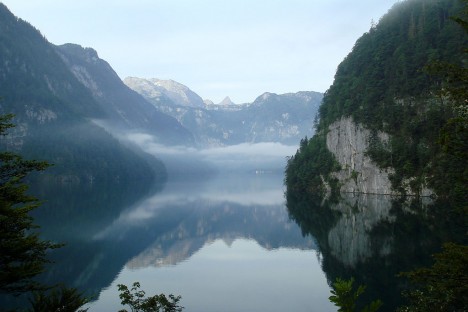
\nLake Königssee, Germany by Bobak Ha’Eri
\n
The Lake Königssee is considered to be the third deepest lake in the entire country. It is known, that the lake was formed during the last ice age by glacial erosion, and as such the lake is 7.7 km long while only being 1.7 km wide. The lake is also popularly known to mountain climbers who make their way to the area declared one of the tallest vertical ascents in northern Europe.
\n
The lake itself, is very clear and is considered by many to be one of the cleanest lakes in all of Germany. In order to ensure that the lake stays clean and clear for future generations, transportation on Lake Königssee is limited to electric powered vessels with the proper permits. This regulation has actually been in place since the beginning of the 1900s.
\n
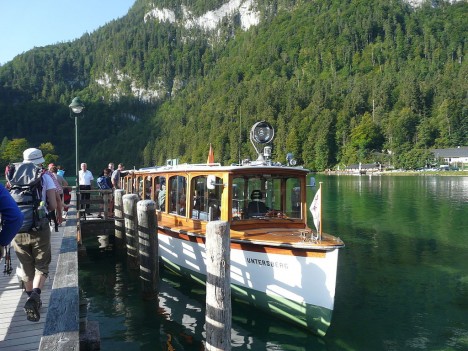
\nAn electric boat, Königssee Lake, Germany by Nachtgiger
\n
The views afforded to anyone who chooses to visit the Lake Königssee is simply awe-inspiring. As a result, not only is the region very popular for mountain climbers, but is also very popular for ecotourists. The large lake is surrounded by parkland which is considered by many to be some of the most beautiful and picturesque in the entire country. There are a number of popular hiking trails around the lake.
\n
Due to the many sheer rock faces that surround Lake Königssee in every direction, there is an amazing echo that can be heard no matter where you are. As a result, those who choose to take a boat to travel the length of the lake, will notice that the boat stopped midway and either play a flugelhorn or a trumpet. Passengers on the boat will notice that there is a distinct echo that can be heard more than seven times bouncing back and forth from one side to the other. In the past, the echo was created by shooting a cannon; however due to safety reasons this is no longer perform.
\n
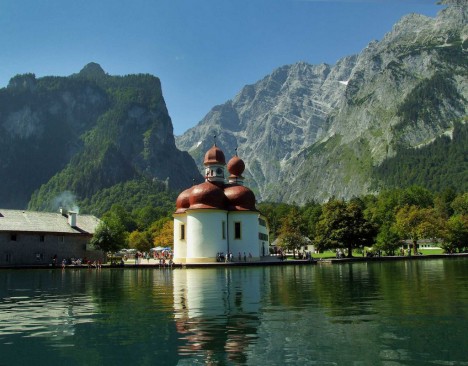
\nSt. Bartholomä church, Lake Konigssee, Germany by gravitat-OFF
\n
At the midpoint of Lake Königssee, there is a small peninsula that sticks out into the lake, which also has on it a smaller lake of its own. The smaller lake which is known by the name of Lake Obersee, has also become a very popular attraction in the area on account of its 470 m tall waterfall known as Röthbach. Unfortunately, there are no hiking trails that can reach the waterfall, and as such many people choose to take boat instead. Along the shores of Lake you will also find the famous St. Bartholomä church which attracts countless visitors as well.
\n
While there are many things to see and do when you choose to visit Germany, if you want to really see the true beauty of the country then you have to make your way to Lake Königssee and the Berchtesgaden National Park region.\n

Lake Königssee is one of those rare places where photos genuinely don’t do it justice. The water is so clear you can see the bottom, and the boat ride across to St. Bartholomew’s Church with the mountains towering above is unforgettable. We took the hike up to the ice chapel and it was well worth the effort.