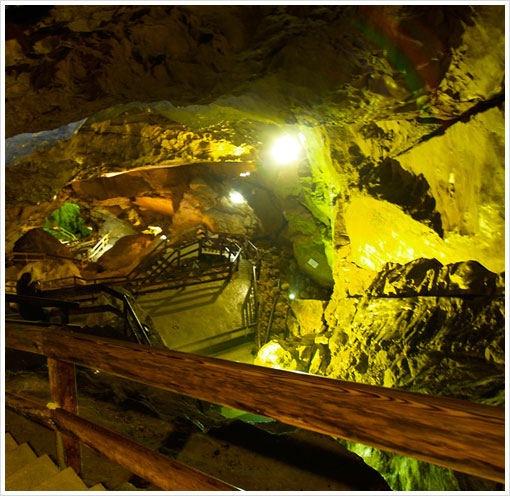
Lamprecht’s Cave in the Salzburg region of Austria is the most accessible deep cave in the world, a 50-kilometre network of passages that you can walk into without any special equipment, following a path that leads through vast chambers, narrow corridors, and carved staircase passages that descend over 1,632 metres into the limestone mountain, making it one of the deepest cave systems in Europe that can be explored entirely on foot. The cave, known in German as Lamprechtshöhle, sits in the Leoganger Steinberge range near the town of St. Martin bei Lofer in the state of Salzburg. Its entrance, a gaping mouth in the limestone cliff face at approximately 700 metres elevation, has been known to local hunters and shepherds for centuries, but the cave’s true extent was only revealed by systematic exploration in the late 19th and early 20th centuries. Today, the first 1.3 kilometres are developed for public access, with paths, bridges, and lighting, while the deeper sections are reserved for experienced cavers with specialist equipment.
Quick Facts: Lamprecht’s Cave
- Location: St. Martin bei Lofer, Salzburg state, Austria, approximately 40 km north-west of Salzburg city and 10 km from the German border. The cave entrance is a 30-minute walk uphill from the village car park
- Best time to visit: May to October when the cave is open for public tours. The cave maintains a constant temperature of approximately 5-8°C year-round, so warm clothing is essential even in summer. Avoid visiting during or immediately after heavy rain, as the cave is subject to flash flooding from the underground river
- Public access: The developed section of the cave covers 1.3 km and takes approximately 90 minutes as a self-guided walk. The path is well-maintained with staircases, railings, and electric lighting. The entrance fee is approximately €12 for adults (as of 2026). Guided tours into the deeper sections are available for experienced walkers and last 3-5 hours
- History of exploration: The cave was first explored to significant depth in the 1870s by the Austrian caver Friedrich Simony. The deepest point, at 1,632 metres below the entrance, was not reached until the 1990s. The cave is still being actively explored, with new passages discovered as recently as 2019
While there are countless caves that can be visited throughout Europe, perhaps one of the most popular destinations is that of the Lamprecht’s Cave (Lamprechtshöhle) which can be found in Austria. It is considered to be one of the most extensive cave systems in all of Europe. Furthermore it is also one of the deepest caves in the world which can be completely accessed by foot.
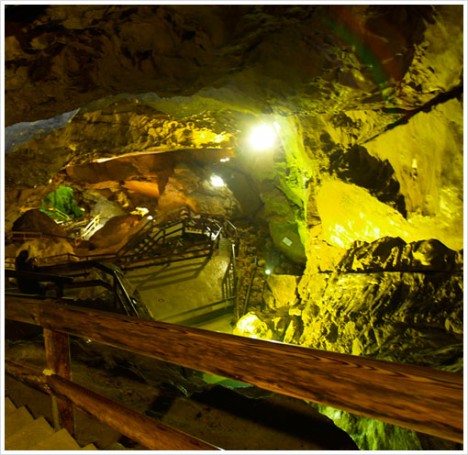
Lamprecht’s Cave by naturgewalten.at
The cave itself is the center of clouded and deep mystery that dates back to the days of the Crusades. According to local legend, the cave was named after a member of the Knights Templar, Knight Lamprecht, who is said to have brought back treasure from the Crusades. Fearing that someone will try to take his treasure, he hid it in the caves.
As the days led on, the Knight grew old and weary and as a result bequeathed his entire treasure to his two daughters equally. However, one of the girls took one part of the treasure for herself and stole the other part that belonged to her sister and hid it deeper in the cave. For centuries, countless people have made their way into the Lamprecht’s Cave in an attempt to find the long-lost treasure that is said to be hidden somewhere deep inside.
Treasure hunters from all over the region would come to the Lamprecht’s Cave in hopes of finding the treasure. As a result, in 1701, the local government decided to prevent access to the cave and built a wall at the cave’s entrance. However, due to the fact that the cave is responsible for drainage of vast amounts of floodwater, the wall eventually fell down.
The cave itself is now easily accessed on foot. For the most part, even though the depth of the Lamprecht’s Cave is more than 1632 meters, the 50 kilometres of caverns that consists of the Lamprecht’s Cave network are easily accessed. However, due to floodwaters it can also be a very dangerous place. Over the years advanced alarm system has been installed within the cave in order to warn any people of potential flooding.
It was back in 1991 and 1998 when 14 tourists along with four cavers were trapped within the cave for a brief period of time as a result of heavy rains. However, although the people are trapped they are not in any real danger as once the floodwaters recede they are able to exit the cave; usually within a day or so.
Due to the fact that the cave is so accessible by foot, it has grown to become one of the most popular caves in all of Europe. One does not have to be a cave expert to traverse the meandering passageways that have been carved out over the millennia by raging floodwaters.
For more information visit naturgewalten.at
