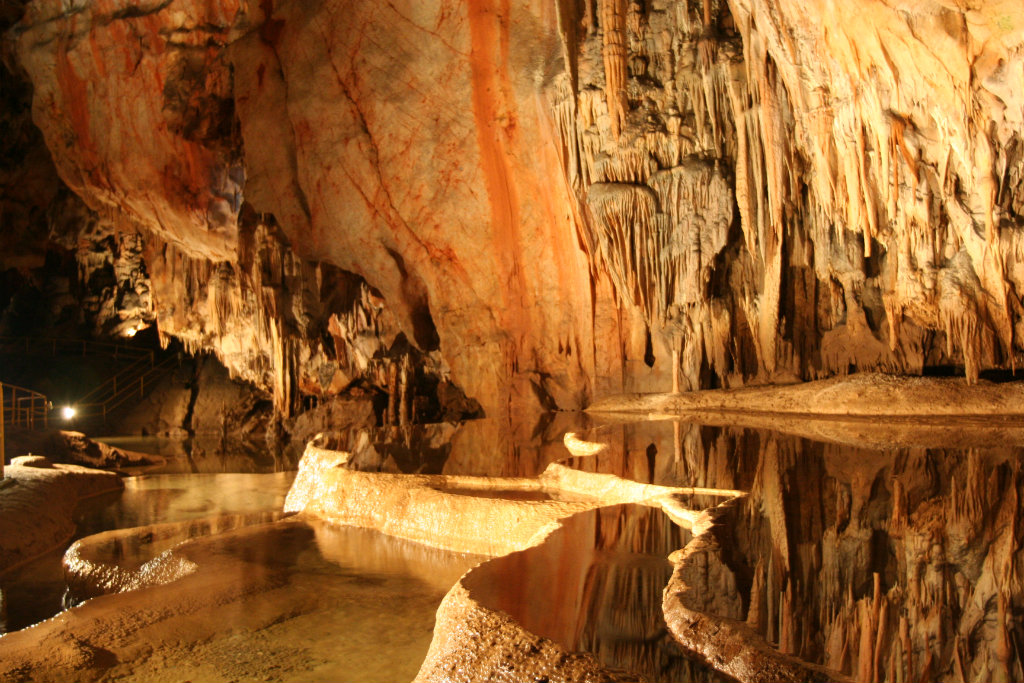
Slovak Karst National Park protects the largest karst landscape in Central Europe, a UNESCO World heritage area of limestone plateaus, deep gorges, and over 1,100 documented caves on the Slovak-Hungarian border, including several of Europe’s most extraordinary accessible show caves.<\/strong> This 346 km² park is the Slovak half of the transboundary Aggtelek Karst protected area (shared with Hungary) and contains some of the most spectacular underground landscapes on the continent, including the Domica Cave with its navigable underground river, the Gombasecká Cave, and the stunning Zádielska Gorge.<\/p>
Quick Facts: Slovak Karst National Park<\/h2>
- Best time to visit:<\/strong> May-October for cave access and hiking<\/li>
- How to get there:<\/strong> ~1.5 hours from Košice by car; the main access towns are Rožňava and Plešivec<\/li>
- UNESCO status:<\/strong> Part of the “Caves of Aggtelek Karst and Slovak Karst” World heritage site<\/li>
<\/ul>
The Remarkable Cave Systems of Slovak Karst<\/h2>
The Slovak Karst contains the highest concentration of caves anywhere in Central Europe, with more than 1,100 known caves and abysses documented within its boundaries. Among these, Domica Cave stands as the crown jewel, stretching for over 5 kilometres across the Slovak-Hungarian border and connecting with the Baradla Cave on the Hungarian side. What makes Domica truly exceptional is the underground river that flows through its chambers, allowing visitors to take boat rides through passages decorated with stalactites and stalagmites that have formed over millions of years. Gombasecká Cave, another highlight of the park, features some of the thinnest stalactite formations in the world, with some measuring less than a centimetre in diameter while reaching lengths of several metres. The cave is also used for speleotherapy, a treatment for respiratory conditions that takes advantage of the cave’s constant temperature and pure air. Jasovská Cave, the oldest publicly accessible show cave in Slovakia, has been welcoming visitors since 1846 and contains archaeological evidence of Paleolithic human habitation. Each cave in the system offers a different underground experience, from vast chambers to narrow passageways, all carved by the slow action of water on soluble limestone over geological timescales.<\/p>
Surface Landscapes and Hiking Trails<\/h2>
Above ground, the Slovak Karst National Park presents a dramatic landscape of limestone plateaus divided by deep canyon-like valleys. The most spectacular of these is the Zádielska Gorge, a narrow canyon with vertical walls reaching up to 300 metres in height. Hiking through the gorge is one of the park’s most popular activities, with trails that lead through forests of beech and oak, past mountain springs and along the edge of dramatic cliffs. The plateau tops are covered in a mosaic of forests and grasslands, where rare species of orchids bloom in the spring and early summer. The park’s hiking network includes routes suitable for all fitness levels, from easy walks along the plateau rims to challenging descents into the gorges. The Hornád River valley forms part of the park’s boundary and offers additional walking opportunities along its course. From several viewpoints along the edge of the plateau, visitors can look out across the Hungarian plain to the south, a vista that on clear days extends for many kilometres. The contrast between the deep green of the forests, the grey-white of the limestone cliffs, and the blue of the distant horizon creates a landscape of remarkable beauty.<\/p>
Conservation and UNESCO World heritage Status<\/h2>
The Slovak Karst was designated a protected landscape area in 1973 and elevated to national park status on 1 March 2002, making it the second youngest national park in Slovakia. Its significance extends far beyond national borders, as the caves of the Slovak Karst and the Aggtelek Karst in Hungary were jointly inscribed as a UNESCO World heritage site in 1995. The park is also recognised as a UNESCO Man and Biosphere Reserve, highlighting its importance for both conservation and sustainable human use. Within the park, 10 nature reserves, 16 national natural phenomena, and 6 natural phenomena receive the strictest levels of protection. These protected zones safeguard not only the cave systems but also the surface habitats that support rare plant and animal species. The park management works closely with the Hungarian side of the transboundary area to ensure coordinated conservation efforts, recognising that the karst landscape does not respect national borders. Visitors are encouraged to explore the park responsibly, staying on marked trails and following cave visitation guidelines to help preserve this extraordinary natural heritage for future generations.<\/p>
Have you explored Slovak Karst or discovered Central Europe’s cave systems?<\/strong> Share your underground adventures in the comments! 🕳️<\/p>
Discover more Slovakia travel guides<\/a> and European caves<\/a>.<\/em><\/p>
Explore all our Slovakia travel guides, from the High Tatras to Bratislava charm.
Explore More
If you enjoyed this article, you might also like:
<\/ul>
The Remarkable Cave Systems of Slovak Karst<\/h2>
The Slovak Karst contains the highest concentration of caves anywhere in Central Europe, with more than 1,100 known caves and abysses documented within its boundaries. Among these, Domica Cave stands as the crown jewel, stretching for over 5 kilometres across the Slovak-Hungarian border and connecting with the Baradla Cave on the Hungarian side. What makes Domica truly exceptional is the underground river that flows through its chambers, allowing visitors to take boat rides through passages decorated with stalactites and stalagmites that have formed over millions of years. Gombasecká Cave, another highlight of the park, features some of the thinnest stalactite formations in the world, with some measuring less than a centimetre in diameter while reaching lengths of several metres. The cave is also used for speleotherapy, a treatment for respiratory conditions that takes advantage of the cave’s constant temperature and pure air. Jasovská Cave, the oldest publicly accessible show cave in Slovakia, has been welcoming visitors since 1846 and contains archaeological evidence of Paleolithic human habitation. Each cave in the system offers a different underground experience, from vast chambers to narrow passageways, all carved by the slow action of water on soluble limestone over geological timescales.<\/p>
Surface Landscapes and Hiking Trails<\/h2>
Above ground, the Slovak Karst National Park presents a dramatic landscape of limestone plateaus divided by deep canyon-like valleys. The most spectacular of these is the Zádielska Gorge, a narrow canyon with vertical walls reaching up to 300 metres in height. Hiking through the gorge is one of the park’s most popular activities, with trails that lead through forests of beech and oak, past mountain springs and along the edge of dramatic cliffs. The plateau tops are covered in a mosaic of forests and grasslands, where rare species of orchids bloom in the spring and early summer. The park’s hiking network includes routes suitable for all fitness levels, from easy walks along the plateau rims to challenging descents into the gorges. The Hornád River valley forms part of the park’s boundary and offers additional walking opportunities along its course. From several viewpoints along the edge of the plateau, visitors can look out across the Hungarian plain to the south, a vista that on clear days extends for many kilometres. The contrast between the deep green of the forests, the grey-white of the limestone cliffs, and the blue of the distant horizon creates a landscape of remarkable beauty.<\/p>
Conservation and UNESCO World heritage Status<\/h2>
The Slovak Karst was designated a protected landscape area in 1973 and elevated to national park status on 1 March 2002, making it the second youngest national park in Slovakia. Its significance extends far beyond national borders, as the caves of the Slovak Karst and the Aggtelek Karst in Hungary were jointly inscribed as a UNESCO World heritage site in 1995. The park is also recognised as a UNESCO Man and Biosphere Reserve, highlighting its importance for both conservation and sustainable human use. Within the park, 10 nature reserves, 16 national natural phenomena, and 6 natural phenomena receive the strictest levels of protection. These protected zones safeguard not only the cave systems but also the surface habitats that support rare plant and animal species. The park management works closely with the Hungarian side of the transboundary area to ensure coordinated conservation efforts, recognising that the karst landscape does not respect national borders. Visitors are encouraged to explore the park responsibly, staying on marked trails and following cave visitation guidelines to help preserve this extraordinary natural heritage for future generations.<\/p>
Have you explored Slovak Karst or discovered Central Europe’s cave systems?<\/strong> Share your underground adventures in the comments! 🕳️<\/p>
Discover more Slovakia travel guides<\/a> and European caves<\/a>.<\/em><\/p>
Explore all our Slovakia travel guides, from the High Tatras to Bratislava charm.
Explore More
If you enjoyed this article, you might also like:
