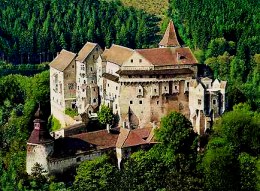

Pernštejn Castle is one of the most visited castles in Moravia, Czech republic, which attracts lots of tourists. It is situated on the cliff above the city Nedvedice. The castle rises nearly 8 centuries and throughout its history has never been conquered. Its majestic towers can be seen from the far away. That seat’s worth seeing.
In the past, from the middle of the 13th century, the castle had been an important and rich Pernštejn seat. Pernštejns Family knew how to arrange a comfortable life. They played an important role in the political affairs of the Czech kingdom. From the Pernštejn Castle there is a great view of the surrounding forests.
Openning hours
April, October – during weekends and bank holidays 9:00 – 15:00
May, June, September – every day except of Monday 9:00 – 16:00
July, August – every day except of Monday 9:00 – 17:00
lunch break 12:00 – 13:00
There are four tours available and the basic admission is 90 CZK – 200 CZK.
If you not book the special tour in advance, you can take the standard tour to the main parts of Pernštejn Castle, which covers about a third of the total area of the castle. If you are lucky, you can join any special tour on the day of your visit, if it is provided for someone else. Special tour includes a presentation of the history of the Pernštejn family and detailed inspection of otherwise forbidden interior of the castle. If you like history, you will like this tour as well.
View Pernštejn Castle – one of the most beautiful castles in the Czech republic in a larger map
Architecture and Fortifications
Pernštejn Castle stands as one of the finest examples of Gothic and Renaissance architecture in Central Europe. The castle’s construction began in the mid-13th century, but most of the visible structure dates from the 15th and 16th centuries when the Pernštejn family undertook extensive renovations. The castle follows a classic Gothic layout with a towering cylindrical keep, fortified walls, and a barbican guarding the main entrance. What sets Pernštejn apart from other Czech castles is the remarkable preservation of its interiors. The Golden Hall, with its intricately carved wooden ceiling and wall paintings, ranks among the most beautiful secular spaces from the Renaissance period in the region.
The castle’s defensive system reflects the turbulent history of Moravia. Multiple gates, drawbridges, and a deep moat protected the approach, while the thick walls could withstand artillery fire. The eastern tower, known as the Barborka, served as both a lookout point and a final refuge during sieges. Visitors can still see the original portcullis mechanism and the slots through which boiling oil could be poured onto attackers. Despite these formidable defences, the castle’s residential quarters reveal a taste for comfort and elegance. The chapel, decorated with Gothic frescoes and furnished with ornate wooden pews, provided a space for quiet contemplation away from the demands of political life.
Exploring the Castle Interiors
The guided tours of Pernštejn Castle take visitors through a sequence of rooms that span several centuries of aristocratic life. The Knight’s Hall, the largest room in the castle, features a carved Renaissance fireplace and portraits of the Pernštejn family members who shaped Moravian history. The library holds over 5,000 volumes, including rare manuscripts and early printed books collected by the family over generations. The armoury displays a collection of weapons ranging from medieval swords to early firearms. Each room contains original furniture, tapestries, and household objects that provide a vivid picture of daily life in a noble residence.
The special tour, which must be booked in advance, opens areas normally closed to the public. These include the upper floors of the main tower, the castle kitchen with its original hearth and utensils, and the cellars where supplies were stored. The tour also includes the castle’s hidden passages within the thickness of the walls, used by servants to move discreetly through the building. History enthusiasts will appreciate the detailed explanations of the Pernštejn family’s political alliances and the architectural changes made over the centuries.
Planning Your Visit
Beyond the castle itself, the surrounding landscape adds to the experience. Pernštejn sits atop a rocky outcrop overlooking the Svratka River valley, with dense forests stretching in every direction. A walking trail circles the castle hill, offering different perspectives of the towers and ramparts. The nearby village of Nedvedice provides basic services including parking, a small grocery store, and a restaurant serving Czech cuisine. Several marked hiking trails connect the castle to the wider network of paths through the Bohemian-Moravian Highlands. Many visitors combine a trip to Pernštejn with nearby attractions such as the Dalešice Hydroelectric Plant or the town of Trebic with its UNESCO-listed Jewish Quarter.
The best time to visit is during the late spring or early autumn, when the weather is mild and the crowds are smaller. July and August can be busy, particularly on weekends, so arriving early in the morning is advisable. The castle also hosts occasional cultural events including medieval fairs, concerts, and theatrical performances that bring the ancient walls to life. weather you choose the standard tour or the more in-depth special tour, Pernštejn Castle offers a journey into the heart of Moravian history that few visitors forget.
Would you explore this medieval castle in the heart of Moravia? 🏰
Explore all our Czech Republic travel guides, from Prague spires to Moravian wine country.
Explore More
If you enjoyed this article, you might also like:
- Top 15 sights to see in Prague – Czech Republic – Czech Republic
- Aquapalace Prague – the biggest aquapark in Czech republic – Czech Republic
- Orlické hory – a mountain ideal for skiing and hiking in the Czech Republic – Czech Republic
