
Vilnius is the capital of Lithuania. It lies about 90 km from Kaunas, far inland on the river Neris, just a few kilometers from the Belarusian border. The city has about 585,000 inhabitants. It is a major road and rail junction. It is important agricultural and machine tools producer, as well as electrical equipment, textiles and chemicals.
In Vilnius you can see the castle ruins, mosque, synagogue, and almost 40 churches. Old Town and the Cathedral Square form the heart of Vilnius. Three bronze statues on the shield of the cathedral are Saint Casimir on the south side, Saint Stanislaus on the north and Saint Helena in the centre. Chapel of Saint Casimir, located at the side of the ship was built in Baroque style. The tomb of Alexander Jagiello – Grand Duke of Lithuania, is located below the chapel.
It is very easy to get lost in Vilnius thanks to the dozens of narrow streets and a number of squares. Thus you can miss some of the most architecturally interesting buildings, such as the church in the shape of a pyramid. The old Jewish quarter, ghetto, the presidential palace, the university and the observatory are among other city’s sights.
The presidential palace was originally the residence of general governors, in 1812 the residence of Napoleon and after his expulsion it was a residence of Marshal Kutuzov. University areal consists of several buildings, including the church, which are interconnected by courtyards.
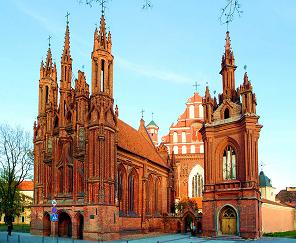
magnificent example of Lithuanian Gothic architecture is St. Anne’s Church from the 16th century. Next to it there is a church of the Bernardine Monastery from the same period. In front of this complex there is a statue of Adam Mickiewicz (Polish-Lithuanian poet, publisher and political writer of the Romantic period).
You can pass through one of eight city gates which are remainings of the city walls, which dates from the 16th century. If you get off the Hill of the Three Crosses, which still commemorates three monks that were allegedly tortured to death here, you will obtain a beautiful view of the city. More to the west, lies the new town, where you can find City Hall. In the past, it housed the Gestapo, then KGB and now it houses the Museum of Genocide of Lithuanian nation.
Less than thirty kilometres north of the city there is the geographical middle of Europe, which was established by the French National Geographical Institute. This centre symbolizes the pyramid, which contains the names of all major European cities and their distance from the center of Europe.
Vilnius was European Capital of Culture in 2009, together with Linz (Austria).
View Vilnius – Baroque city and the capital of Lithuania in a larger map
Gediminas Tower and Vilnius Cathedral
The most iconic landmark in Vilnius is the Gediminas Tower, the remaining western tower of the upper Castle built in the early 15th century. The tower stands on a hill 48 metres above the city and offers panoramic views of the Old Town and the Neris Valley. Inside, a small museum traces the history of Vilnius from its founding in 1323 by Grand Duke Gediminas to the present day. Entry costs 5 euros. At the foot of the hill lies Cathedral Square, the central public space of Vilnius. The Cathedral basilica of St Stanislaus and St Ladislaus, rebuilt in the Neoclassical style in 1801, dominates the square. The cathedral crypt contains the tombs of Lithuanian rulers and nobles. The square is also marked by the Stebuklas (Miracle) tile, a symbolic spot marking the starting point of the Baltic Way protest in 1989, when two million people formed a human chain across Lithuania, Latvia, and Estonia. Visitors spin on the tile for good luck.
Užupis and the Jewish heritage of Vilnius
Across the river Neris from the Old Town lies Užupis, a bohemian district that declared itself an independent republic in 1997. The Užupis Constitution, displayed in multiple languages on a wall near the main square, includes whimsical articles such as Everyone has the right to be unhappy and A dog has the right to be a dog. The district is filled with art galleries, quirky cafes, and sculptures, making it a favourite among creative residents. Vilnius was historically known as the Jerusalem of the North for its vibrant Jewish community, which before World War II numbered over 100,000 people. The Vilnius Gaon Jewish Museum preserves this heritage through exhibitions on Jewish life and culture. The Jewish quarter, centred on the old synagogue courtyard, contains memorials to the victims of the Holocaust. A walking tour of these sites, available through the Vilnius Tourist Information Centre, offers a moving and essential perspective on the city’s layered history.
Would you explore Vilnius Old Town or the independent republic of Užupis? 🏛️
Explore all our Lithuania travel guides, from Vilnius baroque to the Curonian Spit.
Explore More
If you enjoyed this article, you might also like: