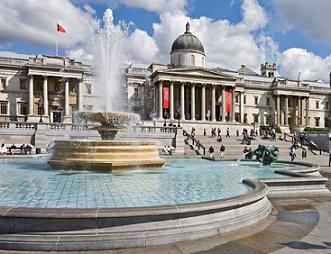

Trafalgar Square is the vibrant heart of London, a vast public space where history, art, and daily city life converge beneath Nelson’s Column. Named after Admiral Horatio Nelson’s decisive victory at the Battle of Trafalgar in 1805, this iconic square has served as a gathering place for celebrations, protests, and quiet contemplation for nearly two centuries. The square’s centrepiece, Nelson’s Column, rises 52 metres above the paving stones, topped by a statue of the one-armed admiral who saved Britain from invasion. Four gigantic bronze lions guard the base, their surfaces polished smooth by generations of children climbing on them. Fountains cascade on either side, their waters catching the sunlight as pigeons once flocked here by the thousand.
Trafalgar Square is the vibrant heart of London and the best starting point for exploration of its central part – right in the neighbourhood there is the government district of Whitehall with the British Parliament and is also close to Buckingham Palace and Westminster Abbey. You can get here by underground with lines Bakerloo or Northern, from the Charing Cross station. Trafalgar Square also serves as a stop for many day and night buses and also for well-known red double-deckers that offer sightseeing tours.
The National Gallery and the Fourth Plinth
The north side of Trafalgar Square is dominated by the National Gallery, one of the world’s greatest art museums, housing over 2,300 paintings spanning the 13th to the 20th centuries. The collection includes masterpieces by Leonardo da Vinci, Van Gogh, Rembrandt, and Turner, and admission to the main collection is free. The gallery’s famous dome and neoclassical facade provide a dramatic backdrop to the square. Adjacent to the gallery, the National Portrait Gallery traces British history through portraits of its most significant figures. On the square itself, the four plinths at each corner hold statues of historical figures, but the fourth plinth, in the northwest corner, has become one of London’s most talked-about public art spaces. Since 1999, the Fourth Plinth Commission has featured a rotating series of contemporary sculptures, from Antony Gormley’s living statue project to the current rotating installations. The commission has become a prestigious platform for emerging and established artists, and the plinth’s changing exhibits ensure that Trafalgar Square always offers something new even for returning visitors.
Royal Connections and Christmas Traditions
Trafalgar Square has a deep connection with the British royal family and national celebrations. The square is the traditional starting point for the annual Remembrance Sunday parade, where the monarch leads the nation in honouring the war dead. It is also the site of the official New Year’s Eve celebrations, drawing tens of thousands of revellers who watch the fireworks display from the surrounding streets. One of the square’s most cherished traditions is the annual Christmas tree, which has been donated by the city of Oslo, Norway, every year since 1947 as a thank you for Britain’s support during World War II. The tree, typically a 20-metre Norway spruce, is decorated with white lights in a traditional Norwegian style and stands at the centre of the square throughout December. The tree-lighting ceremony in early December is a festive occasion featuring carol singing and Norwegian dignitaries. The tradition also served as the backdrop for the famous pigeon-feeding rituals that once defined the square, though feeding was banned in 2003 to protect the historic buildings from corrosive droppings.
The name of this largest public space in London come from the sea Battle of Trafalgar, where on 21 October 1805 the legendary Admiral Horatio Nelson won the battle over the French fleet. In the middle of Trafalgar Square you can find Nelson’s Column, which is surrounded by fountains and four huge bronze statues of lions. At the top of the pillar there is a statue of Lord Nelson, who commanded the British navy at the Battle of Trafalgar.
View Trafalgar Square & Nelson’s Column in a larger map
On the north side there is the National Gallery. South of it is the Church of St. Martin-in-the-Fields. At each corner of Trafalgar Square there is a plinth with statues of George IV, Henry Havelock, and Sir Charles James Napier. The fourth plinth has temporary exhibitions.
Trafalgar Square is also famous as the home of hundreds of pigeons which were feeding by the inhabitants of London for centuries. But few years ago it was forbidden, because birds droppings damaged the local sights. Another tradition which became a familiar is the ritual with preparing the Christmas tree. It is imported from Oslo, Norway, who send it each year as a gift to help the Nordic country during the World War II.
View Trafalgar Square & Nelson’s Column in a larger map
Would you watch the New Year fireworks from Trafalgar Square? 🎆
Explore all our United Kingdom travel guides, from London landmarks to the Scottish Highlands.
Explore More
If you enjoyed this article, you might also like:
