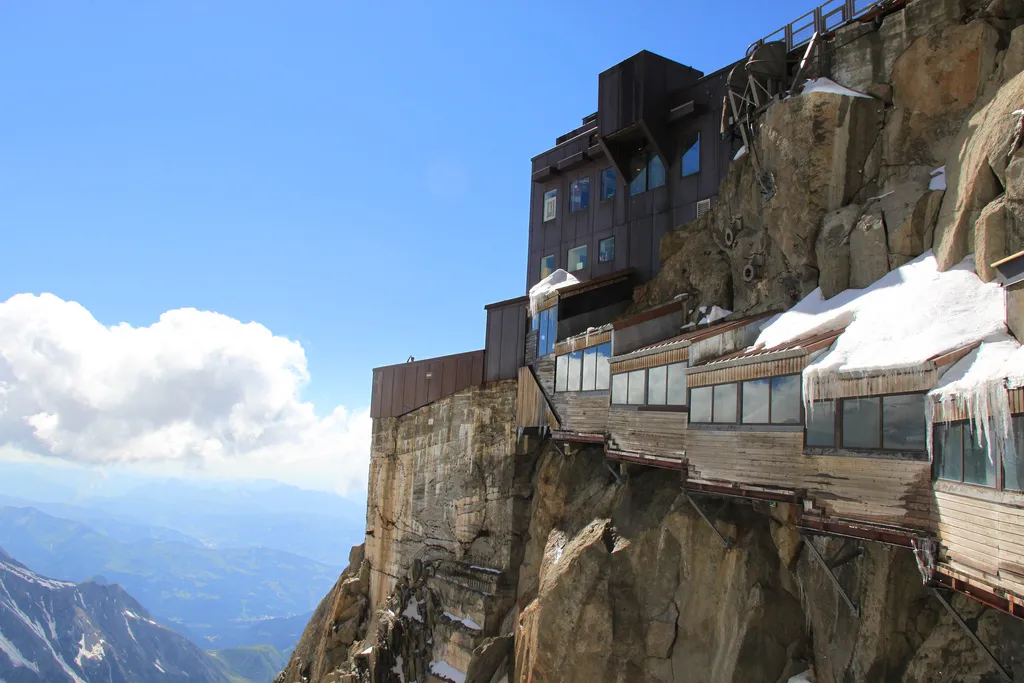
The cable car rises through a layer of cloud, and for a long moment you are suspended in white, the world reduced to the creak of the cables and the hum of the machinery above your head. Then the cloud breaks and you are above it, and the Alps stretch out in every direction like a frozen ocean, the peaks breaking through the cloud layer like islands in a white sea. At 3,842 metres, the Aiguille du Midi in the French Alps offers one of the most dramatic mountain views in Europe. The cable car from Chamonix is the highest vertical ascent in the world, climbing 2,800 metres in twenty minutes, and the view from the top terrace is the reward.
In This Article
The Alpine Giants: Mont Blanc and the Matterhorn
The view from the Aiguille du Midi is the most accessible of the great Alpine panoramas. From the observation deck, you look directly across at the Mont Blanc massif, the highest mountain in Western Europe at 4,809 metres. The glacier that descends from the summit, the Mer de Glace, is visible as a river of ice snaking through the valley below. The terrace is at 3,842 metres, and the altitude is immediately noticeable: you feel light-headed, the air is thin, and the temperature is significantly lower than in the valley. The ticket costs about 70 euros return, and the best time to visit is early morning, before the cloud builds over the peaks. The glass Skywalk, a cube cantilevered over the void, adds an element of vertigo to the experience, with the valley floor 1,000 metres below your feet.
The Matterhorn is the other icon of the Alps, and the best view of it comes from the Gornergrat in Zermatt. The cogwheel train from Zermatt climbs to 3,089 metres in thirty-three minutes, and the panorama from the top includes the Matterhorn, Monte Rosa, and the Gorner Glacier, the second largest glacier in the Alps. The view changes through the day in ways that the Mont Blanc panorama does not. In the early morning, the Matterhorn catches the first light and turns a deep rose pink. By midday, the peak is stark against the blue sky, the details of the rock face visible through the clear air. At sunset, the mountain glows with a warm orange light that photographers call the Alpenglow. The round trip on the Gornergrat railway costs about 110 Swiss francs, and the walk down from the top station to Zermatt takes about three hours on a well-marked trail.
The Dolomites and the Pyrenees
The Dolomites in northern Italy offer a mountain landscape that is completely different from the Alps. The rock is dolomite, a carbonate mineral that weathers into dramatic towers, spires, and pinnacles that catch the sunset light in shades of pink and orange, a phenomenon known as enrosadira. The Tre Cime di Lavaredo, three massive rocky pillars that rise to nearly 3,000 metres, are the most famous formation. The circular walk around the base of the Tre Cime takes about four hours on a well-maintained path that offers constantly changing views of the peaks. The Rifugio Auronzo, a mountain hut at the start of the walk, serves pasta, polenta, and local wine at prices that are reasonable considering the altitude. The Dolomites are also a UNESCO World heritage site, recognised for their geological significance and their exceptional natural beauty.
The Pyrenees offer a mountain experience that is less developed and more rugged than the Alps. The Cirque de Gavarnie in the French Pyrenees is a natural amphitheatre of limestone cliffs that rise to 3,000 metres, with the Gavarnie waterfall, at 422 metres the highest waterfall in France, cascading down the back wall. The walk into the cirque from the village of Gavarnie takes about an hour and follows a gentle path through meadows and pine forest. The scale of the cirque is difficult to grasp until you see climbers on the cliffs, reduced to specks against the massive rock face. The Ordesa Valley on the Spanish side, in the Ordesa y Monte Perdido National Park, offers equally dramatic scenery with a network of well-marked trails that range from two-hour walks to full-day hikes.
Practical Advice for Mountain Viewing
The best mountain views in Europe are available to anyone willing to plan carefully and accept the limitations of the weather. The high-altitude cable cars and cogwheel railways in France, Switzerland, Austria, and Italy make the peaks accessible even to those who do not hike, with the Jungfraujoch in Switzerland, billed as the Top of Europe and accessible by train to 3,454 metres, being the most visitor-friendly option.
The key to mountain viewing is timing. Summer, from June to September, offers the best weather, but the peaks can still be cloud-covered at midday. The early morning, before 10am, is the most reliable time for clear views. In autumn, September and October, the weather is often more stable, the crowds have thinned, and the larch forests turn gold in the valleys below the peaks. Spring, from April to June, offers snow on the high peaks and wildflowers in the valleys, but many high-altitude lifts are closed until late May.
Altitude affects everyone differently. Drink water, avoid alcohol, and take the altitude seriously. The views from the top are worth the minor discomfort, and standing above the clouds, with the mountains stretching to the horizon in every direction, is an experience that redefines your sense of scale.
Have you stood on the terrace of the Aiguille du Midi, watched the Alpenglow on the Matterhorn, or walked the circuit of the Tre Cime? Which mountain view in Europe still haunts you?
Explore all our Europe travel guides, discover the best of the continent.
Explore More
If you enjoyed this article, you might also like:
- The Argyll Coast – Sea, Serenity And Stunning Scenery, Scotland, UK – View all posts in Nature
- Exploring the sunny Costa Brava | Spain – View all posts in Sea sites
- Holidays by the Sea in Malta – View all posts in Malta
