Great Britain’s religious heritage is etched in stone across its landscape. From the soaring Gothic arches of Canterbury Cathedral to the ruined majesty of Tintern Abbey in Wales, these buildings preserve centuries of faith, art, and architectural ambition. The monasteries and convents once housed communities of monks and nuns who farmed the land, illuminated manuscripts in scriptoria lit only by daylight, and offered hospitality to travellers on roads that had not changed since Roman times. The cathedrals remain active centres of worship, their doors open to all who seek a moment of quiet contemplation away from the modern world. Each tells a story of construction, destruction, and renewal that mirrors the history of Britain itself.
In This Article
Fountains Abbey: A World heritage Site in the Yorkshire Dales
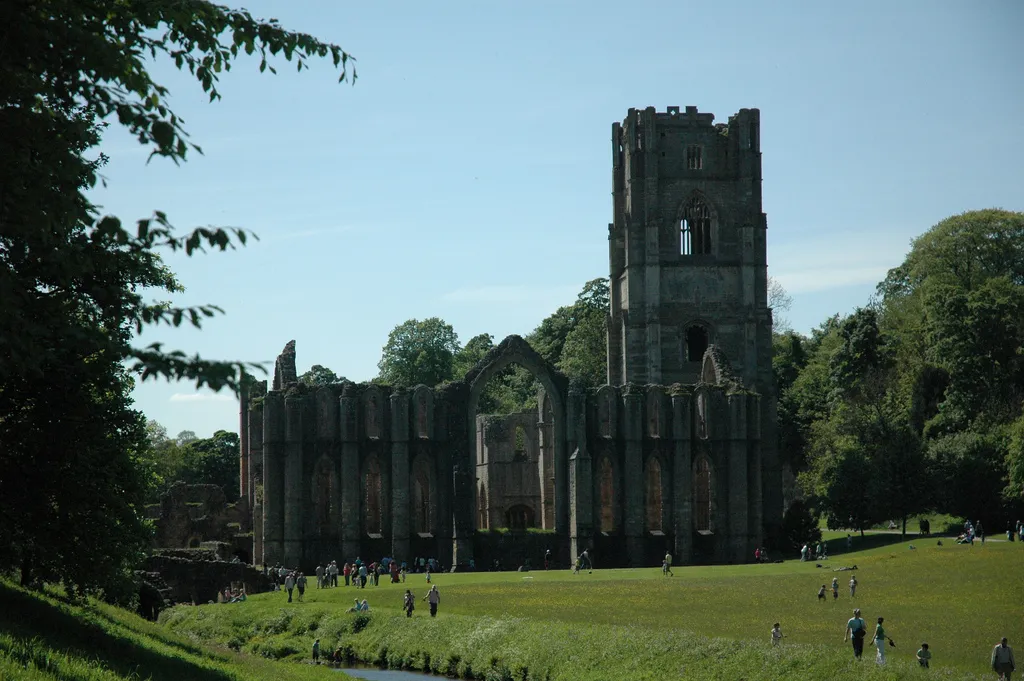
The area around Fountains Abbey has been designated a UNESCO World heritage Site, and one visit explains why. Founded in 1132 by Cistercian monks who sought a stricter observance of the Benedictine rule, the abbey grew over 400 years into one of the wealthiest and most influential monasteries in England. At its peak, the abbey owned tens of thousands of acres across Yorkshire and generated annual revenue equivalent to millions of pounds today. Henry VIII dissolved it in 1539, and the estate passed through several private hands before being donated to the nation in the 20th century. The ruins are among the most complete in the country: the cloister, the chapter house where the monks gathered daily to hear a chapter of the rule, the cellarium running 100 metres long where food and ale were stored, and the 12th-century church with its soaring window arches still standing against the sky. The abbey sits within the Studley Royal Water Garden, an 18th-century landscape park designed by John Aislabie with ornamental lakes, a moon pond, and neoclassical temples including the Temple of Piety and the Temple of Fame. The Serpentine Tunnel, a grotto-like passage built to surprise visitors emerging into the water garden, adds an element of Georgian theatricality. Fountains Mill operated until 1927 and now houses an exhibition where visitors can grind their own corn. The combination of a medieval Cistercian ruin and a Georgian water garden is found nowhere else in Europe.
Rievaulx Abbey and Kirkstall: Cistercian Power in the North
Rievaulx Abbey in North Yorkshire was the first Cistercian monastery in northern England, founded in 1132. At its peak, Rievaulx housed 150 choir monks and another 500 lay brothers who managed the abbey’s vast agricultural estates. The Great Plague of the 14th century wiped out many of the lay brothers, and the community never recovered its former size. By the time Henry VIII’s commissioners dissolved the monastery in 1538, only 23 monks remained. The new owner, the Earl of Rutland, systematically stripped the lead from the roofs and demolished sections of the church, but what remains the presbytery rising to 28 metres, the refectory with its graceful vaulting, and the chapter house still makes a spectacular sight. Kirkstall Abbey in West Yorkshire, just outside Leeds, is one of the best preserved Cistercian abbeys in Britain. Set in parkland along the River Aire, Kirkstall was founded in 1152 and survived largely intact because it was used as a source of building stone rather than being systematically demolished. The nave, the transepts, and the cloister are all complete enough to give a clear sense of monastic life. The abbey is now a scheduled ancient monument and the centrepiece of Kirkstall Abbey Park, a 25-hectare green space popular with walkers and picnickers.
Beverley Minster and Whitby Abbey: Beauty on the Coast
Beverley Minster in the East Riding was founded as a monastery more than 1,300 years ago, and the building that stands today dates from the 13th and 14th centuries. The twin towers, the Percy tomb with its intricate Gothic canopy, and the 68 carved misericords under the choir seats are considered masterpieces of English Gothic craftsmanship. Yorkshire historian J.E. Morris described it nearly a century ago as “the most beautiful building in Yorkshire,” and the assessment still stands. Unlike a cathedral, Beverley is a parish church, but it operates on a cathedral scale: the nave stretches 100 metres in length, the vaulted ceiling rises 30 metres above the floor, and the east window contains medieval stained glass that survived the Reformation. Whitby Abbey crowns the headland above the fishing town of Whitby, its skeletal silhouette visible for miles along the coast. Founded in 657 AD by the Saxon king Oswy, the original monastery hosted the Synod of Whitby in 664 AD, a meeting that shaped the future of Christianity in England by adopting Roman rather than Celtic dating for Easter. Bram Stoker stayed in Whitby in 1890 and used the abbey ruins as a setting for Dracula, the Count arriving in the town as a black dog leaping from a shipwrecked schooner. The best time to visit is late afternoon when the low autumn sun lights the stone and the shadows stretch across the graveyard where the North Sea wind never stops blowing.
Which British cathedral or abbey has moved you the most? ⛪
Explore all our United Kingdom travel guides, from London landmarks to the Scottish Highlands.
Explore More
If you enjoyed this article, you might also like:
- Culture and Art in London 2012 – United Kingdom
- A Weekend in Cool Brighton – United Kingdom
- Glen Coe – a narrow valley with towering mountains on either side | Scotland, UK – United Kingdom
