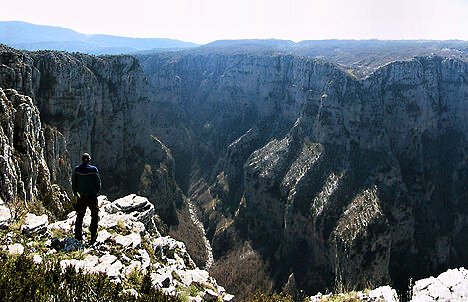
The depth hits you first. Standing at the rim of Vikos Gorge, the ground falls away so steeply that the river below looks like a silver thread. The Guinness World Records lists this as the deepest canyon in the world relative to its width. Silence fills the void between the limestone walls, broken only by the skitter of a loose stone or the call of a hawk circling far below. Wild oregano and thyme grow along the edge, their fragrance rising in the afternoon heat. The rock layers tell a story of a million years of geological pressure.
Vikos Gorge lies at the north-western part of Greece, in the Pindos mountains. It belongs to the deepest canyons in Europe.
Vikos Gorge is 20 km long and 400 m wide but at some places it is only a few meters wide. Its walls are high in some places over 1000 meters. Due to its size, the Vikos Gorge ranked the world’s deepest canyons and is listed in the Guinness Book of Records.
Photo licensed under the Creative Commons, created by Onno Zweers
Part of the Vikos Gorge is covered by the National Park Vikos-Aoos, which was founded in 1973. Except of canyon, there is also Tymfi mountain, river Aoos and several villages. The main part of the gorge stretches from village of Vikos to the village of Monodendri. The river Voidomatis flows through the canyon which constitutes the breathtaking scenery. Along the gap there are several view-points, offering breathtaking views. In the local unspoilt countryside there are many species of plants and animals such as bears, deer and foxes, which are protected by park.
Photo licensed under the Creative Commons, created by Onno Zweers
The area around the Vikos Gorge is ideal for many sports. Among others, climbing, mountain biking and of course hiking, which is the most popular. It is better to hike with a guide as it is very easy to get lost here. There are ongoing organized excursions, including a tour through the Zagori picturesque villages and famous stone bridge.
You can get to the Vikos Gorge e.g. by public bus transportation service. The journey from Athens to Zagori takes about 7 hours.
View Vikos Gorge in Greece in a larger map
Hiking the Vikos Gorge Trail
The classic Vikos Gorge hike runs from the village of Monodendri to the village of Vikos, a 12-kilometre route taking most hikers between five and seven hours. The trail descends from the rim into the gorge floor, following the Voidomatis River through a landscape of towering limestone walls and dense oak forest. The path is well marked, but sturdy hiking boots are essential. Sections of the trail cross the river multiple times, so waterproof footwear is useful. The gorge floor never sees direct sunlight in its deepest sections until late morning, keeping temperatures cool even during summer months.
Hikers should carry at least two litres of water per person. The best months for the hike are April through June when river flow is strongest and wildflowers bloom, and September through October when autumn colours transform the forest. July and August can be uncomfortably hot in open sections. The hike ends at the village of Vikos, where a small taverna serves refreshments. Arrange transport back to Monodendri in advance, by taxi for approximately 20 euros.
The Zagori Villages and Stone Bridges
Surrounding Vikos Gorge are 46 traditional stone villages known collectively as the Zagorochoria. These settlements were built during the Ottoman period when local merchants invested their fortunes in grand stone mansions and the remarkable arched bridges that span the region’s rivers. The most famous is the Kokkoros Bridge near the village of Kipi, a three-arched stone structure built in 1750. The Plakidas Bridge features a single arch spanning 30 metres and is considered one of the finest examples of Ottoman-era bridge building in Greece. A self-guided driving tour of the Zagori villages can easily fill two days.
The Voidomatis River offers opportunities for swimming and kayaking during warmer months. Kayaking is suitable for beginners with Class I and II rapids. half-day kayaking trips cost approximately 35 euros per person. The entire Zagori region was declared a UNESCO Global Geopark in 2014, recognising its exceptional geological features and cultural heritage. Plan at least three days to experience the gorge hike, explore the villages, and enjoy the river activities.
Could you handle the drop at Vikos Gorge? 🏞️
Explore all our Greece travel guides, from ancient ruins to Aegean beaches.
Explore More
If you enjoyed this article, you might also like:
