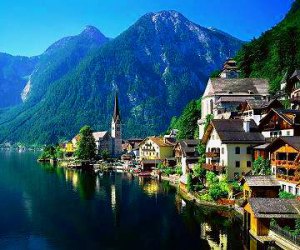
Austria is the country of a thousand faces, an Alpine nation at the crossroads of Europe whose imperial capital, Vienna, was for centuries the political and cultural heart of a continent, whose mountains are among the most beautiful and accessible in the Alps, and whose cultural legacy (Mozart, Strauss, Klimt, Freud, and the Habsburg dynasty that ruled much of Europe for 600 years) far exceeds what any country of 9 million people could reasonably be expected to produce. Austria is also a country of extraordinary natural beauty, from the turquoise lakes of the Salzkammergut region (Hallstatt, the impossibly photogenic village wedged between mountain and lake that UNESCO protects and Instagram adores, is the star) to the glaciers and peaks of the Hohe Tauern National Park, from the vineyards of the Wachau Valley along the Danube to the alpine meadows of Tyrol and Vorarlberg. And it is one of the most liveable countries on Earth, Vienna regularly tops global quality-of-life rankings, the public transport is outstanding, the coffeehouse culture (recognised by UNESCO as intangible heritage) is the perfect blend of Ottoman and European influence, and the cake, the Sachertorte, the Apfelstrudel, the Kaiserschmarrn, is reason enough to visit.
Quick Facts: Austria Travel Guide
- Best time to visit Austria: Year-round; May–September for hiking, the lakes, and the best weather (July–August is peak season and the most expensive period); December for Vienna’s magical Christmas markets; January–March for skiing (Austria has some of the best and most affordable skiing in the Alps); the Salzkammergut lake district is at its most beautiful in spring (April–May, when the mountains still have snow caps and the valleys are green) and autumn (September–October, when the forests blaze with colour)
- Top attractions in Austria: Vienna’s Schönbrunn Palace, the Hofburg, the Kunsthistorisches Museum, and the Spanish Riding School; Salzburg, Mozart’s birthplace, the Sound of Music city, and one of the most beautiful Baroque cities north of the Alps; Hallstatt, the fairy-tale lake village; the Grossglockner High Alpine Road (one of the most spectacular drives in Europe); the Krimml Waterfalls (Austria’s highest); Innsbruck, the Alpine capital surrounded by mountains; the Melk Abbey on the Danube; and the Eisriesenwelt, the largest ice cave in the world near Werfen
- How to get to Austria: Vienna International Airport (VIE) is the main hub; Salzburg (SZG) and Innsbruck (INN) serve regional flights; excellent rail connections, ÖBB Railjet trains connect Vienna to Salzburg (~2.5h), Munich (~4h), Budapest (~2.5h), and Prague (~4h); scenic train journeys (the Semmering Railway, UNESCO-listed) are destinations in themselves
- Currency: Euro (€)
- Language: German, English is widely spoken, especially in tourist areas; Austrians are generally warm and polite, and the formal greeting “Grüß Gott” is the standard greeting in most of the country (replaced by “Servus” in more casual settings)
- Best for: Music and art lovers, skiers and hikers, coffeehouse connoisseurs, romantics, and anyone who appreciates the elegance of a country that knows how to preserve its traditions without being trapped by them
Western and southern parts of Austria are dominated by the Alps, while the eastern provinces, including Vienna are situated in the Danube basin.
until World War I Austria was vast empire that ruled much of central Europe for the centuries. Austria is now a federal republic, consisting of nine states (Burgenland (Eisenstadt), Kärnten (Klagenfurt), Niederösterreich (St.Pölten), Oberösterreich (Linz), Salzburg (Salzburg), Steiermark (Graz), Tirol (Innsbruck), Vorarlberg (Bregenz), Wien (Wien)).
The capital city of Austria – Vienna hosts many international organizations including the Secretariat of the Organization for Security and Cooperation in Europe (OSCE), the International Atomic Energy Agency (IAEA) and the Organization of Petroleum Exporting Countries (OPEC).
The Austrian Parliament has two chambers. National Council (Nationalrat) has 183 members who are elected by direct popular vote for five-year period. Federal Council (Bundesrat) is the second chamber with about 62 members representing different regions. Its members are elected for six years.
Austria has a rich cultural heritage, with a special place of Wolfgang Amadeus Mozart. But also the music of Franz Schubert is very popular. In the field of philosophy and ideas you can find controversy work of Sigmund Freud, while Ludwig Wittgenstein is one of the most influential philosopher of 20th century. Paintings by Gustav Klimt from the early 20th century are highly reputable.
Austria has a mixed industrial-agricultural economy, but an important source of income is tourism.
Austrian cuisine includes specialties like Wiener Schnitzel and Apfelstrudel.
As a tourist in Austria, you will shortly find out that everything is well prepared for you and services are excellent in the tourist areas. weather you visit any place in the summer or winter you will be really satisfied – from tourism and cycling signs of groomed trails, through camping facilities and winter resorts, to cultural and spa programs in the hotels and family pensions.
The highest point of Austria is Grossglockner (3 798 m) and the lowest point is Neusiedler See (115 m).
There are 6 national parks in Austria. The beauty of these six totally different protected natural areas you can enjoy on foot or by bike.
View Austria – Country of a Thousand Faces in a larger map
Have you waltzed in Vienna, hiked the Salzkammergut lakes, skied the Tyrolean Alps, or discovered Hallstatt’s fairy-tale shores? Share your Austrian moments in the comments! 🇦🇹
Explore all our Austria travel guides, from Vienna coffeehouses to Alpine peaks.
Explore More
If you enjoyed this article, you might also like:
