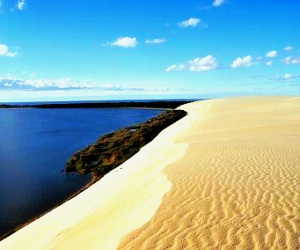
Lithuania is the country of amber, Baltic gold, the fossilised tree resin that washes up on the shores of the Curonian Spit in quantities unmatched anywhere else on Earth, which has been traded along the Amber Road from the Baltic to the Mediterranean since the Roman Empire and remains the defining symbol of this proud Baltic nation. The largest and southernmost of the three Baltic states, Lithuania was once the heart of the largest state in medieval Europe, the Grand Duchy of Lithuania, which at its peak in the 15th century stretched from the Baltic to the Black Sea. Today, Lithuania rewards the traveller with Vilnius, one of Europe’s most beautiful Baroque cities (its UNESCO-listed Old Town is the largest in the Baltic region), the extraordinary Curonian Spit, a 98-kilometre sand dune peninsula shared with Russia’s Kaliningrad enclave that is one of the most unique landscapes in Europe, the Hill of Crosses near Šiauliai (an extraordinary folk monument of over 100,000 crosses representing Lithuanian resistance through centuries of occupation), and a deep, complex history of pagan resilience (Lithuania was the last country in Europe to convert to Christianity, in 1387), Polish-Lithuanian commonwealth glory, Russian imperial and Soviet occupation, and a triumphant independence movement that culminated in the Singing Revolution of the late 1980s.
Quick Facts: Lithuania Travel Guide
- Best time to visit Lithuania: June–August for the warmest weather, the longest days (near-white nights at midsummer), and the most vibrant cultural calendar; May and September for pleasant weather with fewer tourists and the beautiful spring and autumn colours; December for Vilnius’s Christmas market at the cathedral square; February for a winter wonderland experience, Lithuania is cold (temperatures can drop to -20°C), but the snow-covered Baroque Vilnius is magical, and the Curonian Spit covered in snow and ice is unforgettable
- Top attractions in Lithuania: Vilnius Old Town, the Baroque churches, the Gothic St. Anne’s Church (which Napoleon allegedly wanted to take back to Paris in the palm of his hand), the Republic of Užupis (a self-declared artists’ republic with its own constitution, including the right to be happy and the right to be unhappy), and the Gediminas Tower with its panoramic views; Trakai Island Castle, the 14th-century red-brick castle on an island in Lake Galvė, the ancient capital of Lithuania and one of the most beautiful castle settings in Eastern Europe; the Curonian Spit (Kuršių Nerija), a UNESCO World heritage site of massive sand dunes, pine forests, and the fishing village of Nida, where Thomas Mann spent his summers; the Hill of Crosses, a deeply moving site of national resistance and resilience; and the Grūtas Park, the “Stalin World” sculpture park of removed Soviet statues in a forest setting, a bizarre and thought-provoking open-air museum
- How to get to Lithuania: Vilnius International Airport (VNO) has flights from across Europe; Kaunas (KUN) serves budget airlines; excellent bus connections from Warsaw (~8h), Riga (~4h), and Tallinn (~9h); Vilnius is compact and walkable
- Currency: Euro (€)
- Language: Lithuanian, one of the oldest living languages in Europe (closely related to Sanskrit and remarkably conservative over millennia); English is widely spoken among younger Lithuanians and in tourist areas; Russian is understood by older generations but the relationship is complex, English is the safer default
- Best for: History buffs, architecture lovers (Vilnius’s Baroque beauty is underrated), nature enthusiasts (the Curonian Spit is a unique landscape), and anyone seeking a Baltic destination that feels authentic and still underexplored by mass tourism
Lithuania, officially the Republic of Lithuania is a country in Northern Europe, the southernmost of the three Baltic states. Situated along the southeastern shore of the Baltic Sea, it shares borders with Latvia to the north, Belarus to the southeast, Poland, and the Russian exclave of Kaliningrad to the southwest. Across the Baltic Sea to the west lies Sweden and Denmark. Its population is 3.32 million. Its capital and largest city is Vilnius.
Lithuania is the most populous of the three Baltic States. Lithuania’s surface is mostly flat except for a few small hills on the western plateau and the eastern highlands. The highest point is at the Aukštasis top in 294 meters. Lithuania has 758 rivers within its territory, more than 2,800 lakes and 99 km long coast of the Baltic Sea, which is mainly used for recreation and is the subject of conservation. Forest area covers just over 30% of the country.
Approximately 84% of the population are ethnic Lithuanians. The two largest minorities are Poles, with more than 6%, and Russians with more than 5%. The Lithuanian language belongs to the Indo-European languages.
Capital of Lithuania – Vilnius is a picturesque port on the banks of the rivers Neris and Vilna with one of the architecturally most impressive old towns in Eastern Europe. University of Vilnius, founded in 1579, is the Renaissance complex with countless inner courtyards, which are like city within a city.
Lithuanian cuisine is known abroad mainly for its cold beet soup. Regular part of meals are potatoes, which are the most popular cakes and Cepelinai – potato dumplings stuffed with meat, cream cheese and mushrooms.
Have you explored Vilnius’s Baroque old town, walked the dunes of the Curonian Spit, or discovered Trakai’s island castle? Share your Lithuanian discoveries in the comments! 🇱🇹
Explore all our Lithuania travel guides, from the Amber Coast to the Hill of Crosses.
Explore More
If you enjoyed this article, you might also like:
- Vilnius – Baroque city and the capital of Lithuania – Lithuania
- Sweden – open and accepting society – All Countries
- Hungary – delicious goulash – All Countries
