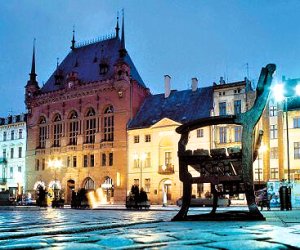
Poland is one of Europe’s most resilient and rewarding destinations, a country that has risen from the devastation of the 20th century to become one of the continent’s most dynamic economies, with beautifully reconstructed historic centres (Warsaw’s Old Town was rebuilt brick by brick from rubble after World War II and is a UNESCO World heritage site), a rich cultural heritage that produced Chopin, Copernicus, and the Solidarity movement that helped bring down the Iron Curtain, and landscapes that range from the wild Białowieża Forest (Europe’s last primeval lowland woodland, home to European bison) to the sandy beaches of the Baltic coast and the dramatic peaks of the Tatra Mountains on the Slovak border. Poland is also one of the best-value destinations in Europe, the food is hearty and excellent (pierogi, żurek, and the finest vodka on the continent), the cities are vibrant and safe, and the weight of history is present everywhere, from Auschwitz-Birkenau (an essential and heartbreaking visit) to the medieval trading port of Gdańsk where the first shots of World War II were fired, to the Wieliczka Salt Mine near Kraków, a UNESCO-listed underground cathedral carved entirely from salt.
Quick Facts: Poland Travel Guide
- Best time to visit Poland: May–June and September for pleasant temperatures and fewer crowds; July–August is the warmest but also the busiest in Kraków and the Baltic coast (Polish families holiday in August); December for the magical Christmas markets (Kraków and Wrocław are particularly beautiful); February for skiing in Zakopane and the Tatra Mountains
- Top attractions in Poland: Kraków’s Rynek Główny (Europe’s largest medieval market square), the Wieliczka Salt Mine, Auschwitz-Birkenau Memorial and Museum, Warsaw’s reconstructed Old Town and the POLIN Museum of the History of Polish Jews, the medieval port of Gdańsk and the European Solidarity Centre, the wooden churches of southern Poland (UNESCO), the Tatra Mountains and Zakopane, Wrocław’s charming market square and its famous dwarf statues, and the Białowieża Forest, one of the last and largest remaining parts of the primeval forest that once covered most of Europe
- How to get to Poland: Warsaw Chopin Airport (WAW) and Kraków John Paul II (KRK) are the main hubs; extensive budget airline connections from across Europe to Warsaw, Kraków, Gdańsk, Wrocław, and Poznań; excellent train connections from Berlin (~5h to Warsaw, ~7h to Kraków), Prague (~7h), and Vienna (~6h); domestic trains are frequent and affordable
- Currency: Polish Złoty (PLN), Poland is not in the Eurozone, and prices remain significantly lower than in Western Europe (a good restaurant meal with wine ~€15–20 per person)
- Language: Polish, a challenging Slavic language, but English is widely spoken in tourist areas, especially among younger Poles; learning a few basic phrases (dzień dobry, dziękuję, proszę) is always warmly received
- Best for: History enthusiasts, budget-conscious travellers, food lovers, hikers and skiers, and anyone interested in the story of Europe’s 20th century
Poland lies in Central Europe and is stretched along the Baltic Cost which is 528 km long. It offers sandy beaches which are among the best in Europe and their characteristic feature is the narrow sandy scythe, which were modelled by the sea. Country borders with the Czech Republic, Slovakia, Ukraine, Belarus, Lithuania and Germany. Poland’s surface is mostly lowland with large lakes, the mountains are only in the south of the country, on the borders with Slovakia and Czech Republic. The highest point is Rysy peak in the High Tatras (2,499 meters above sea level). The landscape is mostly covered with deciduous and mixed forests, pastures and meadows. The climate is maritime and continental. There is a number of protected areas, national parks and reserves.
You can go to Poland for culture (historical towns, castles, palaces, museums) or nature (Tatra Mountains, Beskids, Bieszczady, Pieniny or Table Mountains). If you’re tired of walking the hills and mountains, you can still benefit from the Baltic coast – although the Baltic is quite cold, it still has its charm. You need to visit the Gulf of Gdansk, especially Hel Peninsula is a place that you might like. In the evening, it offers various bars, discos and nightclubs.
The best time for sightseeing in Poland is the period of late spring or early autumn when there is a pleasant warm and resorts are not as crowded as during the summer season. In July and August, the mountains, lakes and seaside resorts are full of tourists (like in the other parts of Europe). However, if you go to the cities, they are mostly calm and quiet. Most of the accommodation and catering facilities on the coast and in other popular locations are closing in the fall and reopening again with the arrival of spring. From late November to mid-March you can enjoy ski season in Poland.
On 1 January 2004 Poland joined the Europeand later on 21 December 2007 joined the Schengen area and were thus abolished checks at internal borders. That does not mean that you can travel across borders without any proof. You must always carry a valid identity document, ie passport or identity card with machine readable zone. If you want to stay in the country for less than 3 months, European citizens are not required to have residence permits.
Before traveling to Poland ask first your health insurance company for European Health Insurance Card, which you must show if you need urgent medical attention. Before the trip we recommend that you take out additional health insurance. In each town should be at least one pharmacy with night operations.
The official monetary unit is Polish Zloty. Prices in Poland are still relatively lower than in Western Europe, more expensive are only imported goods and the accommodation in hotels. You can exchange money in every town in the bank or exchange office.
If you are traveling to Poland, along with your pet, it is necessary to have an international passport, and need to be identified by microchip or tattoo and vaccinated against rabies.
What’s your Poland, Kraków’s medieval square, Gdańsk’s Baltic history, the Tatra peaks, or the bison of Białowieża? Share your Polish adventures in the comments! 🇵🇱
Explore all our Poland travel guides, from Kraków square to the Tatra Mountains.
Explore More
If you enjoyed this article, you might also like:
