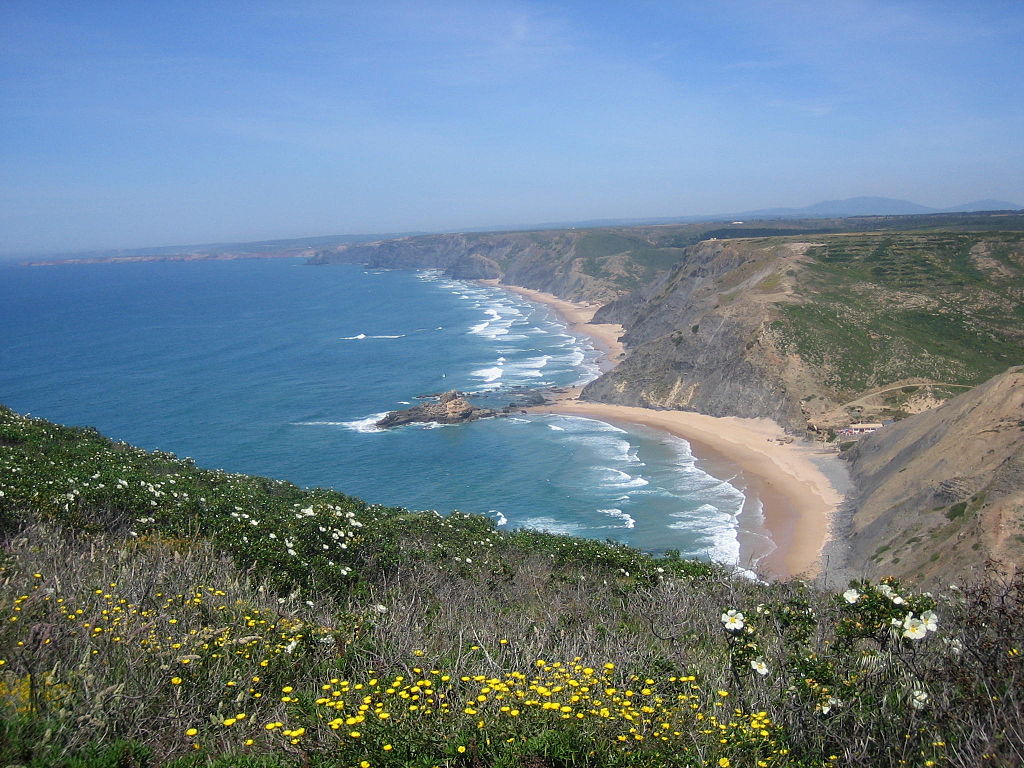
The Parque Natural do Sudoeste Alentejano e Costa Vicentina is 100 kilometres of Portugal’s wildest, most beautiful coastline and the best place in Europe to find a beach entirely to yourself, even in August. Stretching from Porto Covo in the Alentejo down to Burgau in the Algarve, this protected natural park encompasses cliffs that drop straight into turquoise Atlantic water, dunes that shift with the winter storms, and fishing villages where the catch of the day determines the menu. Unlike the built-up resorts of the central and eastern Algarve, the Costa Vicentina has no high-rise hotels, no golf courses, and no theme parks. What it does have is a network of hiking trails, world-class surf breaks, and a biodiversity that draws botanists and zoologists from across Europe.
In This Article
Quick Facts: Southwest Alentejo and Vicentine Coast Natural Park
- Best time to visit: May-June and September-October for perfect hiking weather and empty beaches. July-August is busy in the Algarve section but the Alentejo beaches remain surprisingly quiet. Winter is for storm-watching and the best surf swells
- Top beaches: Praia do Amado (surfing mecca with consistent Atlantic swells); Praia da Bordeira (a huge beach backed by dunes and a lagoon); Praia do Beliche (sheltered cove near Sagres); and Praia da Franquia in Vila Nova de Milfontes (the most developed beach in the park, still low-key)
- Getting there: The Rota Vicentina, a network of 400 km of walking trails, is the best way to experience the park. The Fishermen’s Trail follows the cliff edge for 75 km through the most dramatic sections. Car access requires a vehicle as public transport along the coast is minimal
- Wildlife: White storks nest on the cliffs, booted eagles hunt the thermals above the dunes, and the waters offshore host resident pods of bottlenose dolphins. The park is also a vital stopover for migratory birds crossing between Europe and Africa
While there are countless national parks that can be found throughout Portugal, one of the finest stretches of coastline in all of Europe can be found at the Parque Natural do Sudoeste Alentejo e Costa Vicentine. The 100 kilometre long stretch of coastline that is situated between Porto Covo and Burgau has been well preserved and maintained as an all-natural destination within the country.
So well preserved is the Parque Natural do Sudoeste Alentejo e Costa Vicentine, that zoologists as well as botanist from all over the world make their way to the park every year in order to research and study the vast diversity of plant and animal life that call the park home.
Parque Natural do Sudoeste Alentejo e Costa Vicentine, Portugal by Jovoboro
There are countless bird species which can be found throughout the park. The rarest of these is known as the fishing eagle which can be seen soaring high above overhead. The park is also the only place in the world where the white stork is known to build their nests. The park is also one of the last few places where one can see the European otter in its natural environment.
For the most part, the Parque Natural do Sudoeste Alentejo e Costa Vicentine consists of steep cliff coastlines of varying shapes, sizes and contours. There are also a number of excellent beaches that can be found along the coastline which have become extremely popular amongst surfers not just in Portugal, from all over the world as well. There are countless beaches that can be found, but most of them are very difficult to get to without the assistance of a boat. As such, one can consider the beaches of the Parque Natural do Sudoeste Alentejo e Costa Vicentine to be some of the most secluded in the entire country.
The southernmost edge of the Parque Natural do Sudoeste Alentejo e Costa Vicentine is situated at the Cape of São Vicente and is conveniently marked by the lighthouse which was built in order to protect sailors traversing around the Cape. The area is easily accessed via the popular destination of Sagres, Portugal; which also offers most of the accommodations in the region. There are more than 70,000 hectares within the park that are just waiting to be explored.
