
One million years ago, tectonic shifts created a shallow brackish lagoon in the heart of Andalusia that would become one of the most important nesting sites for the greater flamingo in Europe, a 1,364-hectare wetland where salt crystals float on the surface like a mirror and the pink of a million flamingo wings turns the horizon the colour of dawn. The Laguna de Fuente de Piedra, designated as a protected nature reserve in 1988, is the second-largest flamingo breeding colony in Europe and the largest on the Iberian Peninsula. Every year between February and August, thousands of greater flamingos travel more than 1,000 kilometres to reach these shallow, hypersaline waters where they perform their elaborate courtship dances, build mud-nest mounds, and raise a single chick per pair.
In This Article
Quick Facts: Laguna de Fuente de Piedra
- Best time to visit: February to August for the full breeding season; July is the hatching month when thousands of fluffy grey chicks take their first steps. Early morning or late afternoon light creates the best photography conditions against the reflective salt flats
- Location: Approximately 65 km northwest of Málaga and 20 km from Antequera, in the province of Málaga, Andalusia, southern Spain. Access by car is straightforward via the A-92 motorway
- Visitor facilities: A dedicated visitor centre with viewing hides, interpretive displays, and guided walks. The observation points are positioned to minimise disturbance to the nesting birds. Entry is free, though donations support conservation work
- Conservation success: Over 300 volunteers monitor the flamingo population annually. The lagoon supports over 30 species of breeding birds and countless endemic invertebrates adapted to the hypersaline conditions
It was back in 1988 when a 1,364 hectare parcel of land just outside of Andalucia was first designated as a preserved area in order to help protect one of the largest colonies of pink flamingos on the Iberian Peninsula. Today, the Fuente de Piedra Lagoon is not only home to the largest colony of pink flamingos on the Iberian Peninsula it is the second largest in all of Europe.
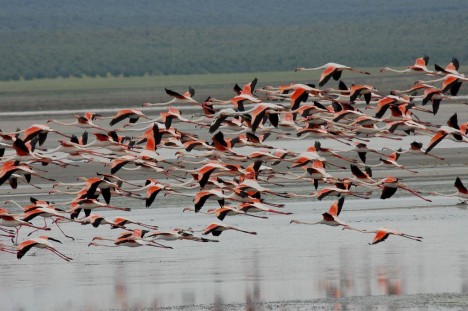
Flamingos on Fuente de Piedra Lagoon, Spain by rjime31
The Fuente de Piedra Lagoon is a beautiful and biodiverse ecosystem. There are more than 30 different species of birdlife that make their way to the lagoon every single year to breed. There are also countless priceless species of fauna that can be found only in the Fuente de Piedra Lagoon. And of course while all these make visiting the lagoon a popular choice, it is the hundreds of thousands of pink flamingos that has attracted so many visitors over the years.
Today, thousands of newborn chicks see their first sunrise over the Fuente de Piedra Lagoon. Thanks to help of more than 300 volunteers who monitor the flamingos as well as make sure that they are all healthy as possible. And while the pink flamingo can be seen throughout the year especially in the months between February and August, it is only during the middle of July that their eggs hatch.
It is important to point out, that the Fuente de Piedra Lagoon is not freshwater; but rather it is brackish. As a result, due to the amount of evaporation in the area, there is always a thin layer of salt crystals floating on the surface of the lagoon. As a result, some of the best photo picking opportunities imaginable will occur as assigned begins to set and its reflection can be seen across the surface of the lagoon as if there were a large perfectly smooth mirror.
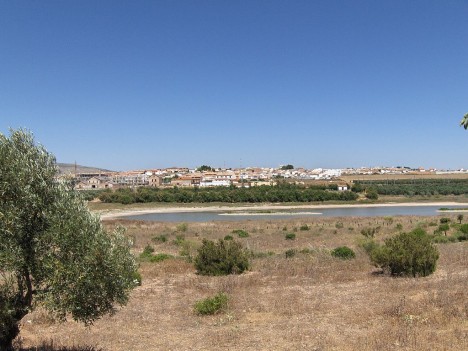
Fuente de Piedra Lagoon, Spain by Tyk
It is simply amazing how far the pink flamingos travel here just to reach the waters of the Fuente de Piedra Lagoon. However it is not uncommon for the birds to travel more than 1000 kilometres every single year. And what is more, is that for centuries, the pink flamingo has chosen to breed in the waters of the Fuente de Piedra Lagoon over any other location in the world.
After breeding, a pair of flamingos will share the responsibility of rearing their chick. The female will lay only a single egg per year and for 29 days will painstakingly monitor and incubate the eggs until it hatches. It is simply amazing to not only watch the courtship dance between flamingos, but also the loving and nurturing that the two, mother and father flamingos, show to the newborn chick as they bring into the world and raise it to maturity.
When you choose to visit the Fuente de Piedra Lagoon, you are choosing to take part in one of the most awe-inspiring natural wonders that the world has ever known.

Laguna de Fuente de Piedra is a must for bird lovers. We went in April during the flamingo breeding season and the sight of hundreds of pink flamingos against the blue water is something I will never forget. It is less commercialised than the Camargue in France — just a simple viewing platform and miles of open sky. Free to enter too, which was a nice surprise.