Prague is a city of more than one hundred spires, nine historic districts, over 1,000 years of continuous urban development, and the sixth most visited city in Europe, receiving approximately 8 million tourists annually, a figure that has grown steadily since the fall of the Iron Curtain made this impossibly beautiful city accessible to the West. The Vltava River winds through the historic centre in a dramatic S-curve, separating the castle-topped Hradčany district from the gothic Old Town, the baroque Malá Strana, and the Josefov Jewish Quarter, creating a compact, walkable city where every street reveals another architectural masterpiece. Prague survived World War II with remarkably little damage, and its medieval core, a UNESCO World heritage site since 1992, is one of the most complete and best-preserved historic city centres on the continent.
In This Article
Quick Facts: Prague
- Best time to visit: May, June, and September for the best weather and manageable crowds. July and August are peak tourist season and the Charles Bridge, the Old Town Square, and Prague Castle are packed from 10am to 6pm. December is magical for the Christmas markets but very cold (0-5°C) and dark by 4pm
- Getting there: Václav Havel Airport Prague (PRG) receives direct flights from most European capitals. The city’s public transport system, consisting of metro (3 lines), trams, and buses, is efficient, affordable, and covers the entire urban area. A 72-hour travel pass costs approximately €12 (as of 2026)
- Top sights: Prague Castle (the largest ancient castle in the world per Guinness World Records, covering 70,000 square metres); the Charles Bridge (built 1357, 516 metres long, 30 baroque statues); the Old Town Astronomical Clock (the oldest functioning astronomical clock in the world, installed 1410); and the Jewish Quarter (six synagogues and Europe’s oldest active Jewish cemetery, established in the 15th century)
- Local tip: The tourist crowds concentrate along the Royal Route between Prague Castle and the Old Town Square. Walk just one street away and you will find quiet courtyards, local pubs, and restaurants serving authentic Czech cuisine at half the price
The city of Prague is the capital as well as the largest city in the Czech Republic. Many people also consider Prague to be the most beautiful city in the entire country and as a result has been commonly referred to as the Golden City as well as the Mother of Cities, or the City of a Hundred Spires.
Prague can be found situated along the banks of the Vltava River in the Northwestern part of the country. It offers a unique and interesting climate with warm mild summers and chilly winters. There are more than 2 million people who live in the metropolitan area that surrounds the city of Prague. Prague is also one of the most popular destinations in all of Europe, and as a result more than 4 million people from all over Europe and the world make their way to the city every single year.
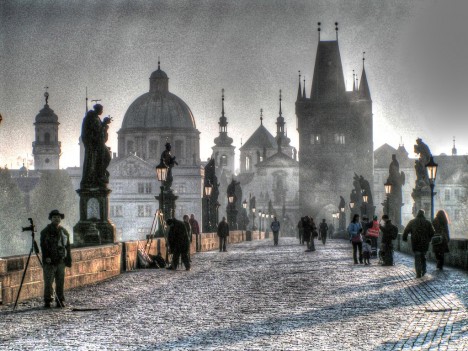
Charles bridge, Prague, The Czech Republic / Photo by Claire (Europe Explored)
For more than 1100 years, the city of Prague has been the cultural, economic as well as political center of the Czech state. The city was first established during the Holy Roman Empire words that as the permanent seat for two different Roman emperors prior to becoming the capital of the Czech Republic. Today, the historic town centre is designated an UNESCO world heritage site.
For the most part, the city of Prague survived much of the destruction associated with both world wars. And thanks to this the city is home to numerous attractions and monuments; many of which are centuries old. The most popular of these attractions of course is that of Prague Castle. Then of course there is the old Charles Bridge, the Jewish Quarter, Kampa, the city’s old historic town square, as well as Petřín Hill.
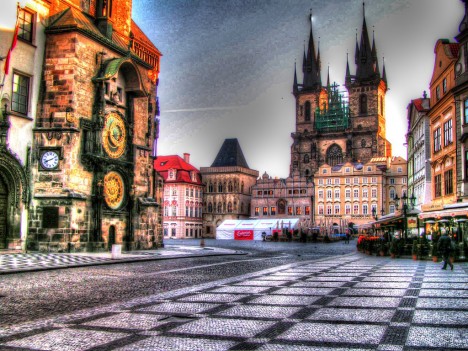
Old town square, Prague, The Czech Republic / Photo by Claire (Europe Explored)
Anyone who chooses to visit the city of Prague will also find that there are 10 different major museums that can be found within the city, as well as numerous theatres, cinemas as well as art galleries and other historically important exhibits. Of course there is no need to walk around the city because there is an excellent and very modern public transportation system that can get you to any destination within the city.
There are many historically important destinations which can be found within the city of Prague. And thanks to the fact that it survived the wrath and destruction of both world wars, most of the destinations and attractions within the city have been well preserved since their initial construction centuries ago. After all, there is a reason why Prague is the sixth most visited city in all of Europe.
Once you choose Prague for your holiday destination (which I always recommend), here you can find Top 15 places to see in Prague! The list has been prepared by me as the current Prague resident.
