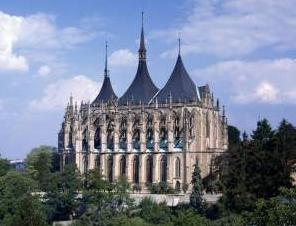
Silver built this town and death decorates its chapel. Kutná Hora once rivalled Prague in wealth and importance. The Sedlec Ossuary contains the bones of over forty thousand people arranged into chandeliers, coats of arms, and a giant bell. It is strange and solemn and unforgettable. Beyond the bone chapel, the town offers the Gothic St Barbara’s Cathedral, whose spires rise above the rooftops like something from a medieval manuscript. The Italian Court once minted the kingdom’s coins. Walking the cobbled streets today, you feel the weight of centuries pressing gently against your shoulders.
Kutna Hora is a historic town in the Czech Republic, located in the Central Region, east of Prague. Town of Kutna Hora was founded in the late 13th century by German miners who began to mine for silver in the mountain region. Since 1300, the local mint began with manufacturing well-known Czech penny. Today Kutna Hora is a great set of medieval and baroque architecture, with more than 300 protected buildings and monuments.
The most important monument in the town of Kutna Hora is undoubtedly a monumental and unique late Gothic church of St. Barbara, patron saint of miners. Another important object is Italian Court (Vlašský dvůr) from 14 century, which served as a mint. Other tourist attractions include the Church of St. James (Kostel sv. Jakuba) from 1330, Cathedral of Our Lady (Chrám Nanebevzetí Pany Marie) on the square, Hradek (Czech Museum of Silver), Gothic fortification, the baroque Jesuit College, a stone house, a Gothic fountain and Church of Ursuline Convent (Kostel Kláštera Voršilek). In the Sedlec suburb there is a former Cistercian monastery, founded in 1142.
historic Centre of Kutna Hora was together with Sedlec added into the UNESCO World heritage List in 1995 . There is a wide range of accommodation, restaurants, shops and clubs. You can visit the underground city of Kutna Hora, where the silver was mined in the Middle Ages and is now available to the public. Kutna Hora has now more than 21 thousand inhabitants.
View Kutná Hora – historic town in Czech Republic in a larger map
The Sedlec Ossuary
Just a fifteen-minute walk from Kutná Hora’s historic centre lies one of the most extraordinary chapels in Europe. The Sedlec Ossuary, sometimes called the Bone Church, contains the skeletal remains of between 40,000 and 70,000 people, arranged into chandeliers, crosses, coats of arms, and even a massive Schwarzenberg family crest. The story begins in 1278, when the abbot of the Sedlec monastery brought back a handful of soil from Golgotha in Jerusalem and scattered it over the cemetery. The cemetery became a desired burial site throughout Central Europe, and when plague and the Hussite Wars swelled the dead, the chapel had to accommodate the bones.
In 1870, a woodcarver named František Rint was hired to arrange the accumulated bones into something orderly. The result is both macabre and beautiful. A giant chandelier made from every major human bone hangs from the centre of the chapel. Skulls with bullet holes from the Hussite Wars sit beside the delicate vertebrae of children. Rint signed his work in bones near the entrance. The ossuary can be visited daily for a small fee, and photography is permitted without flash. It is a sobering but unforgettable experience that grounds Kutná Hora’s wealth in the very human cost of the medieval world.
The Medieval Underground and Practical Tips
Beneath the streets of Kutná Hora lies a hidden world of medieval silver mines. The Czech Museum of Silver offers guided tours of the medieval mine shafts, known as the Hrádek mining complex. You descend into narrow, dimly lit tunnels that were hacked out of the rock by hand in the 14th century. The tour includes a demonstration of medieval mining techniques, including the use of fire to crack the rock face and the wooden drainage wheels that kept the shafts from flooding. Visitors wear miners’ aprons and helmets with lamps, and the tunnels reach around 10 degrees Celsius even in summer. Advance booking is recommended during July and August.
For practical tips, begin your visit at the Italian Court to understand the minting process, then walk up to St Barbara’s Cathedral before visiting Sedlec Ossuary. The walk between these three main sights takes about 15 minutes each way and passes the beautifully preserved Gothic and Baroque houses that earned the town its UNESCO listing. Public parking is available at several lots on the edge of the historic centre, as the old town streets are pedestrian-only. Local restaurants serve traditional Czech dishes, and the town makes an easy day trip from Prague with regular trains taking just under an hour.
Could you handle a visit to the bone chapel or is that too macabre for you? 💀
Explore all our Czech Republic travel guides, from Prague spires to Moravian wine country.
Explore More
If you enjoyed this article, you might also like:
- Orlické hory – a mountain ideal for skiing and hiking in the Czech Republic – Czech Republic
- Peklo (The Hell) – National Natural Monument in the Czech Republic – Czech Republic
- Museum of Music in Prague – popular museum in the Czech Republic – Czech Republic

What a wonderful article. Kutna Hora has been on my wish list for ages and this just moved it right to the top. The photos are stunning. How many days would you recommend for a first-time visitor?