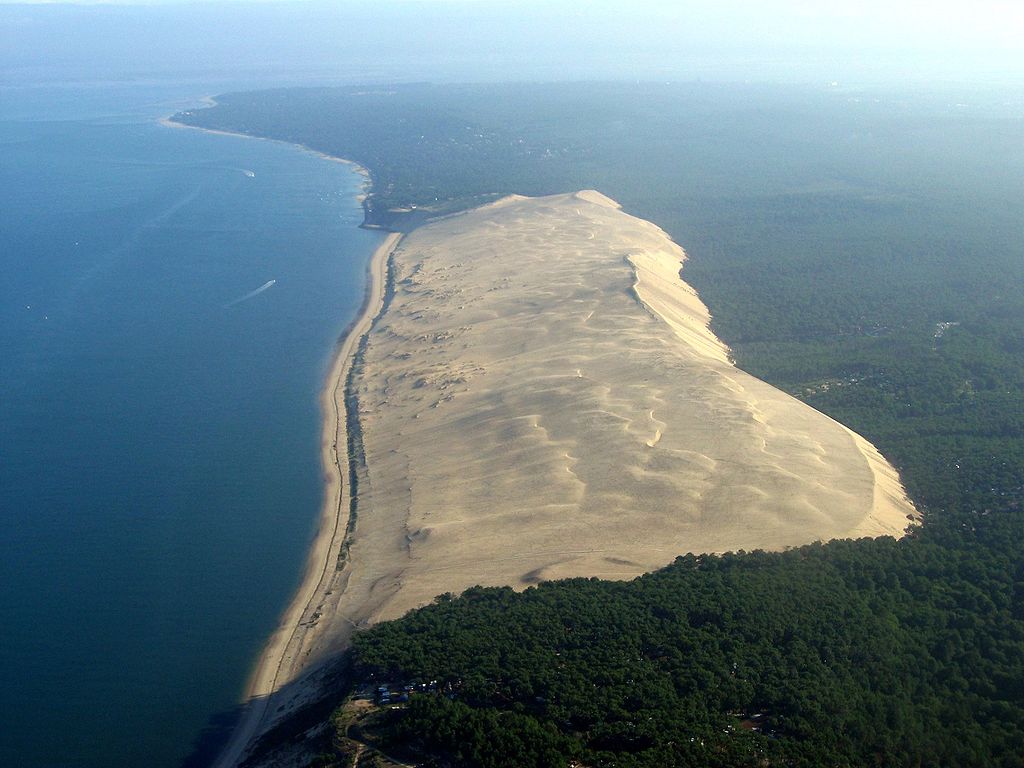
The Great Dune of Pilat (Dune du Pilat) is the largest sand dune in Europe, a colossal mountain of golden sand 110 metres high, 2.7 kilometres long, and 500 metres wide on the Atlantic coast of southwestern France, wedged improbably between the vast Landes pine forest and the Arcachon Bay. Climbing Pilat is one of the most memorable experiences on the French Atlantic coast: the summit reveals a breathtaking panorama of the Atlantic Ocean on one side, the emerald waters of the Bassin d’Arcachon on the other, and the seemingly endless Landes forest stretching to the horizon, and the sand beneath your feet is constantly moving, the dune advancing inland at a rate of 1-5 metres per year, slowly consuming the forest.
In This Article
Quick Facts: Dune of Pilat, France
- Best time to visit: Spring and autumn for comfortable climbing temperatures; summer is busy but offers the best weather; sunset from the dune is spectacular
- height: 110 metres (the height varies slightly year to year as the dune shifts)
- How to get there: ~1 hour from Bordeaux by car (A63 + D259); accessible by bus from Arcachon (~30 min)
- Entry fee: Free access; paid parking in high season (~EUR4-6)
- Pro tip: The staircase (160 steps) makes the ascent easier and is installed seasonally (spring to autumn); without it, it’s a thigh-burning climb through deep sand, good fun but bring water
Great Dune of Pyla is the largest sand dune in Europe. It is located in western France, on the Atlantic coast in La Teste-de-Buch, Aquitaine (one of the 27 regions of France). Dune du Pyla is 2.7 kilometres long, 500 metres wide and up to 108 m high.
How the Dune Was Formed and Continues to Grow
Over the last hundred years, the Dune du Pyla increased at double. At present it consists of 60 million cubic meters of the finest sand with high content of essential oils that resist chemical degradation. until now no one is able to explain how the Dune du Pyla originated centuries ago and why it is still growing. In 1960, the first measurement was performed and found that the dune increases annually by about 5 meters. It already absorbed several paths and buildings.
The formation of the dune is a result of powerful natural forces working together over thousands of years. Prevailing westerly winds from the Atlantic Ocean carry sand from the wide beach at low tide and deposit it inland. The Landes forest acts as a natural barrier, trapping the sand and allowing it to accumulate into the massive dune we see today. The process is continuous and dynamic, with the dune slowly marching eastward at a rate of one to five metres each year. This movement has already swallowed parts of the adjacent forest, and some roads and buildings have had to be relocated as the dune advances. Scientists monitor the dune closely, fascinated by this ever-changing landscape that defies easy explanation.
Activities on the Dune
While climbing to the top of the dune is the most popular activity, there is much more to do at this remarkable natural landmark. Paragliding is particularly popular here, as the combination of strong coastal winds, the height of the dune, and the soft landing area on the beach below creates ideal conditions for both beginners and experienced pilots. On any given day, especially during summer weekends, you can see colourful paragliders soaring above the dune like birds riding the thermals. Several local schools offer tandem flights and lessons for those who want to try this exhilarating sport.
For those who prefer to keep their feet on the ground, the beach at the base of the dune offers excellent swimming and sunbathing, though swimmers should be cautious of strong currents in the Atlantic. The Bassin d’Arcachon side is much calmer and perfect for kayaking, paddleboarding, and boat trips. The area around the dune also features several marked hiking and cycling trails that wind through the Landes forest, offering a different perspective on this unique coastal environment. Birdwatchers will find plenty to see, as the dune and its surrounding habitats attract a variety of coastal and woodland birds throughout the year.
Planning Your Visit to the Dune du Pilat
The Great Dune of Pilat can be found about 60 km from Bordeaux. The site offers parking facilities and a small visitor centre with information about the dune’s geology and ecology. During the summer months, the site can become extremely busy, so arriving early in the morning or later in the evening is recommended. Sunset is arguably the most magical time to be on the dune, as the golden light transforms the sand into a warm orange glow and the views across the bay become truly spectacular. The staircase with 160 steps makes the ascent easier and is installed seasonally from spring to autumn.
At its peak you can get after 160 steep stairs. The Dune du Pilat is also suitable especially for paragliding lovers since the conditions for this sport are ideal here. However swimming is not recommended due to lower currents.
Have you climbed Europe’s highest sand dune or explored France’s Atlantic coast? Share your Dune of Pilat experiences in the comments! 🏜️
Explore all our France travel guides, from Parisian boulevards to Provence lavender.
Explore More
If you enjoyed this article, you might also like:

The Dune du Pilat is absolutely massive — much bigger than photos convey. Climbing to the top is a workout in the sand but the view from the summit is worth every step. You see the forest on one side and the Atlantic on the other. We went at sunset and watched paragliders launch from the top. The nearby oyster huts in Arcachon serve the freshest seafood I have ever eaten.