The Needles – very impressive columns of chalk on the Isle of Wight, United Kingdom
Updated June 10, 2026 by europeexplored
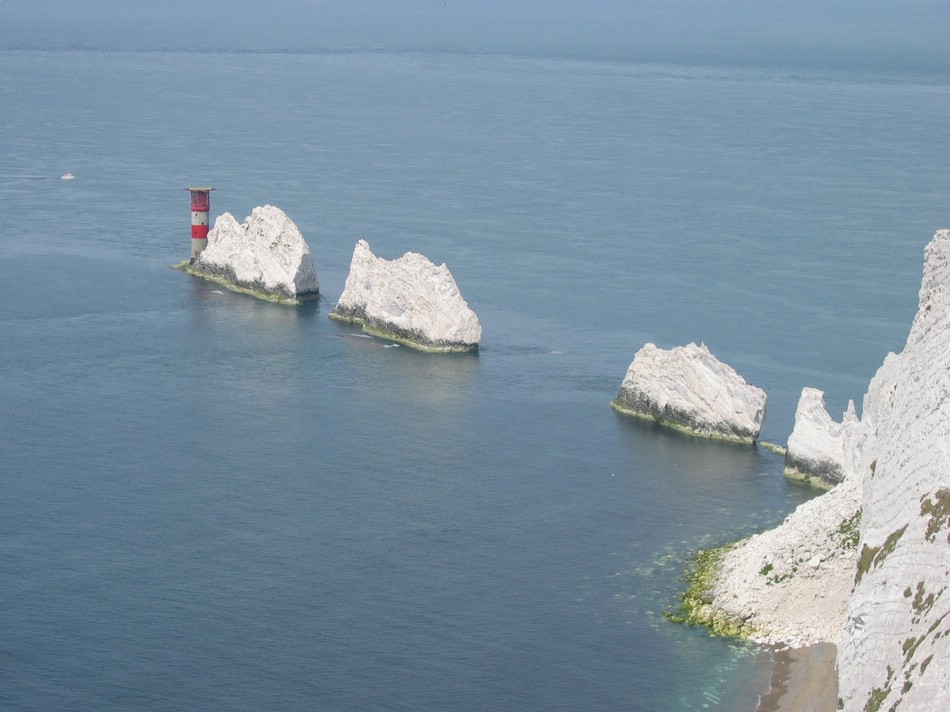
The Needles pierce the horizon off the western tip of the Isle of Wight, three white chalk stacks rising from a churning sea. A fourth pillar collapsed in a storm in 1764, leaving behind the jagged formation that gives this landmark its name. The Alum Bay cliffs behind them stripe the coastline in shades of white, red, yellow, and brown, layers of sand and clay deposited over sixty million years. A chairlift carries visitors down to the beach where coloured sand fills glass souvenirs sold in the gift shop. The Needles Battery, a Victorian fort perched on the headland, houses a rocket testing site from the Cold War era.
\n\n
The Needles pierce the horizon off the western tip of the Isle of Wight, three white chalk stacks rising from a churning sea. A fourth pillar collapsed in a storm in 1764, leaving behind the jagged formation that gives this landmark its name. The Alum Bay cliffs behind them stripe the coastline in shades of white, red, yellow, and brown, layers of sand and clay deposited over sixty million years. A chairlift carries visitors down to the beach where coloured sand fills glass souvenirs sold in the gift shop. The Needles Battery, a Victorian fort perched on the headland, houses a rocket testing site from the Cold War era.
\n\n
Located along the western shores of the Isle of Wight, you will find the very impressive columns of chalk that can be seen rising up out of the sea. Known as The Needles, the three needle shaped pillars are a popular attraction in the area.
\n
The area where the Needles can be found is known as the Jurassic Coast. It is here that the land has been folded as a result of tectonics over the course of millions of years. As a result, the almost vertical strands of rocks can be seen throughout the region. Chalk is one of the more resilient rocks and as a result has continued to stand long after the clays and sandstones have washed away.
\n
\nThe Needles, Isle of Wight, UK by Peter Pearson
\n
It was known that back in the beginning of the eighteenth century, there were four needles in the formation. However, in 1764 a storm ravished the area and knocked over one of the rocks. The name the Needles dates back hundreds of years. Today though, the rocks have lost their needle-like appearance as a result of erosion by the waves.
\n
Another popular attraction in the area is the Needles Lighthouse which was built back in 1859. It has been operational ever since. However, in order to reduce costs and manpower, the lighthouse was automated back in 1994.
\n
There is also an amusement park that can be found on a nearby cliff that over looks the geological land formation. Known as the Needles Pleasure Park, it has grown to become a very popular destination in the area. The park is most well known for the chairlift that takes people to Alum Bay and back.
\n
The headlands that overlook the Needles are home to several gun batteries as well as an experimental testing facility for rockets. While the batteries were in use during the 1950s and 60s, they have long since been decommissioned. The rocket test facility is located mostly underground and was operated by as many as 240 people during the 1960s. Part of the underground facilities have been completely restored and are currently open to the public.
\n
There are a number of old Coastguard cottages that can be found in the area. Now under National Trust, the cottages are available for rental throughout the year. People who wish to have a party in the area, or that would like to visit and stay can rent the Coastguard cottages.
\n
Most of the park and surrounding countryside can be travelled using bicycle or on foot. However, when there is a high wind warning in the area, the site where the batteries are located is closed for safety reasons.\n
\n
Would you ride a chairlift down the coloured cliffs of Alum Bay for a closer look at the Needles?
\n
Looking for more British travel inspiration?
\n\n
\n
The Needles are composed of the same Cretaceous chalk that forms Old Harry Rocks on the Dorset coast, confirming that the Isle of Wight was once physically connected to the mainland. The chalk layer here is approximately 400 metres thick, though only the uppermost portion is visible above the waterline. The unique alignment of the Needles runs roughly east to west, following the strike of the underlying rock strata that were folded during the Alpine orogeny around 30 million years ago. This folding created the Isle of Wight monocline, a sharp bend in the rock layers that brings older Cretaceous rocks to the surface at a steep angle. The relentless action of waves, wind, and frost has exploited weaknesses in the chalk, gradually separating the stacks from the main cliff face. Erosion proceeds at an average rate of approximately one metre per century, meaning the remaining stacks will eventually collapse into the sea, just as their fourth companion did in 1764. The most famous stack, known as the Needle, stands 30 metres tall and is topped by a navigation beacon that guides ships through the western approaches to the Solent. The chalk here is harder than at other locations due to a higher concentration of flint nodules, which explains why the stacks have survived longer than might otherwise be expected.
\n
The Needles Battery and Rocket Testing History
\n
The Old Needles Battery, built between 1861 and 1863, was constructed as part of a chain of coastal defences designed to protect Portsmouth Harbour from French naval attack. The granite and concrete fortification is dug into the cliff top and originally housed four 12-ton rifled muzzle-loading guns with a range of over 3 kilometres. Guided tours of the battery take visitors through the underground magazines, the plotting room, and the gun emplacements, providing insight into Victorian military engineering. A narrow-gauge railway once transported ammunition along the clifftop. The more remarkable chapter in the Needles history began in 1956 when the site was repurposed for rocket testing. The High Altitude Research Programme used the battery to test Black Knight and Black Arrow rockets, Britain independent space launch vehicles. The test stand, launch control room, and remnants of the rocket motors are preserved and form part of the exhibition. Visitors can see the actual Black Arrow R3 rocket, which stands 13 metres tall and was one of the rockets developed here. The testing programme ended in 1971, and the site was transferred to the National Trust in 1975. Combined entry to both the Old and New Batteries costs approximately 14 pounds as of 2026.
\n
Alum Bay and the Coloured Sand Cliffs
\n
Alum Bay is famous for its multicoloured cliff faces, which display 21 distinct bands of sand and clay in shades ranging from pure white to deep crimson. The colours result from different mineral compositions in the sedimentary layers deposited during the Eocene epoch, approximately 50 million years ago. The red bands contain iron oxide, the yellow bands contain limonite, and the white bands are almost pure silica sand. The cliffs reach a height of 90 metres and are protected from public access due to their instability, though the colours are clearly visible from the beach and the chairlift. The Alum Bay chairlift, operating since 1969, carries visitors on a 240-metre ride down the cliff face to the beach below, offering unparalleled views of the coloured strata and the Needles beyond. Return tickets cost approximately 7 pounds. At the beach, visitors can purchase glass ornaments filled with layered coloured sand, a souvenir tradition that dates back to the Victorian era when holidaymakers collected sand samples in bottles. The sand is collected from fallen material at the base of the cliffs rather than excavated directly from the face, ensuring the geological feature remains undisturbed.
\n\n
Would you ride a chairlift down the coloured cliffs of Alum Bay for a closer look at the Needles?
\n
Explore all our United Kingdom travel guides, from London landmarks to the Scottish Highlands.
Explore More
If you enjoyed this article, you might also like:
