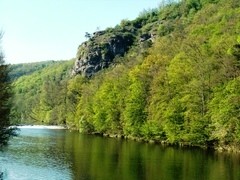
Thayatal National Park is one of Austria’s most beautiful but least-known protected areas, a dramatic 13-kilometre-long valley on the Czech border where the Thaya River has carved a deep, meandering canyon through ancient metamorphic rock, creating a richly forested landscape that is home to wildcats, black storks, and over 40 species of orchid. Together with the adjacent Podyjí National Park on the Czech side, Thayatal forms one of Europe’s most important transboundary protected areas, one of the last great wilderness valleys in Central Europe.
In This Article
Quick Facts: Thayatal National Park
- Best time to visit: May-September for hiking; spring for orchid blooms; autumn for spectacular colours along the river valley
- How to get there: ~1.5 hours from Vienna by car; the park entrance is near the town of Hardegg (Austria’s smallest town, with a picturesque castle); ~15 minutes from the Czech town of Vranov nad Dyjí
- Combine with: Podyjí National Park on the Czech side, you can walk between the two countries within the park
Flora and Fauna of Thayatal National Park
The Thayatal valley is a biodiversity hotspot of extraordinary richness, thanks to its varied geology, microclimates, and the protection afforded by its steep, inaccessible slopes. More than 1,300 species of vascular plants have been recorded in the park, representing nearly half of all plant species native to Austria. The warm, south-facing slopes support a Mediterranean-like community of plants found nowhere else in the country, including the Austrian dragonhead and the rare feather grass. In spring, the valley floor is carpeted with wild garlic, liverwort, and wood anemones, while the higher slopes bloom with orchids: over 40 species have been recorded, including the rare lady’s slipper orchid and the military orchid. The park’s position at the transition between the Atlantic and continental climate zones creates a unique mix of Central European and Pannonian flora.
The fauna of Thayatal is equally remarkable. European wildcat, once extinct in Austria, has successfully recolonised the park from the Czech side and is now a stable breeding population. The black stork, one of Europe’s rarest birds, nests in the tallest trees of the old-growth forest along the river, and visitors may spot it soaring above the valley on warm summer days. Other notable species include the Eurasian otter, the fire salamander, and over 40 species of dragonfly. The park’s cliffs provide nesting sites for peregrine falcons and eagle owls, while the river itself supports populations of brown trout and the endangered Danube salmon. The best time for wildlife watching is early morning or late evening, when the forest comes alive with the calls of birds and the rustling of mammals moving through the undergrowth.
Hiking and Exploring the Thaya Valley
The park offers over 60 kilometres of marked hiking trails, ranging from easy riverside walks to challenging ascents of the valley’s steepest slopes. The most popular route is the Thayatal Rundwanderweg, a 12-kilometre loop that follows the river on one side and returns along the cliff tops on the other, offering dramatic views of the canyon from above. The trail passes the ruins of Kaja Castle, a 13th-century fortress perched on a granite outcrop, and continues through the old-growth forest where the canopy is so dense that little sunlight reaches the forest floor. Several shorter trails branch off the main loop, including the Adlerweg (Eagle Trail), which leads to a viewing platform overlooking the most spectacular meander of the Thaya River.
For those who prefer cycling, the Thaya Valley Cycle Path runs for 100 kilometres from Raabs an der Thaya to Znojmo in the Czech Republic, passing through the park and offering an easy, mostly flat route along the river. Mountain bikers can tackle the steeper trails on the valley slopes. The park’s visitor centre in Hardegg provides trail maps, information on guided tours, and a small exhibition on the park’s natural history. After a day of hiking, visitors can relax at the Hotel Thayatal in Hardegg or cross into the Czech Republic to explore the historic town of Znojmo, known for its well-preserved Gothic and Renaissance architecture and its excellent Moravian wines. The combination of wild nature, medieval castles, and cross-border exploration makes Thayatal one of Austria’s most rewarding and least crowded national parks.
View National Park Thayatal in Austria in a larger map
Have you hiked Thayatal or discovered Austria’s hidden river canyon? Share your transboundary nature experiences in the comments! 🌿
Explore all our Austria travel guides, from Vienna coffeehouses to Alpine peaks.
Explore More
If you enjoyed this article, you might also like:

I have been recommending Thayatal National Park to everyone since I got back. It is one of those rare places that somehow exceeds the photos and the hype. Your article sums up exactly why it is so special. Thoroughly enjoyed the read.