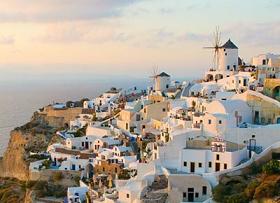
Oia (pronounced “EE-ah”) is the most photographed village in Greece, the iconic cascade of whitewashed Cycladic houses, blue-domed churches, and pastel-coloured neoclassical captains’ mansions clinging to the northern cliffs of Santorini that produces the single most recognisable image of the Greek islands, reproduced on a million postcards, Instagram feeds, and travel magazine covers. Perched on the rim of the massive volcanic caldera that is Santorini’s defining geological feature, Oia is famous for its sunsets, widely claimed to be the most beautiful in the world, when thousands of visitors gather along the cliff-edge terraces, the old Venetian castle ruins, and the narrow marble-paved pathways to watch the sun sink into the Aegean Sea, painting the white village in shades of gold, pink, and violet.
In This Article
Quick Facts: Oia, Santorini, Greece
- Best time to visit: Late April to June and September to early October for warm weather with manageable crowds; July to August is peak season, extremely crowded (cruise ships can deposit up to 10,000 day-trippers on Santorini per day in summer), very hot, and accommodation is at its most expensive; sunset at Oia is crowded year-round but more manageable outside July to August; winter (November to March) sees many hotels and restaurants close but offers a uniquely peaceful Santorini experience
- How to get there: Fly to Santorini (Thira) Airport (JTR) from Athens (~45 min) or direct from many European cities in summer; or ferry from Athens Piraeus (5 to 8 hours, high-speed 4 to 5 hours); from the port or airport, Oia is ~30 minutes by taxi or bus from the capital, Fira
- Top experiences: Sunset from the Oia Castle (Byzantine Castle Ruins), arrive 1 to 2 hours before sunset to claim a spot; the blue-domed churches of Agios Spyridonas and Anastasi (the classic Oia photo); the Oia to Fira hiking trail along the caldera rim (~10km, 3 to 4 hours, one of the most scenic coastal walks in Greece); Ammoudi Bay, the tiny fishing port 300 steps below Oia with waterfront tavernas serving the freshest seafood on Santorini
- Accommodation reality: Oia is one of the most expensive places to stay in Greece. A caldera-view cave suite with a private plunge pool can cost \u20ac500 to 2,000+ per night in high season. Budget-conscious travellers should consider staying in Fira, Firostefani, or Imerovigli (also caldera-view but generally lower prices) and making a day trip to Oia for the sunset. Book months in advance for the best options
- Best for: Honeymooners, romantics, photographers, luxury travellers, and anyone who has dreamed of seeing the most beautiful sunset on Earth
Oia’s Most Photographed Spots and When to Shoot Them
The famous blue-domed view, a cluster of three white churches with cobalt domes overlooking the caldera, is located near the central square of Oia, just below the main marble pedestrian street. The best light is in the late afternoon when the sinking sun illuminates the domes and the whitewashed walls. This spot is not secret, expect a queue of tripods and selfie sticks at peak times. For a less crowded alternative, try the smaller blue-domed church on the path towards the castle, or the beautiful staircase views along the Nikolaou Nomikou pedestrian street.
The sunset at Oia Castle: The ruins of the Venetian castle (Kastro) at the northwestern tip of Oia are the epicentre of the sunset ritual. The terrace fills up with people from late afternoon in summer. An alternative, more comfortable approach: book a table at a caldera-view restaurant (Sunsets, Kastro, or Ambrosia) for dinner and watch the sunset with a glass of Assyrtiko wine, infinitely more civilised, but book days or weeks ahead.
Navigating the Crowds: When and Where to Go
Santorini is struggling with overtourism. In peak season, the narrow streets of Oia are packed, the sunset spots are mobbed, and the cruise ship influx can make the experience feel more like a theme park than a romantic Greek island. The best advice: stay overnight in Oia. The crowds evaporate after the sunset buses depart around 9pm, and early morning (before 9am) offers a peaceful, near-empty village that reveals the magic that drew visitors in the first place. The difference between Oia at 7pm and Oia at 7am is the difference between a tourist trap and paradise.
For the best experience, plan your visit for the shoulder seasons of May, June, or September, when the weather is still warm but the crowds are a fraction of July and August. If you must visit in high season, consider a sunset boat cruise around the caldera to see the sunset from the water, away from the packed castle terrace.
Exploring Beyond the Sunset: Oia’s hidden Corners
Oia is connected to Fira by a paved path that is about 10 km long. Just as in the main city, you will find typical small Greek houses built on rock here as well. Former residents of the town of Oia created here the fishing town, which gradually turned into a rich prosperous town. At that time the village was decorated with non-traditional buildings, which are still there.
The dominant of Oia is the church of Aghia Sazontos, which was built before the year 1680.
In 1956, Oia was affected by the devastating earthquake, and after extensive renovation, this area is among the favorite places.
View Oia village – best of Santorini island in Greece in a larger map
Have you watched the sunset from Oia or discovered Santorini’s caldera villages? Share your Santorini sunset moments, and your tips for finding quiet corners in the crowds, in the comments! \uD83C\uDF05
Explore all our Greece travel guides, from ancient ruins to Aegean beaches.
Explore More
If you enjoyed this article, you might also like:

Oia in Santorini is as beautiful as every Instagram post suggests, but the crowds are intense. We went at sunset and could barely move on the main walkway. The trick is to stay overnight — once the day-trippers leave on the last ferry, the village transforms. Watching the sunset from our hotel terrace in peace was worth every penny.