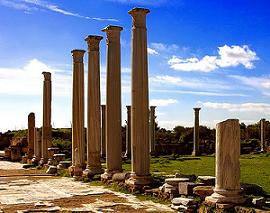
Salamis is the most important archaeological site in Cyprus, a vast ancient city on the island’s eastern coast near Famagusta that served as the capital of Cyprus for over a thousand years, from the late Bronze Age through the Roman and Byzantine periods. Today, Salamis is a hauntingly beautiful expanse of ruins stretching along the Mediterranean shoreline: a magnificent Roman gymnasium with marble columns, a 15,000-seat theatre, extensive baths and mosaics, and the remains of a once-great harbour that was the commercial and political heart of ancient Cyprus.
Quick Facts: Salamis, Cyprus
- Best time to visit: March–May and October–November for pleasant temperatures; summer (June–September) is very hot, visit early morning and bring water and sun protection
- Top attraction: The Gymnasium and the Theatre, both among the finest Roman monuments in the eastern Mediterranean
- How to get there: Located in Northern Cyprus, ~10km north of Famagusta (Gazimağusa); ~1 hour from Nicosia by car; accessible by taxi or organised tour from Famagusta
- Entry fee: Small fee (try ~€3–5)
- Practical note: Salamis is in the Turkish Republic of Northern Cyprus (recognised only by Turkey), access is straightforward from the south via pedestrian checkpoints in Nicosia (bring your passport)
The Roman Gymnasium and Theatre
The Roman Gymnasium is the undisputed highlight of Salamis. This vast complex, rebuilt after earthquakes in the 4th century AD, features a magnificent colonnaded palaestra (exercise courtyard) surrounded by 64 marble columns, many of which have been re-erected to their full height. The columns are topped with ornate Corinthian capitals, and fragments of statues and inscriptions lie scattered around the base, giving the site a tangible sense of Roman grandeur. Adjoining the gymnasium are the Roman baths, where you can still trace the layout of the frigidarium (cold room), tepidarium (warm room), and caldarium (hot room), complete with fragments of original mosaic flooring. Just a short walk away, the great theatre of Salamis once seated 15,000 spectators and remains impressively intact. Carved partly into the natural hillside, its cavea (seating area) offers superb views across the archaeological site to the Mediterranean Sea beyond. The theatre was used for dramatic performances and gladiatorial contests, and its excellent acoustics mean it still hosts cultural events today.
Beyond the Main Ruins
While the gymnasium and theatre draw the most attention, Salamis is a vast site that rewards those who venture further afield. The Roman baths complex includes a large public latrine with marble seating for dozens of users, a fascinating glimpse into the communal life of the ancient city. The remains of the harbour area, now sitting some distance from the modern coastline due to centuries of silting, show the extent of Salamis as a major trading port. The site also contains a well-preserved early Christian basilica with intact mosaic floors depicting geometric patterns and animal motifs, evidence of the city’s transition from pagan to Christian rule. Much of Salamis remains unexcavated, with low forested hills of mimosa, pine, and eucalyptus covering the buried quarters. This gives the site an atmosphere of mystery and discovery, as new finds continue to emerge with each archaeological season. For the best experience, allow at least two to three hours to explore the full extent of the ruins, and bring a hat and plenty of water, especially in the summer months when the exposed site offers little shade.
Founded in the 11th century BC, Salamis was the principal city of ancient Cyprus and the seat of the legendary King Teucer (a hero of the Trojan War). It reached its zenith during the Roman period, when the gymnasium, theatre, and baths were built on a monumental scale. The city was devastated by earthquakes in the 4th century AD and was gradually abandoned as the harbour silted up, with much of the population moving to what became Famagusta.
Salamis was the capital of Cyprus in the 11th century BC. It is situated on the east coast of Northern Cyprus, at the mouth of the river Pedieos, 6 km north of modern Famagusta.
There is still a large area awaiting excavation and this is forested with mimosa, pine and eucalyptus trees.
The archaeological site is the most spectacular in the island because the ruins are very extensive and are in a wonderful state of preservation. For more than a 1000 years, the Ancient Salamis lay buried in sands which saved the site from wanton destruction in the Middle Ages. It must be remembered that all the ancient ruins in Europe were -free for all- quarries for the builders of the medieval castles. It was not until the late 19th century that various governments formed departments of antiquities which began keeping a watchful eye on ruins. In a similar way, Pompeii lay buried in volcanic ash, and was also saved from vandalism. As Pompeii is to Italy, so is Salamis to Cyprus.
View Salamis – Ancient Roman City in Cyprus in a larger map
Have you explored the ruins of Salamis or discovered Cyprus’s ancient heritage? Share your Cypriot archaeological adventures in the comments! 🏛️
Explore all our Cyprus travel guides, from Aphrodite birthplace to the divided capital.
Explore More
If you enjoyed this article, you might also like:
