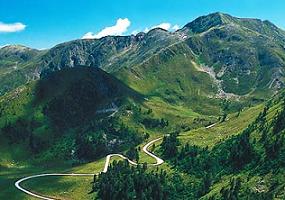
Nockberge National Park is one of Austria’s most distinctive protected areas, a UNESCO Biosphere Reserve in the state of Carinthia whose gently rounded, grass-covered mountains (the “Nocke”) create a landscape unlike anywhere else in the Alps: vast rolling alpine pastures dotted with traditional wooden huts, rare wildflowers, and spectacular panoramic roads that have earned the region the nickname “Austria’s Tuscany.” Part of the larger Gurktal Alps, the Nockberge offer a gentle, accessible alpine experience compared to the jagged peaks of the High Tauern National Park to the west, perfect for family hiking, scenic driving, and wellness in the nearby thermal spa town of Bad Kleinkirchheim.
In This Article
Quick Facts: Nockberge National Park
- Best time to visit: June–September for hiking and the spectacular wildflower bloom on the alpine pastures; late June–early July for the peak of the flowering season; autumn for golden larch forests; winter for skiing at Bad Kleinkirchheim and the Turracher Höhe
- Top attraction: The Nockalm Road (Nockalmstraße), a 35km toll road winding through the park’s most scenic sections with numerous viewpoints, hiking trailheads, and mountain restaurants
- How to get there: ~1 hour from Klagenfurt Airport (KLU); ~2 hours from Salzburg; the main access points are Bad Kleinkirchheim and Innerkrems
- Entry fee: Nockalm Road toll ~€22 per car (2024 prices); hiking trails within the park are free
- UNESCO status: Designated a UNESCO Biosphere Reserve in 2012, one of only a handful of biosphere reserves in Austria
- Best for: Scenic driving, family-friendly hiking, wildflower enthusiasts, and those seeking a gentler Alpine experience
Hiking the Gentle Mountains of the Nockberge
The Nockberge Mountains offer some of the most accessible and rewarding hiking in the Austrian Alps. Unlike the steep, rocky ascents of the High Tauern or the Dolomites, the rounded summits of the Nockberge provide gentle gradients that suit walkers of all fitness levels. The park features over 200 kilometres of marked hiking trails, ranging from short nature walks to full-day traverses across the alpine pastures. One of the most popular routes is the circuit around the Falkertsee, a crystal-clear mountain lake surrounded by wildflower meadows, where you can spot marmots whistling from their rocky lookout points and chamois grazing on the higher slopes. For a shorter option, the Heiligenbach Waterfall Trail leads through shady woodland to a series of cascading falls, perfect for a family afternoon outing. During late June and early July, the alpine pastures explode into colour as countless wildflowers bloom, including rare orchids, gentians, and the striking Austrian leopard’s-bane.
Exploring the Nockalm Road
The Nockalm Road is one of Austria’s most spectacular scenic drives and the best way to experience the park’s vast landscapes from the comfort of your car. Running 35 kilometres from Innerkrems to Bad Kleinkirchheim, this well-maintained toll road climbs to over 2,000 metres above sea level, offering panoramic viewpoints at every turn. Along the way, you will find numerous pull-off points where you can stop for photographs, enjoy a picnic, or start a short hike into the backcountry. The road passes several traditional alpine huts (Almen) where you can sample local Carinthian specialities such as Kasnudeln (cheese-filled pasta pockets) and fresh buttermilk while taking in the sweeping views. The highest point on the road, the Eisentalhöhe at 2,044 metres, provides a breathtaking panorama of the entire Nockberge massif and, on clear days, all the way to the distant peaks of the Dolomites in Italy. The road is typically open from late May to late October, depending on snow conditions.
The Nockberge National Park is one of the seven Austria’s national parks. The park was established in 1987 and it is European only high mountain national park. On the area of approx. 20ha the park offers great gentle, rounded mountain tops, alpine pastures and woodland. The particular beauty of this natural preserve makes hiking in the Nockberge mountains a wonderful adventure.
The distinctive shape of the gently rolling Nockberge Mountains is rare in the history of geology and unique in the Alps. The mountains developed hundred million years ago thanks to an interchange of lands, seas, desserts and jungles.
The name “Nocke” comes from the round shape of the softly rolling mountains and hills between 2,200m and 2,300m above sea level.
You can visit the following destinations that are close to this park:
Lake Bled – 67 km, the Julian Alps – 60 km, Triglav – 59 km, Ravines Vintgar – 64 km, Klopeiner See – 74 km, glacier Mölltal – 56 km, Wörther See – 46 km, Liechtenstein – 59 km, Waterfall Pericnik – 54 km, Kitzlochklamm – 70 km
View Nockberge National Park in Austria in a larger map
Have you driven the Nockalm Road or hiked the gentle mountains of Carinthia? Share your Nockberge and Austrian Alpine experiences in the comments! 🏔️
Explore all our Austria travel guides, from Vienna coffeehouses to Alpine peaks.
Explore More
If you enjoyed this article, you might also like:
- Best European skiing destinations – Austria
- An enjoyable winter vacation in Austria – Austria
- Sole-Felsen-Bad – Thermal Water Park in Austria – Austria
