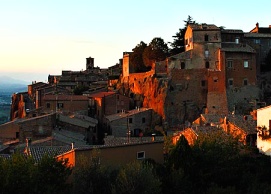
Orvieto is one of the most spectacular hill towns in Italy, a volcanic tufa plateau rising almost vertically from the Umbrian plain whose crown jewel is the Duomo di Orvieto, one of the greatest Gothic cathedrals in Italy, with a glittering facade of gold mosaics, carved biblical scenes, and rose windows that the art historian John Ruskin described as “the most beautiful piece of coloured religious architecture in existence.” Below the city, a labyrinth of 1,200 Etruscan-era caves and tunnels honeycombs the volcanic rock, the Orvieto Underground, while above ground, Orvieto offers some of the finest white wine (Orvieto Classico) and most spectacular views in Umbria.
In This Article
Quick Facts: Orvieto, Italy
- Best time to visit: Year-round; spring and autumn for the most pleasant temperatures; avoid July-August weekends when the town is busy with Italian day-trippers; December for the Umbrian Jazz Winter festival held in Orvieto’s medieval halls
- How to get there: ~1.5 hours from Rome by car (A1 motorway); ~1.5 hours by train from Rome Termini to Orvieto station + funicular up to the city
- Top attractions: The Duomo (signature piece: Luca Signorelli’s fresco cycle of the Last Judgement in the San Brizio Chapel, the work that inspired Michelangelo’s Sistine Chapel), St. Patrick’s Well (Pozzo di San Patrizio, a 16th-century double-helix staircase well, 62 metres deep), and the Orvieto Underground cave tour
- Don’t miss: A glass of Orvieto Classico wine at one of the enotecas on the Corso Cavour watching the sunset over the Umbrian hills
The Duomo: A Masterpiece of Italian Gothic
City of Orvieto is located at west part of the central Italian region of Umbria. It lies on the volcanic rock. Orvieto was founded by the Etruscans, and it used to be a very important economic center. Today it is an important tourism center.
The Duomo di Orvieto was begun in 1290 by Pope Nicholas IV as a grand statement of faith and civic pride. The structure’s stunning facade, attributed to Lorenzo Maitani, is a symphony of golden mosaics, sculpted bronze doors, and intricate bas-reliefs depicting scenes from the Old and New Testaments. The mosaics shimmer brilliantly in the Umbrian sunlight, particularly during the late afternoon when the golden hour transforms the entire piazza into a glowing tableau. Inside, the cathedral’s crowning glory is the San Brizio Chapel, where Luca Signorelli painted his extraordinary fresco cycle of the Last Judgement between 1499 and 1504. Michelangelo studied Signorelli’s work before beginning the Sistine Chapel, and the influence is visible in the muscular figures and dramatic compositions of his own masterpiece.
Underground City, Traditions, and Local Flavours
The oldest monument in Orvieto from the Etruscan period are remnants of the temple Tempio del Belvedere. Impressive is also the Etruscan Necropolis located under the Orvieto rock. The most representative medieval sight is Duomo from the late 13 century. From modern monuments there is a well Pozzo di San Patrizio.
Beneath Orvieto’s medieval streets lies a hidden world that is every bit as fascinating as the city above. Over 1,200 caves, tunnels, cisterns, and chambers have been carved into the soft volcanic tufa rock over the course of 2,500 years. The Etruscans began the excavation, digging wells and storage chambers. The medieval inhabitants expanded the network, adding cellars, wine presses, dovecotes, and even an olive oil mill complete with original stone grinding wheels. During World War II, these caves served as air-raid shelters. Today, guided tours of Orvieto Underground take visitors through several levels of this subterranean labyrinth, revealing Etruscan staircases and medieval quarry tunnels.
In Orvieto local residents still maintain their traditions. Almost in every part of the year, there are held various cultural events and celebrations. Every year in mid-May, there is for example the Festa della Palombella – celebrations established by noble family already in the 15th century. There is also Palio dell’Oca – competition established by noble families. At the beginning of October you can attend celebrations Orvieto con gusto, where you can taste their typical products.
The famous products are olive oil and excellent wines, red, white or rose. Orvieto Classico, the town’s signature white wine, is made primarily from Grechetto, Trebbiano, and Verdello grapes cultivated on the volcanic slopes surrounding the plateau. The mineral-rich soil gives the wine a distinctive character with notes of citrus, white flowers, and almonds. Many of the medieval cellars that once stored grain and supplies now house atmospheric enotecas where visitors can taste local wines alongside pecorino cheese, cured meats, and the famous Umbrian black truffle.
View Orvieto – the city of artistic and architectural treasures and wine traditions in Italy in a larger map
Have you marvelled at Orvieto’s golden cathedral facade or tasted the local white wine? Share your Umbrian hill town experiences in the comments! 🍷
Explore all our Italy travel guides, from the Dolomites to Sicily.
Explore More
If you enjoyed this article, you might also like:
