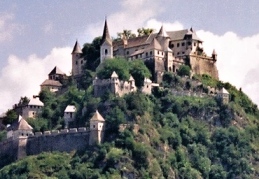
Hochosterwitz castle is one of the largest castles in Europe. It is located in Austria, about 8 km east of the town of Sankt Veit an der Glan, and 22 km northeast of the city of Klagenfurt. Hochosterwitz castle stands on a secluded hill on the edge of large forests. There is a very nice view of the landscape from the castle and you can see it even from about 30 km distance. The castle’s dramatic silhouette, rising 160 metres above the surrounding valley, has made it one of the most photographed landmarks in Carinthia.
Hochosterwitz castle is very old. It was first mentioned as early as the 860th. The castle was heavily damaged by frequent incursions of Turkish troops at the turn of the 16th and 17th century. In 1541 it was a site of of Emperor Ferdinand I. Later in 1571, it was bought by Baron George Khevenhuller. Since then the owners of the castle is still the Khevenhuller family. Under their rule in 1570-1586 the castle was extended to large fortification system, which was at that time quite unique in its scope.
In This Article
The Fourteen Gates and the Impregnable Defences
The access road is over 600 metres long and you have to pass through 14 gates. According to legend, Hochosterwitz Castle has never been conquered, and the fourteen defensive gates that line the winding approach road are the primary reason for this remarkable record. Each gate was designed as an independent defensive position, complete with its own drawbridge, portcullis, and murder holes through which defenders could rain arrows and boiling pitch onto attackers. The gates are staggered along the steep hillside in such a way that each one covers the approach to the next, creating a layered defence system that made a direct assault nearly impossible. The first gate, built in 1576, bears the Khevenhuller family crest and sets the tone for what lies ahead. As you climb higher, the gates become progressively more fortified, with the upper gates featuring thicker walls, narrower passages, and more sophisticated locking mechanisms. The final gate opens onto the castle courtyard, where the reward for the 600-metre climb is a breathtaking panorama of the Carinthian Alps and the surrounding countryside. The medieval chapel inside the castle features original wall paintings from the 16th century that have survived remarkably well, depicting scenes from the life of Christ and the saints in vivid colours that still retain their original vibrancy.
The Museum Collection and the Castle Well
Inside the castle, a carefully curated museum exhibition traces the history of the fortress and the Khevenhuller family through six centuries. The collection includes medieval armour and weapons, including suits of plate armour worn by the castle’s defenders, crossbows, halberds, and early firearms that demonstrate the evolution of military technology in Central Europe. A particularly impressive exhibit showcases Turkish weapons and artefacts captured during the Ottoman sieges, including ornate curved sabres, decorated shields, and banners that tell the story of the frontier conflicts that shaped this region. The museum also displays original documents and maps from the 16th-century fortification works, alongside portraits of the Khevenhuller family members who have owned the castle for over 450 years. The castle chapel contains a 13-metre-deep water tank carved directly into the rock beneath the fortress, ensuring a fresh water supply even during prolonged sieges. This cistern, together with the castle’s own food stores and bakery, made the fortress entirely self-sufficient and contributed to its undefeated status. The chapel itself is a masterpiece of Gothic architecture with a ribbed vault ceiling and an altarpiece dating from 1520.
Practical Information for Visiting Hochosterwitz
Hochosterwitz Castle is privately owned by the Khevenhuller family but it is open to the public in the period from Easter to October. The castle can be reached by car from Klagenfurt in about 25 minutes via the B83 highway, with ample free parking at the base of the hill. From the car park, visitors can either walk up the 600-metre access road through all fourteen gates, which takes about 20 to 30 minutes and offers the full medieval experience, or take the shuttle bus that runs regularly during opening hours for a small additional fee. The shuttle is particularly recommended for visitors with mobility issues or those travelling with young children, as the climb is steep. Inside the castle, the museum, chapel, and courtyard are all accessible, though some areas have narrow staircases and low doorways typical of medieval construction. A restaurant serves traditional Carinthian cuisine, including Kasnudeln (pasta pockets filled with cheese and mint) and fresh apple strudel, on a terrace overlooking the valley. Allow at least two hours for your visit, longer if you want to enjoy the hiking trails that circle the castle hill through the surrounding forests. The views from the top are particularly stunning in the late afternoon when the sun lights up the Alpine peaks in the distance. Photography is permitted throughout the castle, and the approach road through the fourteen gates offers some of the most dramatic photo opportunities of any castle in Austria.
Would you conquer the fourteen gates for those Carinthian Alpine views? 🏔️
Explore all our Austria travel guides, from Vienna coffeehouses to Alpine peaks.
Explore More
If you enjoyed this article, you might also like:
