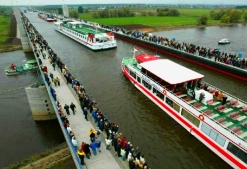
The Magdeburg Water Bridge (Wasserstraßenkreuz Magdeburg) is the longest navigable aqueduct in the world, an extraordinary 918-metre-long concrete channel that carries a river over a river, allowing cargo barges to cross high above the Elbe on Europe’s most audacious piece of waterway engineering. Opened in 2003 after nearly a century of planning, the bridge connects the Mittelland Canal to the Elbe-Havel Canal, eliminating a 12-kilometre detour through the Elbe’s locks and representing a triumph of modern engineering on a scale that has to be seen, preferably from a boat cruising across it, to be believed.
In This Article
Quick Facts: Magdeburg Water Bridge
- Best time to visit: April–October for boat trips across the bridge; the visitor centre and viewing platforms are open year-round
- Length: 918 metres: the longest navigable aqueduct in the world
- How to get there: ~1.5 hours from Berlin by car (A2); ~1 hour from Hanover; Magdeburg’s main station is a 15-minute bus ride away
- Experience it: Boat tours cross the bridge from the visitor centre at Hohenwarthe, offering the unique experience of cruising over a river 30 metres below
Magdeburg Water Bridge (Wasserstrassenkreuz Magdeburg) is really unique bridge – it is the longest navigable aqueduct in the world. Its structure is crossing over the Elbe River in Hohenwarthe near the city of Magdeburg, Germany. As one of the few in the world it was not designed for vehicle traffic, but for the ships! This is indeed, as the name predicts, the water bridge or channel.
Magdeburg Water Bridge was opened in 2003 and connects Berlin’s inland harbour network with the ports along the Rhine river. The bridge also allows the traffic of larger ships. This unique bridge is able to support even the heaviest boats and also to withstand the winter ice.
Its length is 918m, depth 4.25m and width is up to 34 m. The construction took €500 milion and used 24,000 tonnes of steel and 68,000 cubic meters of concrete.
View Magdeburg Water Bridge in Germany – the longest navigable aqueduct in the world (918m) in a larger map
Engineering Marvel: How the Water Bridge Was Built
The idea of a water bridge across the Elbe dates back to the early 20th century, when the Mittelland Canal was first constructed. Engineers recognised that the existing route required barges to descend a series of locks into the Elbe itself, a time-consuming and sometimes hazardous process, especially when river levels were low. The crossing plan was shelved due to World War I, revived in the 1930s, then abandoned again during World War II. It was not until German reunification in 1990 that the project gained renewed urgency. Construction began in 1997 and took six years at a cost of 500 million euros, using 24,000 tonnes of steel and 68,000 cubic metres of concrete. The water channel is 4.25 metres deep and 32 metres wide, enough to accommodate the largest European cargo barges. The bridge is supported by 13 concrete piers extending 30 metres to the riverbed. An aeration system prevents freezing in winter, and sensors monitor structural stress and ice formation in real time to ensure year-round operation.
Visiting the Magdeburg Water Bridge: What to See
The visitor experience centres on the Wasserstrassenkreuz Magdeburg Visitor Centre at Hohenwarthe, featuring a viewing platform that brings you within metres of passing barges sailing at eye level 30 metres above the Elbe. An interactive exhibition explains the canal system’s history, the bridge’s engineering, and the daily operation of the waterway, which sees around 1,100 ships pass through each month during the navigation season. The highlight is the 45-minute boat tour that actually crosses the bridge, offering the surreal experience of cruising over a river while sitting in a boat. Tours operate from April to October. The observation tower at Hohenwarthe provides an elevated perspective of the entire crossing, allowing you to see barges approaching from both directions while the Elbe flows far below. The site makes an easy stop on a journey between Berlin and Hanover, and can be combined with a visit to Magdeburg itself, where the Gothic cathedral and the Green Citadel building by Friedensreich Hundertwasser provide a cultural counterpoint to the engineering marvel at Hohenwarthe.
Have you cruised across the Magdeburg Water Bridge or discovered Germany’s engineering marvels? Share your experiences in the comments! 🚢
Explore all our Germany travel guides, from Berlin buzz to Bavaria castles.
Explore More
If you enjoyed this article, you might also like:
