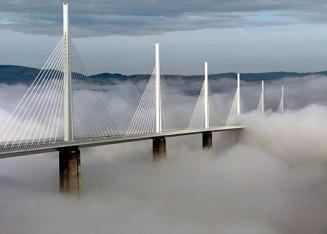

When you drive through the French A75 highway which connects Paris with Barcelona, you cannot miss the technical gem in the form of the highest bridge in the world – Millau Viaduct. The bridge crosses the valley of the river Tarn in southern France and was designed by French bridge engineer Michel Virlogeux in collaboration with the British architect Lord Norman Foster. The bridge was officially opened in December 2004.
The Millau Viaduct serves to speed up and calm the traffic. Before its construction it was necessary first to descend into the valley and then climb again on the other side, which greatly slowed down the transport, and meant a significant traffic load in the valley.
In This Article
Engineering Marvels and Design Innovation
The Millau Viaduct consists of eight road spans supported by seven pillars shaped like inverted Ys. The roadway stretches 2,460 metres in length and weighs 36,000 tons. Each of the six central spans measures 342 metres, while the two outer spans are 204 metres each. Rising 90 metres above the road surface, steel pylons (each weighing over 600 tons) anchor the stay cables that hold the deck suspended between the pillars. The maximum height of the road above the ground reaches 246 metres, making the viaduct taller than the Eiffel Tower. The seventh pillar, standing at 343 metres, is the tallest structural pillar ever built. Norman Foster’s architectural vision ensured that the structure appears almost weightless, as if floating above the Tarn Valley. The steel deck, painted in a soft grey that blends with the sky, minimises visual impact. A transparent noise barrier along both sides protects drivers from crosswinds while preserving uninterrupted views of the surrounding countryside. The design incorporates an advanced computer monitoring system with hundreds of sensors that measure wind speed, temperature, structural movements, and cable tension in real time, allowing engineers to anticipate maintenance needs before problems arise. Special expansion joints accommodate thermal movements of up to one metre as the steel deck expands and contracts with temperature changes.
Construction Challenges and Timeline
Actual construction of the Millau Viaduct began in October 2001 and lasted three years, with the bridge opening to traffic in December 2004. The project employed over 500 workers at peak construction and cost approximately 400 million euros, financed entirely by the Eiffage concession company in exchange for toll revenue over a 75-year period. The construction presented extraordinary engineering challenges. The seven pillars had to be built first, rising from the valley floor using traditional concrete pouring methods adapted for the extreme heights. Once the pillars reached their full height, the steel deck sections were assembled on both sides of the valley and pushed out over the pillars using a technique called incremental launching. Each deck section was manufactured in Normandy, transported in pieces to the site, welded together on the approach embankments, and then hydraulically pushed forward one section at a time. The launching process required precise coordination to ensure that each section landed perfectly on its intended bearing point. Weather conditions added further complications, with strong winds regularly halting work at height. During winter, temperatures dropped below freezing, requiring heated concrete and special additives to maintain structural integrity. Despite these obstacles, the bridge was completed on schedule and within budget, a remarkable achievement for a project of this scale. No workers lost their lives during construction, a safety record that stands as a testament to the rigorous protocols implemented on site.
Visiting the Viaduct and the Tarn Valley
Today the Millau Viaduct is not merely a transportation link but a tourist attraction in its own right. A dedicated visitor centre on the northern approach, complete with a museum, restaurant, and souvenir shop, offers exhibitions on the bridge’s design and construction. An outdoor viewing platform provides excellent photo opportunities, particularly in the late afternoon when the setting sun illuminates the pillars against the backdrop of the Tarn Valley. For a different perspective, visitors can drive across the bridge and stop at the Aire du Viaduc de Millau, a rest area on the southern side with panoramic views back toward the structure. The surrounding region of the Aveyron department is rich in attractions. The town of Millau itself is famous for its glove-making heritage and the nearby Gorges du Tarn, a deep limestone canyon popular for kayaking, canoeing, and rock climbing. The Cirque de Navacelles, a horseshoe-shaped meander carved by the Vis River, is a UNESCO-listed site just an hour’s drive away. The Roquefort cheese caves, where the famous blue cheese has been aged for centuries, are also within easy reach. Day trips from Millau can combine a bridge visit with wine tasting at local vineyards producing Marcillac and Estaing appellations. The bridge toll is around 10 euros for cars, and the journey across takes less than two minutes, but the memory of gliding above the valley at such height stays with drivers long after they have returned to ground level.
View Millau Viaduct – the tallest bridge in the world France in a larger map
Explore all our France travel guides, from Parisian boulevards to Provence lavender.
Explore More
If you enjoyed this article, you might also like:
