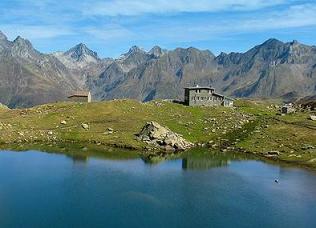

Pyrenees – wild, scenic and beautiful. This mountain range forms a natural border between France and Spain and in spite of many civilisation shoots it is still among the best preserved nature areas in Europe. However its steep cliffs, snowy peaks and deep valleys attract still more and more tourists and on the wild rapids of the rivers there are more boats and rafts, the Pyrenees still have a touch of wildness and secrets.
It is obviously desirable to maintain this natural wealth into the future. The part of the Pyrenees even got to the UNESCO World heritage Site thanks to its uniqueness. It is an area around Mont Perdu, which limestone massif rises to a height of 3,352 metres above sea level. The total area covers 31,189 hectares, although it was initially smaller. The first entry was made in 1997, and the protected area was enlarged three years later. It is also a place of the oldest Spanish National Park with long name Parque Nacional Valle de Ordesa – Monte Perdido, founded in 1918 on an area of 20.5 km2 and later extended. On the French side it has a younger partner, the Pyrénées National Park established in 1967.
In This Article
Mont Perdu and the UNESCO World heritage Area
The Mont Perdu massif, straddling the border between France and Spain, forms the centrepiece of the Pyrenees UNESCO World heritage site. Its limestone summit, Monte Perdido, rises to 3,355 metres and is the third-highest peak in the range. The surrounding area encompasses some of the most dramatic mountain scenery in Europe, including the Ordesa, Pineta, and Añisclo canyons on the Spanish side, and the three great glacial cirques of Gavarnie, Troumouse, and Estaubé on the French side. The Cirque de Gavarnie, a natural amphitheatre of rock walls reaching 1,500 metres in height, is perhaps the most famous, with the Gavarnie waterfall plunging 422 metres down its eastern face, the tallest waterfall in France and one of the highest in Europe. Hiking trails of varying difficulty allow access to viewpoints overlooking these geological wonders. The GR10 and GR11 long-distance trails traverse the entire range on the French and Spanish sides respectively, offering multi-day treks through landscapes of bare limestone, alpine meadows, and dense beech forests. Refuges along the routes provide bunk-bed accommodation and hot meals, making even remote sections accessible to overnight hikers. Spring and early summer, when wildflowers carpet the valleys in shades of blue, yellow, and pink, is an especially rewarding time to visit.
Canyons, Caves, and Geological Wonders
On the Spanish side of the Pyrenees, two of the largest and deepest canyons in Europe cut through the limestone massif. The Ordesa Canyon, protected within the Ordesa y Monte Perdido National Park, features sheer walls rising over 800 metres on either side of the Arazas River. A well-maintained trail follows the valley floor past multiple waterfalls, including the spectacular Cola de Caballo (Horse’s Tail) cascade at the canyon’s head. The Añisclo Canyon, narrower and more remote, requires a full day of hiking to explore its depths, where cliffs close in to create a sense of profound isolation. A network of faja trails, narrow ledges cut into the canyon walls, offers experienced hikers heart-pounding routes with vertiginous drops. For those seeking an even greater challenge, the clavijas routes involve steel cable handrails and metal steps bolted into the rock. Below the surface, the Pyrenees conceal extensive cave systems, some of which rank among the deepest in the world. The Pierre-Saint-Martin cave system reaches a depth of 1,342 metres, while the Gouffre de la Pierre Saint-Martin has been explored for over 50 kilometres of underground passages. Guided caving trips are available from adventure centres in the valley towns, suitable for beginners as well as experienced spelunkers.
Wildlife, National Parks, and Winter Sports
The Pyrenees host three national parks, each protecting a distinct segment of the range. Spain’s Aigüestortes i Estany de Sant Maurici National Park, in the Catalan Pyrenees, centres on a stunning array of glacial lakes surrounded by granite peaks. Ordesa y Monte Perdido National Park, the oldest in Spain, protects the canyon systems and the Mont Perdu massif. On the French side, the Pyrénées National Park stretches for 100 kilometres along the border, encompassing high-altitude terrain where marmots whistle from rocky slopes and bearded vultures glide on thermal currents. The Pyrenean brown bear, though critically endangered, still survives in the central portion of the range, with a population estimated at around 70 individuals. Other notable species include the izard (Pyrenean chamois), the lammergeier (bearded vulture), and the golden eagle. In winter, the Pyrenees transform into a ski destination with resorts such as Baqueira-Beret in Spain and Saint-Lary-Soulan in France offering reliable snow conditions from December through April. The range’s proximity to the Mediterranean means that spring arrives early on the southern slopes, and wild daffodils bloom in the foothills as early as March.
View Pyrenees Mountains – hiking paradise between Spain and France in a larger map
Explore all our France travel guides, from Parisian boulevards to Provence lavender.
Explore More
If you enjoyed this article, you might also like:
