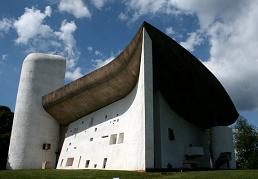
Notre Dame du Haut in Ronchamp is one of the most important works of 20th-century architecture, a radical pilgrimage chapel designed by Le Corbusier in 1955 whose sweeping white concrete roof (said to be inspired by a crab shell), irregularly shaped windows of coloured glass, and organically curved walls broke every rule of traditional church architecture and created a building so unconventional that it continues to astonish visitors 70 years later. Perched on a hilltop in the Vosges mountains of eastern France, on the site of a medieval pilgrimage chapel destroyed in World War II, Ronchamp is Le Corbusier’s most personal and poetic work, a UNESCO World heritage site that attracts architecture pilgrims from around the world to the unlikeliest of rural French locations.
In This Article
Quick Facts: Notre Dame du Haut, Ronchamp
- Best time to visit: Year-round; the interplay of light through the coloured glass windows is most dramatic in the morning or late afternoon; the hilltop setting is extraordinarily atmospheric in all seasons
- How to get there: ~1.5 hours from Basel by car; ~3 hours from Strasbourg; the nearest town is Belfort (~30 min); parking at the base of the hill, 10-minute walk up
- Entry fee: ~€10 (adult) including the neighbouring monastery and porter’s lodge (both also designed by later architects in dialogue with Le Corbusier)
- UNESCO: Part of “The Architectural Work of Le Corbusier” transnational World heritage site (inscribed 2016)
Notre Dame du Haut is a unique Roman Catholic chapel of the French architect Le Corbusier. It is situated at Ronchamp in Haute-Saone department in the region of Franche-Comté in France. It was built between 1950-1955 and is one of the most daring solution of the church buildings in the history of architecture at all.
Le Corbusier (Charles-Edouard Jeanneret, 1887, 1965) has been dominated in French architecture from the 1920. Notre Dame du Haut, was built on the foundations of a Christian chapel of 4th century, which was destroyed during the World War II. The construction of Notre Dame du Haut represents an extreme outcome of Corbusier’s artistic endeavors. The chapel has a simple structure with two entrances, the main altar and chapel under the towers. Concrete and stone, which were the remnant of the original chapel, form the basics of the monumental structure.
Notre Dame du Haut is the first example of post-modern architecture. Its exclusivity, both in the history of European architecture and architectural history of the church, can everyone appreciate in Ronchamps.
Architecture and Design of Ronchamp
Le Corbusier’s design for Notre Dame du Haut represents a dramatic departure from his earlier work and from traditional church architecture. The chapel’s most striking feature is its massive roof, which curves upward like a ship’s hull and is inspired by a crab shell. The roof is supported on small columns, leaving a gap between it and the walls that allows a sliver of light to enter from above. The walls are built from rubble stone from the original chapel, rendered in whitewashed concrete and punctuated by small, irregularly shaped windows set with coloured glass. These windows, 51 in total, create a luminous interior that changes character throughout the day as sunlight filters through in shifting patterns of red, blue, yellow, and green. The south wall, which Le Corbusier called the “wall of light,” is the most dramatic, with its scattered window openings of varying sizes creating a star-like constellation of colour on the interior surface.
Interior Atmosphere and Spiritual Experience
Stepping inside Notre Dame du Haut is an experience that transcends architecture. The interior is deliberately dim, with light entering primarily through the coloured glass windows and the gap beneath the roof, creating an atmosphere of mystery and contemplation. The floor slopes gently toward the altar, which is positioned slightly off-centre, drawing visitors forward without a sense of rigid symmetry. Three small chapels are set into the thickness of the north wall, each topped with a tower that rises above the roofline and admits light from above. These chapels are intimate spaces designed for private prayer. The interior can hold approximately 200 people, but the feeling is never crowded due to the careful modulation of space and light. Le Corbusier, though not a religious man, said he wanted to create “a vessel of silence, of prayer, of peace, of spiritual joy.” The success of this intention is evident in the quiet reverence that descends upon visitors as they pass through the heavy wooden door.
Planning Your Visit to Ronchamp
The chapel is located in the small town of Ronchamp in eastern France, near the Swiss border. The easiest way to get there is by car, with Basel approximately 1.5 hours away and Strasbourg about 3 hours. Parking is at the base of the hill, followed by a 10-minute walk up through the forest. The site is open year-round, though hours vary by season. Admission costs approximately 10 euros and includes access to the chapel, monastery, and porter’s lodge. The best time to experience the coloured light effects is in the morning or late afternoon. Photography is permitted inside without flash. Allow at least two hours to fully appreciate the chapel and its hilltop setting with panoramic views of the Vosges mountains.
View Notre Dame du Haut, unique Roman Catholic chapel in France in a larger map
Have you visited Ronchamp or discovered Le Corbusier’s architectural poetry? Share your impressions of Notre Dame du Haut in the comments! ⛪
Explore all our France travel guides, from Parisian boulevards to Provence lavender.
Explore More
If you enjoyed this article, you might also like:
