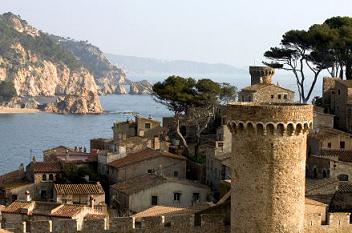
Tossa de Mar is one of the most popular and beautiful resorts on the Costa Brava, a historic fishing village-turned-holiday destination on the Catalan coast whose superbly preserved medieval walled old town (Vila Vella), with its castle and lighthouse perched on a rocky headland overlooking turquoise coves, is the only surviving fortified medieval town on the Catalan coast and one of the most romantic settings in Spain. The town famously attracted artists in the 1930s, including Marc Chagall, who called Tossa “blue paradise,” and the combination of the Vila Vella’s ancient cobbled streets, the excellent beaches (Platja Gran right below the castle), and the lively promenade make Tossa one of the Costa Brava’s most complete resort experiences.
In This Article
Quick Facts: Tossa de Mar, Costa Brava
- Best time to visit: May, June and September for warm weather without the peak July, August crowds; the Vila Vella is especially magical at sunset when the castle walls are lit and the light turns golden on the Mediterranean
- How to get there: ~1.5 hours from Barcelona by car (C-32); regular buses from Barcelona Estació del Nord (2 hours)
- Don’t miss: The view of the Vila Vella from the Platja Gran beach, one of the classic Costa Brava photographs, and the walk up through the old town to the lighthouse at sunset
One of the most popular resorts on the Costa Brava in Spain is Tossa de Mar with more than 5000 inhabitants. This former fishing village began to develop in the 90′s of the 20th century and today offers a quiet and relaxed atmosphere. The town boasts a rich history, which is proved by the numerous monuments, including the remains of the castle and fortifications.
View Tossa de Mar, one of the most popular resorts on the Costa Brava in Spain on the Larger Map
The old city center of Tossa de Mar offers a network of narrow streets and its most important monuments include the Church of San Vicente. You also should visit a local gallery and city museum. Along the coast you can find the beaches like Gran Playa, El Codolar and La Baume, offering a complete tourist service. At sea you can enjoy a variety of water sports, such as the diving, sailing, surfing, water skiing or scooters. Along the coast there in a pretty nice promenade with shops and souvenir shops, clothing, jewelry and ceramics. Hotels in Tossa de Mar offer a large hotel complexes, but you will find also the camping here.
The Vila Vella: A Walk Through History
The Vila Vella, Tossa de Mar’s walled old town, is the only surviving fortified medieval settlement on the Catalan coast, and walking its cobbled streets is like stepping back in time. The walls were built between the 12th and 14th centuries to protect the town from pirate attacks, and their three massive towers and battlements remain remarkably well preserved. Within the walls, narrow lanes wind past whitewashed houses, flower-filled courtyards, and quiet squares where washing flutters on lines above the street. The castle at the highest point of the promontory now houses the Municipal Museum, which includes works by Marc Chagall and other artists who were drawn to Tossa in the 1930s. Chagall spent time in Tossa in 1934 and described the town as his “blue paradise,” a phrase that still appears in tourism materials today. The lighthouse at the tip of the promontory marks the end of the cobbled path and offers spectacular views back over the bay.
Beaches and Coastal Activities
Tossa de Mar boasts three main beaches, each with its own character. Platja Gran, the largest and most central, curves in a gentle crescent directly beneath the Vila Vella walls, providing swimmers with the extraordinary experience of floating in turquoise water while looking up at a medieval castle. The beach is well equipped with sun loungers, umbrella rentals, and beachside restaurants serving fresh seafood. El Codolar, a smaller pebble beach tucked into the shelter of the town walls, is quieter and favoured by locals. La Baume, a small sandy cove a short walk south of town, offers a more secluded experience away from the main tourist areas. Water sports are well catered for, with several operators offering kayaking, paddleboarding, and scuba diving excursions. The rocky coastline to either side of the beaches is excellent for snorkeling, with clear water and abundant marine life. Boat trips along the coast depart regularly from the harbour, offering views of the cliffs and coves that are inaccessible by land.
Getting to Tossa de Mar and Where to Stay
Tossa de Mar is easily accessible from Barcelona, approximately 100 kilometres to the south. The drive takes about 1.5 hours via the C-32 motorway. Regular buses depart from Barcelona’s Estacio del Nord, with the journey taking about two hours and dropping passengers in the town centre. Accommodation options range from luxury hotels to family-run guesthouses in the old town. For a memorable stay, choose a hotel within or near the Vila Vella walls. Apartments are available for longer stays, and campsites lie just outside town. The best strategy is to stay overnight, as the day-trippers depart in the late afternoon and the old town regains its peaceful medieval character.
View Tossa de Mar, one of the most popular resorts on the Costa Brava in Spain in a larger map
Have you wandered Tossa’s medieval Vila Vella or discovered the Costa Brava’s walled town? Share your Catalan coastal discoveries in the comments! 🏰
Explore all our Spain travel guides, from Barcelona Gaudí to Andalusia plazas.
Explore More
If you enjoyed this article, you might also like:
