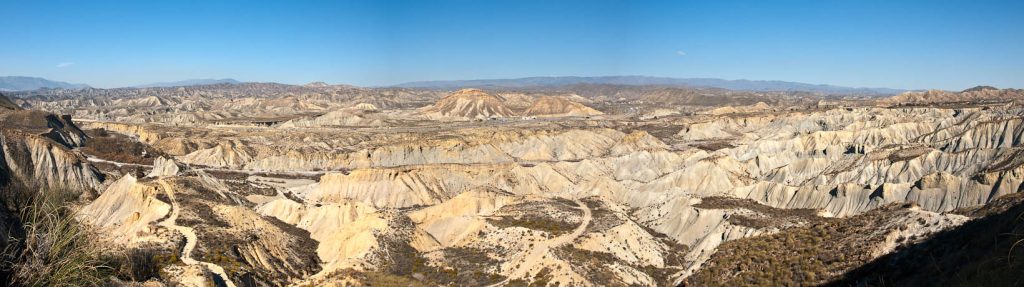
The dry heat hits your face like an open oven door as you step onto the dusty ground of the Tabernas Desert. This is one of the few true deserts in Europe and it looks nothing like the green Spain you expected. Rugged ravines and parched hills stretch toward the horizon under a bleached sky. The landscape once served as the backdrop for spaghetti western films and you half expect a cowboy to appear from behind a rock. Silence dominates here broken only by the wind scuttling dry brush across the cracked earth.
Situated in the southeastern portion of Spain, you will find one of the few deserts in all of Europe. The Tabernas Desert covers an area of 280 square kilometres and sees less than 200 millimetres of annual rainfall. Due to the fact that it is surrounded by mountains on all sides, it never receives the humid breeze coming from the Mediterranean Sea. This rain shadow effect creates the arid conditions that make Tabernas a true desert.
Tabernas Desert, Spain by Luis Daniel Carbia Cabeza
Unlike some deserts in the world, the Tabernas Desert is not located below sea level. For the most part, the lowest portion of the desert is actually more than 400 metres above sea level. Like any other desert, it gets extremely hot during the summer seasons, with temperatures exceeding 40 degrees Celsius on an annual basis. The vast majority of the desert lies below 900 metres above sea level. Above this point, the temperature becomes substantially more bearable and the annual rainfall increases. Although the desert is hot and dry, it is not uncommon to see snow on the tops of the surrounding mountains during winter, creating a striking contrast between white peaks and ochre badlands.
Flora, Fauna, and Unique Ecosystem
As with just about any desert, when it does rain in the Tabernas Desert, the rainfall is quite torrential. Storms that manage to cross the mountain peaks can be dangerous. The ground is filled with craggy sandstone and almost no vegetation. The sandstone is virtually incapable of retaining moisture, so the valley tends to flood and erode during heavy rains. However, the desert is not absent of all flora and fauna. The most common plant is the sea lavender, which is almost extinct elsewhere in Europe. Other drought-resistant species include esparto grass, thyme, and various succulents that have adapted to the extreme conditions. There are also numerous reptiles and amphibians including ladder snakes, ocellated lizards, terrapins, spiny-footed lizards, and natterjack toads. Mammals such as hedgehogs, rabbits, and several species of dormouse make their home in the rocky terrain. Overhead, it is not uncommon to see a Bonelli eagle or a peregrine falcon soaring above. The desert ecosystem has adapted to extreme conditions, with many species exhibiting nocturnal behaviour to avoid the intense daytime heat. Spring blooms can transform parts of the landscape when sufficient rain falls, creating a brief but spectacular display of wildflowers across the normally barren slopes.
Film History and Visiting the Western Theme Parks
The desert landscape has been used as a filming location for classic spaghetti westerns including A Fistful of Dollars and The Good, the Bad and the Ugly, which were directed by Sergio Leone and starred Clint Eastwood. The unique terrain stood in for the American frontier, and several western-themed sets remain open to visitors today. Oasys Mini Hollywood features stunt shows with cowboys and Native American performers, a zoo with over 800 animals, a swimming pool, and a replica Wild West town with saloon and jailhouse. Entry costs 25 euros. Texas Hollywood offers a more rustic set experience with horseback riding and cowboy re-enactments in a fully functional film set. Fort Bravo is a third western set that has been used for more recent productions including Game of Thrones and Indiana Jones. The desert trails can be explored on foot or by guided 4×4 tour that takes visitors deep into the badlands where the geology is most dramatic. The nearby town of Tabernas has a historic Moorish castle dating from the 11th century and several restaurants serving traditional Almerian cuisine. Photography enthusiasts find the golden hour light particularly spectacular as it illuminates the layered sandstone formations in shades of amber, ochre, and rust.
Would you visit a European desert or do you prefer your landscapes green and lush? 🌵
Explore all our Spain travel guides, from Barcelona Gaudí to Andalusia plazas.
Explore More
If you enjoyed this article, you might also like:
