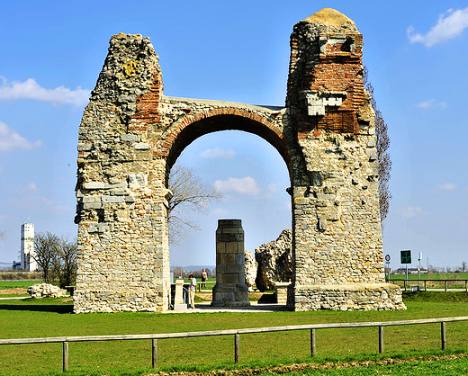
Just a few kilometers from the Czech borders, about 20 km west of the Slovakian capital Bratislava, on the way to Vienna, lies the small towns Petronell and Bad Deutsch-Altenburg. There was, in the times of the Roman Empire, located a legionary camp and a capital of the province of upper Pannonia – Carnuntum. The city was strategically located on the Amber Road – an ancient trade route for transferring the Amber, connecting North and South of Europe.
The city is mentioned for the first time at the beginning of our era, during the reign of emperor Augustus. The city was the base for Roman troops. Even the Emperor Marcus Aurelius stayed here for 3 years (172-175), during Markoman Wars. The city was destroyed by the Germans in the 4th century and Valentinian I. tried to restore it. But the city has never achieved such fame again and later, in the Middle Ages, was completely destroyed by the Hungarians.

Photo licensed under the Creative Commons, created by Ulrich Latzenhofer
Now it is possible to visit the Archaeological Park Carnuntum in 3 different parts: Civilian part, Military part and Museum Carnuntinum.
In This Article
The Civilian City: Streets, Baths, and the Pagan Gate
The civilian part of Carnuntum offers the most complete picture of daily Roman urban life anywhere north of the Alps. Excavations have revealed a full street grid with stone-paved roads, drainage channels, and the foundations of private houses, shops, and public buildings. The reconstructed public bath complex, built using authentic Roman techniques, shows how bathing was a central social ritual. Romans would move through the frigidarium, tepidarium, and caldarium in sequence, meeting friends and conducting business along the way. The adjacent dwelling house, also reconstructed, gives visitors a tangible sense of Roman domestic life with its internal courtyard, heated floors, and wall paintings. Just a few minutes walk from these ruins stands the amphitheatre, which once held up to 15,000 spectators. It was the fourth largest amphitheater in the entire Roman empire. Gladiatorial contests, animal hunts, and public executions took place here, drawing crowds from across the province. Beyond the amphitheatre rises the Heidentor, or Pagan Gate, a monumental four-sided arch that marked the entrance to the fortification. At its center stands a statue of Emperor Constantine II, erected between 354 and 361 AD. The gate originally stood over 20 metres tall and was clad in marble, a visible symbol of Roman power on the frontier.
The Military Camp and the Naval amphitheatre
The military section of Carnuntum lies on the outskirts of Bad Deutsch-Altenburg, about 3 kilometres from the civilian area. This was the heart of the legionary fortress, home to Legio XIV Gemina, a crack unit that served as the backbone of Romes defensive line along the Danube. The most remarkable feature of this section is the second amphitheatre, which could be flooded with water for staged naval battles, known as naumachiae. These spectacles were immensely popular and required complex engineering to fill and drain the arena. The military amphitheatre seated about 6,000 soldiers and officers, a fraction of the legions full strength but enough for the garrison. Beside the amphitheatre, a small gladiator museum now displays weapons, armour, and training equipment used by the fighters who entertained the troops. From the military zone, the Roman road network stretched south toward Italy and east along the Danube, making Carnuntum a vital hub for troop movements and trade.
Museum Carnuntinum and Practical Information
The Museum Carnuntinum sits in Bad Deutsch-Altenburg, just a short walk from the Danube riverbank. Its collection spans the full history of the Roman city, from its founding under Augustus to its decline in the 4th century. Highlights include beautifully preserved mosaics, glassware, jewellery, and the famous Carnuntum cameo, a carved gemstone showing the imperial family. Military artefacts include full legionary armour, siege engines, and a reconstructed Roman catapult. The museum also houses inscriptions and stone monuments that document the daily administration of the province. Adjoining the main building is an open-air lapidarium displaying hundreds of carved stones and funerary monuments. Museum is opened daily from 16 April to 15 November at 9.00 to 18.00 and the basic admission is €9. For further details visit the official site of Open Air Museum Petronell-Carnuntum.
View Open Air Museum Petronell-Carnuntum – Roman world in Austria in a larger map
Would you explore Carnuntum’s amphitheatre or the Roman museum first? 🏛️
Explore more Austria travel guides.
Would you explore Carnuntum’s amphitheatre or the Roman museum first? 🏛️
Explore all our Austria travel guides, from Vienna coffeehouses to Alpine peaks.
Explore More
If you enjoyed this article, you might also like:
