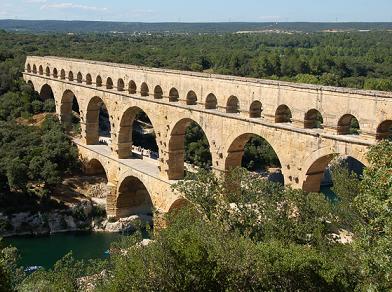
Fifty thousand tons of limestone blocks hold themselves together without mortar. The Pont du Gard spans the Gardon River with three tiers of arches, the tallest reaching nearly fifty metres. It carried water from a spring in Uzès to the city of Nîmes, a distance of fifty kilometres with a gradient of just thirty-four centimetres per kilometre. Roman engineers built this in the first century AD, and it still stands, perfectly aligned, largely intact. Visitors swim in the river below the bridge in summer. Kayakers paddle through the arches. The scale only truly registers when you stand beneath the lower arcade and look up.
The basic requirement of life is water and regular water supply and its transport is an absolute necessity for a living. Since ancient times people knew this and tried to transport it as easy as it was possible to the human houses – so they began to build aqueducts.
Most impressive and largest aqueduct at that time was undoubtedly the Pont du Gard in Provence, in southern France. It dates from Roman times – was built 2000 years ago. It is not only beneficial structure, but also an architectural gem. It can certainly be called wonder of the ancient world. This building has been preserved almost in working conditions until today.
Aqueduct transferred water from the Eure spring to the wells in Nimes (48 km). Noteworthy is that the height difference between spring and wells is only 17 m, which proves truly outstanding calculations of the whole system.
A part of the aqueduct is a huge, three-storey bridge over the river Gard, which is also the most interesting part. The bridge is 275 meters long, 49 meters high and at the highest part it is 3 meters wide. It consists of three rows of arches – the arcades. Blocks of stone are embedded into each other with millimeter accuracy while no fasteners were used.
At the time of the Roman Empire the city of Nimes had approximately 50 000 inhabitants. Aqueduct was able to supply about 400 liters of water daily for each person.
The bridge is now a major tourist attraction and one of the most visited monuments in France with more than 2 million tourists per year. In 1985 it was included in UNESCO World heritage Site.
You can even stay in camping which is situated right bellow the Aqueduct.
View Aqueduct Pont du Gard – ancient Roman aqueduct bridge in Provence, France in a larger map
Roman Engineering: Precision Across 50 Kilometres
The Pont du Gard was part of a 50-kilometre aqueduct system carrying water from the Fontaine d’Eure spring near Uzès to the Roman city of Nemausus, modern Nîmes. The water dropped only 17 metres over the entire length, a gradient of 34 centimetres per kilometre. This required surveying techniques so precise that the margin of error is less than one metre over the whole distance. The aqueduct delivered an estimated 40,000 cubic metres of water per day, enough to supply the baths and fountains of Nîmes which had a population of about 50,000. The bridge was built without mortar. Limestone blocks weighing up to 6 tons each were held together with iron clamps set in lead. The water channel measures 1.2 metres wide and 1.8 metres high, lined with waterproof cement made of crushed pottery and lime.
The Museum, Nearby Roman Cities, and Visitor Information
The on-site museum opened in 2000 covers Roman engineering, daily life in Nîmes, and the history of the aqueduct. Entry is included in the site admission of 9.50 euros. Nîmes, 20 kilometres south, has the best-preserved Roman arena in France, seating 24,000 spectators and still used for events. The Maison Carrée, a perfectly preserved Roman temple built in 16 BC, costs 7 euros. Uzès, 12 kilometres north, is a medieval town with a Renaissance ducal palace and a Saturday market full of Provençal produce. A combined ticket for the Pont du Gard and the Nîmes arena costs 16 euros and is valid for 3 days. The site is open year-round with extended hours during July and August when the river banks are floodlit for evening swimming and kayaking beneath the arches.
Would you rather swim beneath the Pont du Gard or explore the Roman arena in Nîmes? 🏛️
Explore all our France travel guides, from Parisian boulevards to Provence lavender.
Explore More
If you enjoyed this article, you might also like:
