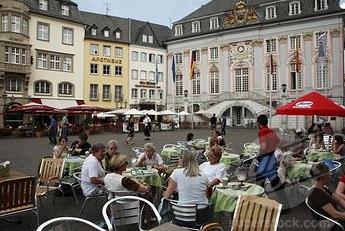
Bonn carries its history with quiet dignity along the banks of the Rhine. This city served as the capital of West Germany for four decades, a role that shaped its character without overwhelming its charm. Beethoven was born here in 1770, and his presence permeates the old town. His birthplace at Bonngasse 20 draws music lovers from around the world. The Beethoven Festival fills concert halls with his compositions every autumn. Beyond the musical heritage, Bonn offers a superb botanical garden, a sprawling university quarter, and the Museum Mile with its collection of art and history. The riverside promenade invites long walks past beer gardens and historic buildings. Bonn never shouts about its attractions. It simply invites you to discover them.
Bonn is a city located in Germany on the Rhine River, about 25 km south of Cologne. Bonn is known as the first capital of the Federal Republic of Germany and the birthplace of the calssical composer Ludwig van Beethoven. At present, the Bonn is mainly a vibrant university city, the center of future technologies, the headquarters of UN agencies and world-class metropolis with art exhibitions and concerts.
Beethoven’s Bonn: Following the Composer’s Footsteps
No visit to Bonn is complete without exploring the legacy of its most famous native son. Ludwig van Beethoven was born in December 1770 at Bonngasse 20, a modest townhouse in the city centre that now operates as the Beethoven House museum. The museum displays an extraordinary collection of original manuscripts, including portions of the Ninth Symphony, his last grand piano, and personal items such as his hearing aids and spectacles. The adjacent digital interactive room allows visitors to explore his compositions in detail. Each autumn, the Beethoven Festival transforms the city into a concert hall, with over 60 performances taking place in venues across Bonn, from the Beethovenhalle concert hall to the intimate chambers of the Electoral Palace. The festival attracts leading orchestras and soloists from around the world. Beyond the dedicated museum and festival, Beethoven’s presence is felt throughout the city. The Beethoven Monument in the Munsterplatz, erected in 1845, is a popular meeting point, and the composer’s face appears on shop signs, street names, and even local wine labels. A walking trail connects the key locations of his early life, including the church where he was baptised and the school he attended.
The Museum Mile and Rhine Promenade
Bonn’s Museum Mile, or Museumsmeile, is a cluster of five nationally significant museums located along the south side of the city centre. The Kunstmuseum Bonn houses an outstanding collection of German expressionist art and works by August Macke, who lived and worked in the Bonn region. Across the street, the Kunst- und Ausstellungshalle der Bundesrepublik Deutschland, known as the Bundeskunsthalle, hosts major international touring exhibitions spanning art, science, and culture. The Haus der Geschichte, or House of the History of the Federal Republic of Germany, is arguably the most engaging museum on the mile, presenting German post-war history through immersive exhibits, including a reconstructed parliamentary chamber and original vehicles from the Cold War era. The Museum Alexander Koenig is a natural history museum with impressive dioramas of European wildlife, and the Deutsches Museum Bonn focuses on German technological innovations. After exploring these museums, a walk along the Rhine promenade provides the perfect contrast. The riverside path stretches for several kilometres, passing beer gardens, the landmark Alter Zoll bastion, and the Rheinaue park, a sprawling green space that hosts open-air concerts and the annual Rhine in Flames fireworks festival.
Insights into the history
At first Bonn was the Roman military settlement. In the 13th century it had become a city and from the 16th century it was the home of Archbishops and Prince-electors of Cologne. Between 1949 and 1990 Bonn was the capital of Germany.
Historical monuments and sights
After the year of 1950, the government district grew up in Bonn, which is dominated by the 30 levels building. North of it you can see Schaumburg palace that housed the Chancellery and the Hammerschmidt Villa, which was the seat of the president. The historic center of Bonn and the government district is separated by the Koblenz Gate. Not far from it you can visit a courtyard garden. On its outskirts there is the University Museum of Art with originals and casts of ancient sculptures.
View Bonn – the first capital of Germany and birthplace of Ludwig van Beethoven in a larger map
In Bonn you can find also Poppelsdorf castle, which is used by the university. Near the castle there is a monument to the composer Robert Schumann. Very interesting is also the baroque town hall located in the centre of the city and close to it the memorial dedicated to the composer Ludwig van Beethoven. The oldest building in Bonn is a Romanesque church, built in the 11th to 12th century. The new buildings include the Municipal Theatre, built in 1964 and Beethoven’s multipurpose hall.
Tourist Attractions
City of Bonn offers a variety of sports. There is also an outdoor swimming pool, indoor pool, sports hall, stadium and other facilities. The wine experts should not miss the bars on the banks of the Rhine River that offers great view of the Seven-hills (Siebengebierge) – the area of the local wine Riesling.
View Bonn – the first capital of Germany and birthplace of Ludwig van Beethoven in a larger map
Do you seek out the birthplaces of famous composers when you travel? 🎵
Explore all our Germany travel guides, from Berlin buzz to Bavaria castles.
Explore More
If you enjoyed this article, you might also like:
