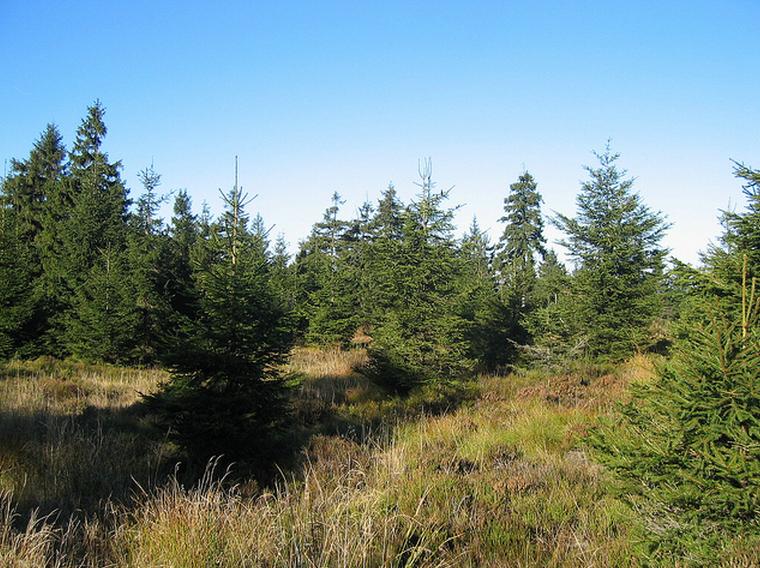
Spruce forests stretch across the rounded summits of the Harz Mountains, their dark green broken only by the granite outcrops that punctuate the high plateau. The Harz National Park protects one of the largest continuous forested areas in Germany, a landscape of deep river valleys, waterfalls, and the iconic Brocken peak, the highest mountain in northern Germany. The Brocken, shrouded in legend as the meeting place of witches on Walpurgis Night, offers panoramic views across the entire range. The park resident wildlife includes wild cats, black storks, and the elusive lynx, reintroduced to the Harz after a century and a half of absence.
\n\n
Harz National Park, known in German as Nationalparkverwaltung Harz, is located at the border of three provinces in central Germany. The National Park is mostly forested. The upper Harz is covered with coniferous forests, while the Lower Harz is mostly covered by deciduous trees. Above the upper limit of the forest at an altitude of about 1,100 metres above sea level, you can find scree slopes, alpine meadows, and raised bogs. Harz National Park was established in its current form in 2006 and covers an area of 247 square kilometres, making it one of the most significant protected areas in central Germany.
\n
\nPhoto licensed under the Creative Commons, created by Sebastian Fuss
\n\n
Climate, Wildlife, and Natural Attractions of the Harz
\n
When planning your trip to Harz National Park, be aware of the cooler and rainier conditions in the mountains. Although the Harz is not a high mountain range, its geographical location exposes it to constant moist ocean air from the North Sea, creating a climate similar to that of mountains reaching about 2,000 metres above sea level. Be prepared for a large number of fellow visitors, as Harz National Park is one of the most visited places in Germany. Among the most beautiful places to explore are the Rübeland caves with their impressive stalactite formations, the highest peak of Brocken at 1,141 metres, the dramatic Hohneklippen granite crags, the scenic Eckerstausee lake, Falkenstein Castle perched on a rocky outcrop, the historic Harzgerode Castle, the hilltop resort of Sankt Andreasberg with its mining heritage, and the saltwater spa of Bad Harzburg. The park is also home to a rich diversity of wildlife. Wild cats roam the dense forests, black storks nest in the remote valleys, and the Eurasian lynx, successfully reintroduced since 1999, now has a stable breeding population of around 100 individuals throughout the Harz region. Birdwatchers can spot peregrine falcons, western capercaillies, and a wide variety of woodpecker species.
\n
\nPhoto licensed under the Creative Commons, created by Mike Jentsch
\n\n
The Brocken Summit and the Steam Railway Experience
\n
The Brocken, at 1,141 metres the highest peak in northern Germany, is accessible via the Brocken Railway, a historic steam-powered narrow-gauge train that has been operating since 1899. The journey from Wernigerode takes approximately 90 minutes, climbing steadily through forested slopes before emerging onto the treeless summit plateau. A return ticket costs 59 euros. The summit offers far-reaching views across the entire Harz range and, on exceptionally clear days, as far as the Thuringian Forest and even the Brocken peak of the Harz itself visible from miles away. The Brocken Garden, an alpine botanical garden established in 1890, displays plant species native to the Harz highlands and is one of the oldest of its kind in Germany. The Harz National Park visitor centre at Schierke provides trail maps, wildlife information, and details about the lynx reintroduction programme. For hikers, the Goetheweg trail from Torfhaus to the Brocken summit is a well-marked 8-kilometre route that takes about two and a half hours, passing through bogs and stunted spruce forests. The Brocken has long inspired German writers and artists. Goethe featured the mountain and its Walpurgis Night legends in his masterpiece Faust, and every year on the night of 30 April, modern-day witches and revellers gather at the summit to celebrate this ancient tradition with music, costumes, and fireworks.
\n\n
For families, the Harz offers numerous child-friendly attractions beyond hiking and the steam railway. The medieval town of Wernigerode with its fairy-tale castle, the interactive Explorado science museum in Halberstadt, and the mining museum in Clausthal-Zellerfeld all provide engaging experiences for younger visitors. The Harz is also famous for its Christmas markets, particularly in the historic towns of Wernigerode and Goslar, which are among the most atmospheric in Germany. A visit to the Harz National Park is a journey into the heart of German nature, history, and folklore.
\n\n
View Harz National Park – one of the most visited places in Germany in a larger map
\n
\n
Would you hike the Brocken or take the steam train to the summit? 🚂
\n
Explore all our Germany travel guides, from Berlin buzz to Bavaria castles.
Explore More
If you enjoyed this article, you might also like:
