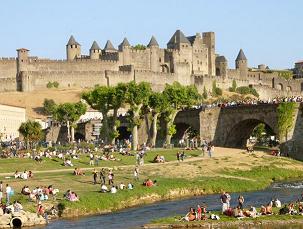
Fifty-two towers and nearly three kilometres of ramparts encircle the medieval citadel of Carcassonne. The fortress rises above the Aude River with fairy-tale turrets and pointed slate roofs that look as though they belong in a storybook. The inner streets hold stone houses, small squares, and the basilica of Saints Nazarius and Celsus with its stained-glass windows and sculpted portals. Viollet-le-Duc restored the fortress in the nineteenth century, adding the conical roofs that now define its silhouette. From a distance, Carcassonne appears exactly as a medieval fortified city should appear. The drawbridge, the portcullis, the double walls all fulfil expectations set by imagination.
In This Article
A City Built on Layers: From Roman Oppidum to Fortress
Carcassonne stands on ground that has been inhabited for more than two and a half thousand years. An Iron Age oppidum occupied the hilltop before the Romans established a fortified town called Carcaso in the 1st century BC. The Romans built the lower sections of the walls that still stand today, using large stone blocks laid without mortar. This technique, known as opus quadratum, is visible near the Porte Narbonnaise where the original Roman masonry meets the later medieval additions. During the 11th and 12th centuries, the Trencavel family ruled the city and expanded its defences significantly. They added the outer wall, deepened the moat, and constructed the Castle of the Counts, a fortified palace within the citadel that could serve as a final refuge during a siege. Because the city was not controlled directly by the church, it became a place of relative tolerance where religious minorities, including Jews and Cathars, found shelter. The city flourished as a trading centre, connecting the Mediterranean coast to the interior of the Languedoc region. This prosperity ended in 1659 when the Treaty of the Pyrenees gave Carcassonne to France. Cut off from its Catalan trading networks, the city declined rapidly. By the early 19th century, parts of the walls had collapsed and residents had repurposed the stone for their own homes. The once-mighty fortress was on the verge of being demolished entirely before a campaign to save it gained momentum.
Viollet-le-Duc and the Controversial Restoration
Eugene Viollet-le-Duc remains one of the most debated figures in architectural history. The French government appointed him to lead the restoration of Carcassonne in 1853, and he spent the next 58 years working on the site. His approach was not to preserve the fortress as it stood but to complete it as he believed it should have looked. He added pointed slate roofs to the towers, conical turret caps, and decorative crenellations that archaeological evidence suggests may never have existed. Critics argue that he invented a Romantic medieval fantasy rather than preserving authentic fabric. His defenders point out that without his intervention Carcassonne would have crumbled into a pile of rubble. Viollet-le-Duc had already restored Notre-Dame de Paris, the basilica of Saint-Denis, and the Chateau de Pierrefonds using the same approach. His method was to study the surviving fragments, research comparable buildings of the same period, and then reconstruct the missing elements in a way that created a coherent whole. Today, visitors can judge for themselves. The restored sections are clearly marked, and the original Roman stonework remains visible beneath the later additions. The result draws more than two million visitors each year, making Carcassonne one of the most visited tourist attractions in France. Walking the ramparts at sunset, when the stone glows golden and the shadows lengthen across the Aude Valley, it is difficult to argue that the restoration was anything less than a cultural triumph.
The Canal du Midi and the Wines of the Languedoc
A short distance from Carcassonne lies the Canal du Midi, one of the greatest engineering achievements of the 17th century. Designed by Pierre-Paul Riquet and completed in 1681, the canal stretches 240 kilometres from Toulouse to the Etang de Thau on the Mediterranean coast. The project employed 12,000 workers and took just 14 years, an astonishing pace for the era. The canal features 63 locks, including the famous staircase of eight locks at Fonseranes, a spectacular piece of engineering that lifts boats 21.5 metres in a distance of 300 metres. Plane trees line the entire length of the canal, planted to stabilise the banks and provide shade for the horses that once towed barges. Today, the towpath has been converted into one of France’s finest cycling routes. Visitors to Carcassonne can easily spend a morning at the fortress and an afternoon cycling along the canal. The surrounding region produces some of France’s most interesting wines, including Corbieres, Minervois, and La Clape. Local vineyards offer tastings and tours, and the town of Limoux, 30 minutes south, is famous for producing the world’s first sparkling wine, Blanquette de Limoux, which predates Champagne by more than a century. The local cuisine is equally compelling. Cassoulet, a slow-cooked bean stew with duck confit and pork sausage, has been a staple since the Middle Ages. The best places to try it are the traditional bistros in the Bastide Saint-Louis, the lower town built on the opposite bank of the Aude.
Would you rather defend Carcassonne’s walls or storm them as an attacking army? ⚔️
Explore all our France travel guides, from Parisian boulevards to Provence lavender.
Explore More
If you enjoyed this article, you might also like:
