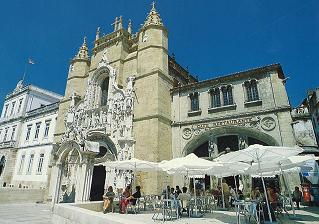
A city built on a hill beside the Mondego River, where one of Europe oldest universities still operates within ancient stone walls. Students in black capes hurry through arched passageways. The Joanina Library holds gilded shelves and resident bats that eat the book-eating insects. Below the university, the old town spills down narrow streets lined with fado houses and ceramic workshops. The Santa Cruz Monastery shelters the tombs of Portugal first kings. Coimbra feels lived in, not preserved for tourists. Its alleys carry genuine shadows and laundry hanging from wrought-iron balconies. The river reflects the city lights every evening.
Coimbra is a beautiful historic city in central Portugal on the river Mondego. It has about 150,000 inhabitants. Coimbra mainly attracts tourists due to its monuments. In the past it was also the capital of Portugal from 1139 to 1256 and is the birthplace of 6 Portuguese Kings.
In This Article
The University of Coimbra and the Joanina Library
The University of Coimbra is the oldest university in the Portuguese-speaking world and one of the oldest in continuous operation in Europe, founded in 1290. Originally established in Lisbon, it moved permanently to Coimbra in 1537 and has occupied the royal palace on the hilltop ever since. The university complex is a UNESCO World heritage site spanning Renaissance to Baroque architecture. The Joanina Library, built between 1717 and 1728, is the crown jewel. Its three rooms are decorated with gilded exotic wood bookshelves holding over 60,000 volumes, many from the 16th to 18th centuries. The library maintains a colony of bats that emerge at night to eat insects that would otherwise damage the books. The St. Michael Chapel features a magnificent Baroque organ and azulejo tile panels. The university tower, built in 1733, offers panoramic views of the city and the Mondego River valley.
Students still wear the traditional black cape, known as the traje académico, which has been the university uniform since the 17th century. The Coimbra academic song tradition, Fado de Coimbra, is a distinct musical style performed only by male students using classical and Portuguese guitars.
The Festivals and Cultural Life of Coimbra
Coimbra is divided into two parts, upper and lower town. The main center of the lower town is Praça do Comércio. The main center of the upper town is Praça da República. Major attractions include the Sé Velha cathedral built in 1064, the botanical garden, the Sé Nova cathedral founded by Jesuits in 1598, the Santa Cruz church from 1131, and two monasteries.
Coimbra hosts many celebrations and festivals throughout the year. The most important is Queima das Fitas, a student ceremony marking the end of graduation courses. It starts on the first Friday of May and lasts 8 days, one for each faculty. It is among the biggest student festivities in Europe, featuring concerts, parades, sports activities, a gala ball, and the historic nighttime student fado serenade (Serenata Monumental) on the steps of the Old Cathedral before a crowd of thousands.
Other festivals include the Festival de Queima das Fitas in May, Festival de Santos Popular in June, and the Festa da Rainha Santa Isabel and Festa da Cidade in July.
Exploring Coimbra Monuments and Surroundings
The Santa Cruz Monastery, built in 1131, houses the tombs of the first two Portuguese kings, Afonso Henriques and Sancho I. The monastery features a magnificent Renaissance portal and a pulpit carved from a single block of stone. The Sé Velha, or Old Cathedral, is a Romanesque fortress-church from the 12th century with a crenellated exterior reflecting Reconquista military architecture. The Portugal dos Pequenitos theme park features miniature replicas of Portuguese monuments. The university botanical garden, founded in 1772, is one of the oldest in Europe and offers a peaceful retreat with terraced gardens, fountains, and exotic plants from former Portuguese colonies.
If you are planning your trip to Portugal, you should not miss Coimbra.
View Coimbra beautiful historic city in Portugal in a larger map
Would you rather study in Coimbra library or Lisbon nightlife? 🎓
Explore all our Portugal travel guides, from Lisbon hills to the Algarve coast.
Explore More
If you enjoyed this article, you might also like:
