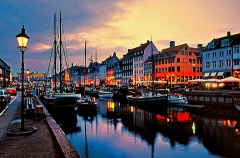
Copenhagen is the Scandinavian capital that does everything well, blending royal history, cutting edge design, world class cuisine, and a cycling culture that puts most cities to shame. The compact city centre rewards exploration on two wheels or on foot. Nyhavn colourful harbour front draws cameras from every angle, its seventeenth century townhouses housing restaurants and bars serving smorrebrod and snaps. Tivoli Gardens, one of the oldest amusement parks in the world, weaves fairy tale charm through its gardens and rides. The Little Mermaid statue sits quietly by the water. Christiansborg Palace houses the Danish Parliament while Rosenborg Castle displays the crown jewels. Noma and other acclaimed restaurants have put Copenhagen at the centre of the global food scene.
Copenhagen is a beautiful city with an amazing atmosphere, which is multiplied when sitting over a beer or wine in a port or in a picturesque corner of old town. Copenhagen offers all. Although Copenhagen is still in motion, it’s not a hectic or rushed – but looks very kindly, and perhaps a bit lazy. When the sun shines, the garden restaurants are open, and lot of people come to eat, drink and have fun.
In This Article
Royal Palaces and historic Landmarks
In the capital of Denmark you can find literally everything you could imagine about culture. Thanks to absolutely flat plain, which is so typical for Denmark, Copenhagen is the perfect place suitable for the construction of beautiful castles and palaces. From the Royal Palace Amalienborg Slot, through Rosenborg Castle and Christiansborg Palace to Borsen palace. Amalienborg, with its four identical rococo facades surrounding an octagonal courtyard, has been the winter residence of the Danish royal family since 1794. Every day at noon, the changing of the guard marches through the city streets from Rosenborg Castle to Amalienborg, a ceremony that draws crowds of spectators. Rosenborg Castle, built in the early 17th century by Christian IV, houses the Crown Jewels and the Danish Crown Regalia in its basement treasury. The Knights’ Hall on the first floor displays the coronation thrones and three life-sized silver lions standing guard.
Christiansborg Palace, located on the small island of Slotsholmen, tells a more complex story. The current building is the third on the site, following devastating fires in 1794 and 1884. Today it houses the Danish Parliament, the Supreme Court, and the Prime Minister’s Office. Visitors can tour the Royal Reception Rooms, which were restored in the 1990s and feature modern Danish design alongside historic tapestries. The palace tower, at 106 metres, offers one of the best panoramic views of the city and is accessible by a separate elevator entrance free of charge.
Museums, Art and the Alternative Spirit
What you definitely should not miss are many small museums in the city. Museum of Danish design, fabulous Museum of Hans Ch. Andersen, Karen Blixen Museum in a short distance from Copenhagen…etc… But on a small area of Copenhagen there is still squeezing something else – it is independent State of Christiania that was founded in the 70′s of 20th century. Christiania remains one of Europe’s most fascinating social experiments, a self-proclaimed autonomous neighbourhood where about a thousand residents live by their own rules. The area is known for its colourful houses, organic eateries, music venues, and the controversial Pusher Street. Photography is strictly prohibited within Christiania, and visitors are asked to respect the community’s guidelines. The atmosphere is relaxed and creative, with art studios and workshops tucked among the residential areas.
For the lovers of modern architecture there is a new library building named the Black Diamond, or a brand new opera house built as a gift for Danish people. The Black Diamond, an extension of the Royal Danish Library, is named for its black granite and glass facade that angles sharply over the waterfront. Inside, the building features a sweeping atrium with curved balconies, a concert hall, and a rooftop restaurant. The Copenhagen Opera House, located directly across the harbour on Holmen, was a gift from the A.P. Moller Foundation. Its auditorium seats 1,500 and is lit by a massive chandelier made of crystal and hand-blown glass. Guided tours of the Opera House are available in English on most afternoons.
Walking Through the City’s Charm
Perhaps the best feature of Copenhagen is the possibility of long walks through the city – through the Pedestrian Zone Stroget or through some of the parks. Stroget is one of the longest pedestrian streets in Europe, stretching nearly two kilometres from Radhuspladsen to Kongens Nytorv. Along the way, you pass department stores, designer boutiques, street performers, and historic squares such as Gammeltorv and Amagertorv. The side streets branching off Stroget hide some of the city’s best cafes, delis, and specialty shops. The King’s Garden, the oldest public park in Copenhagen, offers a peaceful escape with its manicured hedges, rose garden, and the imposing backdrop of Rosenborg Castle.
View Copenhagen – the capital and largest city of Denmark in a larger map
Would you visit Copenhagen for its food scene, its royal palaces, or its waterfront charm? 🇩🇰
Explore all our Denmark travel guides, from Copenhagen canals to Viking heritage.
Explore More
If you enjoyed this article, you might also like:
