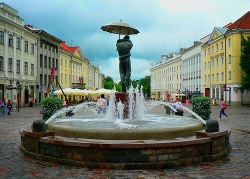
The dome of Tartu University Library glows amber in the late afternoon light, casting a warm reflection across the Emajogi River. The oldest city in Estonia pulses with academic energy, its neoclassical buildings framing a Town Hall Square where students and locals gather around the kissing students fountain. Tartu feels different from Tallinn: quieter, more introspective, deeply connected to ideas rather than tourism. The red brick of the cathedral ruins watches over the city from Toome Hill.
In this college town of Tartu with an amazing atmosphere you can see one of the most leaning buildings in Europe. Tartu is the oldest city and also the second largest city in Estonia. It lies in the southeast part of Estonia and it is said that Tartu is more Estonian than the capital city – Tallinn. Besides the rich cultural heritage it is also important technological research and development. The city played an important role for national liberation. Here in Tartu there were published newspapers and founded the first Estonian companies. On February 2 in 1920 a peace agreement between Russia and Estonia was signed here, in which Russia recognized the independence of the newly established state.
Tartu is a university town. The history of the local university dates back to 1632, and for centuries it has undergone a number of prominent personalities, such as W. Ostwald, owner of a Nobel Prize in chemistry. During the opening days, you can get into the university building. Except of the University Museum you can visit also a student cell. A small attic room looks like in the 19th century, where troublesome students were locked here as a punishment for violation of school rules, e.g.
- canceling the night calm, or late return of books to the library – 2 days
- an insult to the ladies – 4 days
- an insult to the attendant – 5 days
- fighting – up to 3 weeks
The center of Tartu is Raekoja plats with the Town Hall from 18th century. Originally its tower was empty, the clock has been installed later to stop students from being late. At the northeast corner of Town Hall Square you can see the ‘Leaning House’ as the answer to the Leaning Tower of Pisa. This is one of the most interesting sights in Tartu. Just few streets away you find toy museum, full of dolls and teddy bears from all different parts of the world and historical periods. During your walk through Tartu, you can find many other attractions. Inside the students canteen you will discover the most beautiful student caffe in the world.
View Tartu – the oldest city in Estonia in a larger map
The Estonian National Museum
Just a twenty-minute walk or a short bus ride from Tartu’s town hall square, the Estonian National Museum presents one of the most compelling modern museum experiences in the Baltic region. The building itself is a striking architectural statement: a long glass pavilion that appears to rise from the landscape like a runway, with one end cantilevering dramatically into the air. Inside, the permanent exhibition called Encounters traces the story of Estonia from the last ice age through the Soviet occupation to the digital present. The museum succeeds because it focuses on everyday life rather than kings and battles. You walk through reconstructed rooms from different eras, handle replica objects, and listen to oral histories of people who lived through the defining events of the 20th century.
The exhibition on Estonian folk culture is particularly rich, displaying traditional clothing, wooden beer mugs, and intricately patterned mittens that served as coded messages between the fingers of their patterns. A separate section explores the lives of Estonia’s Finno-Ugric relatives, including the Seto people of the southeast, with their distinctive singing traditions and Orthodox faith. The museum also hosts temporary exhibitions on contemporary Estonian art and design. Allow at least two to three hours for the main exhibition alone. The museum cafe serves Estonian comfort food with a modern twist, and the gift shop offers high-quality handicrafts that make meaningful souvenirs far removed from the standard tourist trinkets found elsewhere.
Tartu’s Quirky Side and Old Town Charms
Tartu wears its eccentricity with pride. The Kissing Students fountain in the town hall square is the city’s most famous landmark, depicting two students embracing beneath an umbrella, but it is far from the only playful statue in the city. Look for the bronze Oscar Wilde and Eduard Vilde sitting on a bench near the Barclay Hotel, a tribute to the Estonian writer Vilde and his unexpected connection to the Irish wit. A statue of a stork with a briefcase stands near the university, and the Leaning House on Lai Street tilts at a drunken angle that predates the more famous Leaning Tower of Pisa by a century. The city embraces this playful spirit with an annual humour festival and the Tartu Hansa Days medieval market.
The old town itself, while smaller than Tallinn’s, has a cozier and more authentic character. The main streets of Rüütli and Ülikooli are lined with neoclassical buildings, art nouveau facades, and hidden courtyards. The Tartu Town Hall, built in the late 18th century, dominates the square with its elegant pink facade and baroque spire. Toome Hill, the raised parkland on the banks of the Emajõgi River, offers walking trails past the ruins of the 13th-century cathedral and the University of Tartu’s main buildings. The Supreme Court of Estonia sits in a former courthouse on the hill, its interior open to visitors during working hours. Tartu repays the curious traveller who takes time to explore beyond the obvious sights.
Have you visited the student heart of Estonia? 📚
Explore all our Estonia travel guides, from Tallinn old town to Baltic islands.
Explore More
If you enjoyed this article, you might also like:
