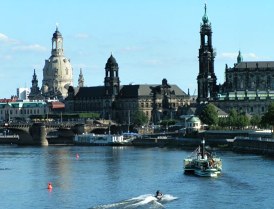
Morning light spills across the sandstone facades of the Zwinger courtyard as a lone cello note drifts from a nearby conservatory window. The Elbe River, broad and silver, reflects the twin spires of the Frauenkirche while cyclists glide along the Brühlsche Terrasse. Dresden does not shout about its beauty. It reveals itself slowly through baroque balconies, white porcelain treasures in the Green Vault, and the scent of fresh Streuselkuchen drifting from a corner bakery. This is a city that rose from ashes and rebuilt itself with quiet dignity, every stone and statue placed with reverence for what was lost and hope for what remains.
German charming city of Dresden is situated in a valley on the River Elbe, near the Czech and Polish borders. Dresden has a long history as the capital and royal residence for the Electors and Kings of Saxony, who for centuries furnished the city with cultural and artistic splendour. The city was completely destroyed by the controversial Allied aerial bombing towards the end of World War II. The impact of the bombing and 40 years of urban development during the East German socialist era have considerably changed the face of the city. Some restoration work has helped to reconstruct parts of the historic inner city, including the Katholische Hofkirche, the Semperoper and the Dresdner Frauenkirche. Since the German reunification in 1990, Dresden has re-emerged as a cultural, educational, political and economic centre of Germany.
In This Article
The Zwinger Palace and the Green Vault: Saxon Treasures
The Zwinger Palace, an architectural masterpiece of the late Baroque period, was built between 1710 and 1719 under the direction of architect Matthäus Daniel Pöppelmann and sculptor Balthasar Permoser. Commissioned by Augustus the Strong, Elector of Saxony and King of Poland, the Zwinger was designed as an orangery and festival venue showcasing the wealth of the Saxon court. Its expansive courtyard, surrounded by graceful galleries and pavilions, is crowned by the Nymphenbad, a grotto-like fountain adorned with mythological figures that is one of the finest Baroque sculptural ensembles in Europe. Today the Zwinger houses three world-class museums: the Old Masters Picture Gallery, the Porcelain Collection, and the Mathematics and Physics Salon.
The Old Masters Picture Gallery contains one of Europe’s most important collections of Renaissance and Baroque paintings, including Raphael’s Sistine Madonna, the painting that gave the world the iconic image of two cherubs resting on their elbows. Other masterpieces include works by Rembrandt, Vermeer, Titian, Correggio, and Dürer. The Porcelain Collection holds over 20,000 pieces of Meissen, Chinese, and Japanese porcelain. The Green Vault, located in the adjacent Royal Palace, is Europe’s oldest museum, founded in 1723. The historic Green Vault displays over 3,000 treasures including the 41-carat Dresden Green diamond, one of the largest natural green diamonds in the world, and the exquisite Throne of the Grand Mogul, a miniature court scene with over 5,000 gemstones.
Rebirth from Rubble: The Frauenkirche and Dresden’s Reconstruction
The Frauenkirche, Dresden’s most famous landmark, is a symbol of the city’s destruction and rebirth. Completed in 1743, the Lutheran church was one of the finest Protestant Baroque churches in Europe, its massive sandstone dome visible from miles across the Elbe valley. The bombing of Dresden in February 1945 reduced the Frauenkirche to rubble. After German reunification, a remarkable international fundraising campaign supported the reconstruction using original plans and salvaged stones. The rebuilt Frauenkirche was consecrated in 2005, its golden cross and orb a gift from the British people, and its dome once again dominates the skyline as a monument to peace.
The reconstruction of Dresden is one of Europe’s most ambitious heritage projects. The Semperoper, originally built in 1841 and rebuilt after World War II, reopened in 1985 as one of the world’s leading opera houses. The Royal Palace, severely damaged in the war, has been progressively reconstructed and now houses the Green Vault and the Numismatic Cabinet. The Procession of the Princes, a 102-metre-long porcelain mural depicting Saxon rulers, survived the bombing remarkably intact and remains one of the largest porcelain artworks in the world.
Dresden’s Cultural Scene and Riverside Beauty
The Brühlsche Terrasse, a broad promenade overlooking the Elbe River, has been called “the Balcony of Europe” for its glorious views of the river and the city skyline. This elevated walkway connects the city’s major cultural institutions, including the Albertinum with the New Masters Gallery. Beyond the historic centre, the famous Striezelmarkt, Germany’s oldest Christmas market, transforms the Altmarkt square into a festive wonderland every December. Just outside the city, Pillnitz Castle and its Baroque park offer a peaceful escape into the Saxon countryside.
View Dresden – a charming city with art and culture in Germany
The Elbe Valley of Dresden was an internationally recognised site of cultural significance by the UNESCO World heritage Committee for five years. After being placed on the list of endangered World heritage Sites in 2006, the city had its status as world heritage site formally removed in June 2009, for the wilful breach of the UNESCO World heritage Convention, due to the construction of a highway bridge across the valley within 2 km of the historic centre. It thereby became the first location ever in Europe to lose this status, and the second ever in the world.
View Dresden – a charming city with a unique blend of art and culture in Germany in a larger map
Which European city surprised you most with its art and culture 🏛️
Explore all our Germany travel guides, from Berlin buzz to Bavaria castles.
Explore More
If you enjoyed this article, you might also like:
